Just updated the Constellation Series with the constellation Cancer.
Go and take a look if you are free.

Just updated the Constellation Series with the constellation Cancer.
Go and take a look if you are free.
Wow, so many things piled up after my 2 weeks holidays!
First, let me post the past two weeks carnival of space:
• #140 is held at Lights in the Dark
• #141 is held at Starry Critters
I spent the days before Chinese New Year at the Langkawi National Observatory and the past week eating, playing and sleeping at home. The weather is not bad at the observatory, will post some pictures soon here. Stay tuned!
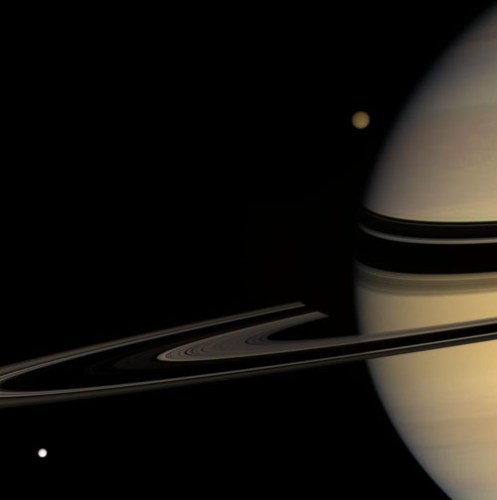
Are you one of those people out there who is always stunned by Cassini’s images of Saturn? I know I’m… and the good news is we are going to be stunned for another SEVEN more years!
Few days ago, NASA has just announced that it will extend the mission to 2017 after the current extended mission expired on June this year. This is the mission second extension, thus the name extended-extended mission or XXM. The first extension was called the Equinox Mission, which study Saturn and its moons as it entered equinox. This second extension – the Solstice Mission – will continue until a few months past Saturn’s summer solstice.
When Cassini first arrived at Saturn in 2004, it was just after the planet’s northern winter solstice. On August 2009, Saturn entered equinox as the sun shines directly on the equator and then begin to illuminate the northern hemisphere and the rings’ northern face. The mission extension into the northern summer solstice will present opportunity to follow seasonal and other long-term weather changes of Saturn’s system all the way from its winter to its summer.
And to remind us on how beautiful Saturn system can be…

Saturn at Equinox

Storms at Saturn’s North Pole

Saturn’s moon Pan, orbiting in the Encke Gap, casts a slender shadow onto the A ring

Enceladus – a moon full with fractures, folds, and ridges
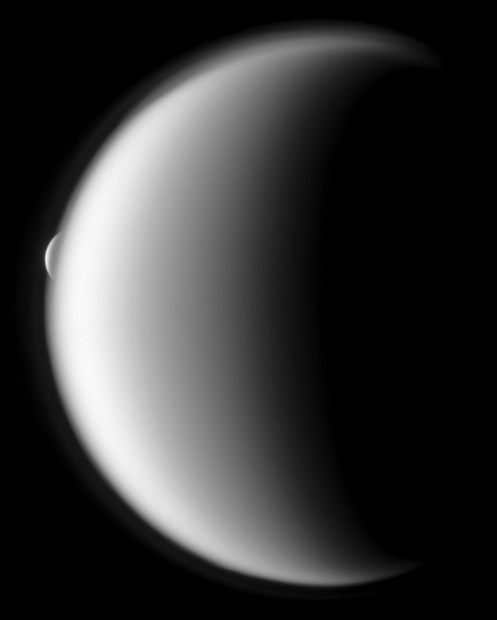
Rhea emerges after being occulted by the larger moon Titan
For more images, go to the Cassini imaging team (CICLOPS) home page. Also check out Saturn by Cassini at The Big Picture 1, 2, 3, 4.
All images credit to NASA/JPL/Space Science Institute
This week Carnival is up at Mama Joules, a nice place to drown yourself with astronomy stuffs this weekend.
The Red planet is going to put on its best show since 2008. It’s getting closer and closer each day now, until on Jan 27, at a distance of 99 million km away, it’ll reach its closest encounter with us. Two days later, on the 29th, it comes into opposition.
So now is the best time to observe Mars because it will appear bigger and brighter. You don’t need to wait until end of the month though; you can actually start your observation now and the view is already excellent.
However, this apparition is not as good as its previous one, because it occurs with Mars relatively far away. It only has an angular size of 14.1” (but it’s still bigger than “normal time” Mars, which can be as small as 10” or less).
Mars Opposition is quite common, occurring every 2 years and 2 months, but not all oppositions are equal – some are great (like the one in 2003, which gave rise to the Mars Hoax), and some are not so good (as with the case for this year). This is because the orbits of Earth and Mars are not circular and they do not centre exactly on the Sun, the distance between Earth and Mars, and hence the size of Mars, can vary for each opposition.

Mars at Opposition: This illustration shows the relative positions of Earth and Mars at the last seven oppositions (1995-2007), when the Sun and Mars are on exact opposite sides of Earth. The images of Mars show the planet’s apparent relative size at each opposition, as viewed by Hubble Space Telescope. Illustration credit: Z. Levay (STScl)
Mars is in Cancer now, where it rises in the east as soon as the sunset and soars overhead around midnight. You don’t need any equipment to view it, just the naked eyes will do. Although the Full Moon is near Mars during opposition, it’ll not drown the planet at all. Shining at magnitude -1, its reddish hue outshines every star in this region, so it’s very easy to find.
If you want to observe the Martian surface features, then you’ll need a telescope. It’s best to wait until the Red Planet climbs higher in the sky before starting your observation so that you’ll view it through lesser of our turbulent atmosphere. The first feature you’ll see on Mars is usually the polar ice cap – in this case is the north polar ice cap since the planet’s north pole is now tilted towards us. If the sky is clear and steady, you’ll be able to see other prominent features on the Martian surface such as Syrtis Major, Hellas, Sabaeus Sinus etc.
And if you are in Kuala Lumpur this weekend, why not drop by Bukit Jalil Golf and Country Resort for a Mars sighting activity organised by Starfield Instruments?
Just 3 weeks into the new year and I already missed 2 weeks of Carnival of Space… bad me…
Anyway, visit Simostronomy and One Astronomer’s Noise to catch up with some recent space stories.
I think I’m quite late in announcing this:
We are going to have a partial solar eclipse tomorrow!
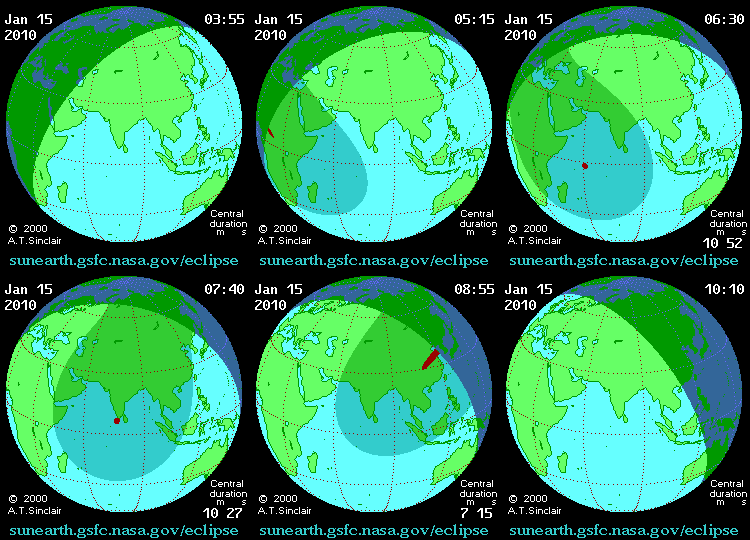
Same as last year, the main show is not the partial eclipse, but the annular one which begins its path in Africa and passes through Chad, Central African Republic, Democratic Republic of the Congo, Uganda, Kenya, and Somalia. After leaving Africa, the path crosses the Indian Ocean where the maximum duration of annularity reaches 11 min 08 s. The central path then continues into Asia through Bangladesh, India, Myanmar, and China.
A partial eclipse is seen within the much broader path of the Moon’s penumbral shadow, which includes Eastern Europe, most of Africa, Asia, and Indonesia. (I was actually thinking of going to India for the annular eclipse, but plans don’t work out, so I guess I’ll have to stay back here for the partial one…)
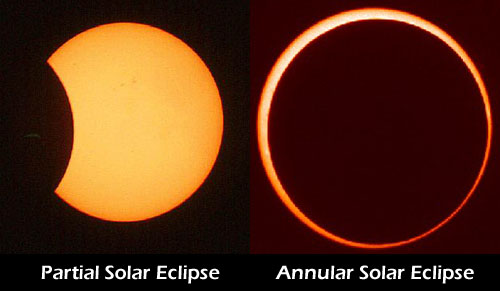
In Malaysia, the first contact – when the Moon first “touches” the Sun – begins around 3:01 pm. The Moon will then slowly cover up part of the Sun until maximum eclipse at 4:26 pm, when the Sun is 39 degrees above the horizon. Around 5:38 pm, the Moon leaves the Sun’s disk and the show ends.
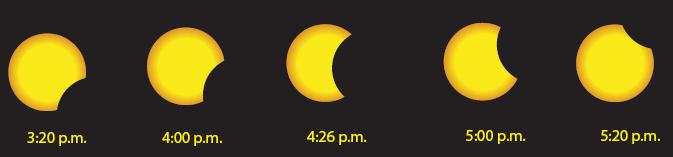
During maximum eclipse, 28.6% of the Sun’s disk (area) will be obscured by the Moon, although 40.9% of the Sun’s diameter is obscured. That’s the different between eclipse obscuration and eclipse magnitude. Click here to see an example.
So now, how to we observe this event safely?
There are few ways. You can project the image of the Sun onto a piece of paper or a wall either by using pinhole projector or telescope, or use a solar filter either the glasses type or attached it in front of a telescope. Only then, you can observe the Sun safely. You don’t really need a telescope to enjoy this.
Please bear in mind that although the Sun will be partially covered, the remaining of the crescent Sun will still be intense enough to damage your eyes. It is NOT safe at all to look at the partial Sun directly.
ANGKASA is holding and an observation at Planetarium Negara from 2:30 to 6:00 pm. If you are around the area, do drop by and join in the activities.
Clear skies everyone!
 My Dark Sky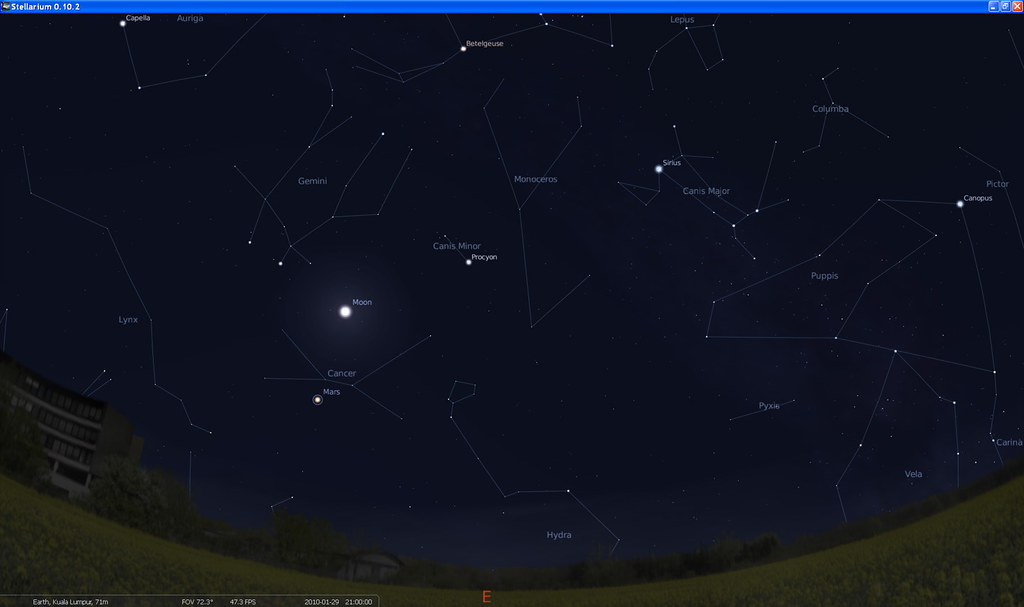


 My Dark Sky


You must be logged in to post a comment.