In this digital age, astronomy is no longer just gazing at the sky. We can see, learn and have a lot of fun by just surfing the internet – beautiful pictures, animations, videos, podcasts, blogs, reviews, games, digital star-charts, planetarium softwares, remote telescopes, simulations, tools and even become citizen scientist.
I always come across a lot these cool stuffs. Sometimes I’ll share them here (if I’m free to write), but most of the time after playing around for a while, I forgot about them.
Yesterday, out of nowhere, it suddenly strikes me that why not I make a page and compile all the cool things I came across. “Good idea”, I said to myself and so there you go: at the sidebar under Pages now you can see “Astronomy Cool Stuffs”. The list is still quite short, but I’ll add more to it as time goes by.
[updated to include a video from ESOCast at the end of the post]
Have you seen our Milky Way Galaxy stretch across the night sky before? Have you seen a nebula before? Yes? No? No matter what’s the answer, you need a dark sky to see it. If your life is always hanging around a city, most probably you don’t have access to dark sky. Even if you do, sometimes cloudy sky will get in the way.
But now, things have changed. In this digital age, you can enjoy the glory of our Galaxy right in front of your computer – through the GigaGalaxy Zoom Project.
The ESO’s GigaGalaxy Zoom project reveals the full sky as it appears with the unaided eye from one of the darkest deserts on Earth, then it zooms in on a rich region of the Milky Way using a hobby telescope, and finally uses the power of a professional telescope to reveal the details of an iconic nebula.
The creators of the GigaGalaxy Zoom project hope that these tremendous efforts in bringing the night sky as observed under the best conditions on the planet to stargazers everywhere will inspire awe for the beautiful, immense Universe that we live in.
“The vision of the IYA2009 is to help people rediscover their place in the Universe through the day- and night-time sky, and this is exactly what the GigaGalaxy Zoom project is all about,” says project coordinator Henri Boffin.
GigaGalaxy Zoom features a web tool that allows users to take a breathtaking dive into our Milky Way. With this tool users can learn more about many different and exciting objects in the image, such as multicoloured nebulae and exploding stars, just by clicking on them.
Milky Way Panorama. Credit: ESO/S. Brunier. Click image for high resolution image (Warning: 24MB)
The first of three amazing, ultra-high-resolution images of GigaGalaxy Zoom project is a magnificent 800-million-pixel panorama of the entire sky as seen from ESO’s observing sites in Chile. This 360-degree panoramic image reveals the cosmic landscape that surrounds our tiny blue planet. The plane of our Milky Way Galaxy, which we see edge-on from our perspective on Earth, cuts a luminous swath across the image.
The painstaking production of this image came about as a collaboration between ESO, the renowned French writer and astrophotographer Serge Brunier and his fellow Frenchman Frédéric Tapissier. Brunier spent several weeks during the period between August 2008 and February 2009 capturing the sky, mostly from ESO observatories at La Silla and Paranal in Chile.
Galatic Centre. Credit: ESO/S. Guisard. Click image high resolution image (Warning: 26MB)
The second image is a new and wonderful 340-million-pixel vista of the central parts of our home galaxy as seen from ESO’s Paranal Observatory with an amateur telescope. This 34 by 20-degree wide image shows the region from Sagittarius to Scorpius.
The very colourful Rho Ophiuchi and Antares region is a prominent feature to the right, although much darker areas, such as the Pipe and Snake nebulae also stand out. The dusty lane of our Milky Way runs obliquely through the image, dotted with remarkable bright, reddish nebulae, such as the Lagoon and the Trifid Nebulae, as well as NGC 6357 and NGC 6334. This dark lane also hosts the very centre of our Galaxy, where a supermassive black hole is lurking.
Stéphane Guisard, world-renowned astrophotographer and an ESO engineer, made the second image. To create this stunning, true-colour mosaic of the Galactic Centre region, Guisard assembled about 1200 individual images, totalling more than 200 hours of exposure time, collected over 29 nights.
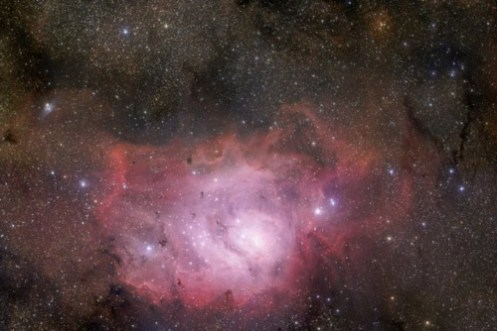
The Lagoon Nebula. Credit: ESO. Click image for extremely high resolution image (Warning: 65MB)
The third and final image is a 370-million-pixel breathtaking vista of the M8 – the Lagoon Nebula, and demonstrates the quality and depth of the observations needed by professional astronomers in their quest to understand our Universe.
Lagoon Nebula is located roughly 5000 light-years away towards the constellation Sagittarius. The nebula is a giant interstellar cloud, 100 light-years across, where stars are forming. The scattered dark patches seen all over the nebula are huge clouds of gas and dust that will soon give birth to clusters of young, glowing stars.
The image was taken with the 67-million-pixel Wide Field Imager attached to the MPG/ESO 2.2-metre telescope at the La Silla Observatory in Chile and covers more than one and a half square degree.
So, there you go, dive into our galaxy, explore and admire its beauty with just mouse clicks away.
Source: European Southern Observatory – Press Release 1, 2, 3.
ESOCast10: GigaGalaxy Zoom – The Sky, from the Eye to the Telescope
On this coming October 9, NASA’s Lunar Crater Observation and Sensing Satellite (LCROSS) will smack into a permanently shadowed crater on our Moon’s pole to look for hidden water ice – the target is the 48-km wide crater Cabeus A, located at 82.2 degree south and 39.1 degree west.
LCROSS will first send its spent upper-stage Centaur rocket into the crater to kick up some debris. Then it will fly into this plume of debris and measure the plume’s properties before it itself also impact the same spot. The analysis of the plume hopefully will contain signs of elusive water.
Click here and scroll down to the end for video animation showing the location of the Cabeus A crater.
“The selection of Cabeus A was a result of a vigorous debate within the lunar science community that included review of the latest data from Earth-based observatories and our fellow lunar missions Kaguya, Chandrayaan-1, and the Lunar Reconnaissance Orbiter,” said Anthony Colaprete, LCROSS project scientist and principle investigator at NASA’s Ames Research Center.
Cabeus A was selected based of a set of conditions such as favorable illumination of the debris plume for visibility from Earth, where we will be watching closely. Cabeus A also has a high concentration of hydrogen (a constituent of water, H2O) and favorable terrain such as a flat floor, gentle slopes and the absence of large boulders.
Can we amateur see the plume? Not me… my telescope is too small… but scientist estimated that the impact plume may be visible through telescope as small as 10 to 12 inches and above. If you have a telescope this big and would like to join in monitoring the impact, then visit the LCROSS_Observation group for participation in the LCROSS Amateur Observation Campaign.
This week Carnival is hosted by Flying Singer at Music of the Spheres. There are stories on Hubble, education and observation, the future, art, multimedia etc. Go and take a look.
Last May, the Space Shuttle Atlantis was launched to carry out the final servicing mission of our beloved Hubble Space Telescope. After three months of focusing, testing and instruments calibrating, Hubble is back and is now ready for full science observations!
Let’s take a look at the images just released from the rejuvenated space telescope.
Colorful Stars Galore Inside Globular Star Cluster Omega Centauri
This is the famous globular cluster Omega Centauri, zoom in to the very core of the giant cluster. This is taken by the Wide Field Camera 3 (WFC3) which replaced the Wide Field and Planetary Camera 2 (WFPC2).
There are 100,000 stars in this small crowded region. How crowded? Look at the centre of this image and you get an idea how packed it is. But with Hubble new sharp eye, we are able to resolve them into individual colourful stars.
The different colours of the stars show them to be at different stages of their life, from yellow-white “normal” stars like our Sun, to red-giant as they become bigger and cooler later in their life. There are also these blue stars which are either struggling to stay alive by fusing helium in their core or are the so-called “blue stragglers” which are older stars that acquire a new lease on life when they collide and merge with other stars. There are also white dwarfs (stars like our Sun at the end of their life) visible as faint blue dots in the image.
Butterfly Emerges from Stellar Demise in Planetary Nebula NGC 6302
Credit: NASA, ESA, and the Hubble SM4 ERO Team
This is another image from WFC3 – the Butterfly Nebula in Scorpius. The delicate beautiful wings are actually gases heated to more than 20,000 degree Celcius and are racing across space at 1 million km per hour! Fast enough to travel to the Moon in 24 minute.
The gases were ejected by a dying star at the centre. This red-giant was once about five times the mass of our Sun. The star itself is not visible – it is hidden within a doughnut-shaped ring of dust. Click here to see the “before” image.
One of the great features of WFC3 is its ability to see from near infrared through visible light and into the near ultraviolet. This allows Hubble not just seeing deeper into the universe but also seeing simultaneously in different “colours”. This is important because different wavelength of light will give us different views and information on the same object. The next image clearly illustrates this.
Stars Bursting to Life in the Chaotic Carina Nebula
This image shows pillar of gas and dust resides in the Carina Nebula. The top image was taken in visible light, showing the glow of light from hot, massive stars. Streamers of gas and dust can also be seen flowing off the top of the pillar. At the dark notch in centre of the pillar, we saw some evidences of a young star blowing jets, but the star itself is invisible. Looking in visible light, the clouds is opaque – we can’t see what’s inside (or behind) the clouds.
But if we look at different wavelength – as shown in the near-infrared image at the bottom of the image above – the gas and dust “disappeared” and only a faint outline of the pillar remains. Infrared light, unlike visible light, can pass through the clouds easily. By penetrating the wall of gas and dust, the infrared vision of WFC3 reveals the infant star that is probably blasting the jet.
Galactic Wreckage in Stephan’s Quintet
Another one from WFC3. This group of galaxies is known as Stephan’s Quintet, or Hickson Compact Group 92. It shows a clash among galaxies, which is quite common in the universe. You can clearly see the distortion, elongated spiral arms and long tidal tails among the three galaxies at the centre and top. But why do the upper left one looks undisturbed? Because it has nothing to do with the group. It is just a chance alignment along our line of sight. NGC7320 is actually a foreground galaxy about seven times closer to Earth than the rest of the group.
Other amazing images came from the Space Telescope Imaging Spectrograph (STIS) and the Advanced Camera for Surveys (ACS). STIS was dead in 2004 and ACS in 2007, both due to electronic short circuits. These two instruments were brought back to life during the Servicing Mission 4 last May. It was a great challenge to repair these instruments because they are not meant to be repaired in orbit at the first place. For example, to repair STIS, astronauts had to remove 111 screws to allow access to the failed power converter.
The repairs were a success. Both the instruments are now working splendidly.
Gravitational Lensing in Galaxy Cluster Abell 370
See the arcs and streaks in the image above? These are actually galaxies behind this galaxy cluster. The stretched images of background galaxies are due to a phenomenon called gravitational lensing. According to Einstein, mass wraps space. The warping of space by the massive cluster’s gravitational field acts like a lens (thus the name gravitational lensing), magnifies the image of galaxies lying far behind it and distorts their light, often making them look like an arc. Located at 2 o’clock position in the image above is one prominent example of the arc.
Probing the Last Gasps of the Doomed Star Eta Carinae
This is a spectrum of one of Eta Carinae’s giant lobes taken by STIS. Spectrum, the colourful strip in the image above, is the separation of light into its component colour. Spectrum is very useful because it can tell us a lot about the chemical content, temperature and motion of an object in the sky. From this spectrum, we identify iron and nickel in the outer material and found that the interior material is carried away by the ongoing wind from Eta Car A, the primary star.
Last but no least, a beautiful face-on spiral galaxy in Ursa Minor:






 My Dark Sky
You must be logged in to post a comment.