
This week Carnival is now up at The Planetary Society Blog. As usual, if you want to know some astro-happening in the past week, then you should pay it a visit.
Goodbye Chandrayaan-1
•September 6, 2009 • Leave a Comment The Indian lunar orbiter Chandrayaan-1 was lost…
Just 2 days after I wrote about how Chandrayaan-1 teamed up with LRO to take a look at Erlanger Crater, I got the news that we lost radio contact with it. I didn’t write about it that time because I hope that somehow we will be able to recover it… but it seems that it was gone…
Chandrayaan-1 was launched from Satish Dhawan Space Centre (SDSC) SHAR, Sriharikota in Southern India on October 22 last year. It was designed to last two years, but it only lasted 315 days, barely half its expected lifetime. However, according to its project director M Annadurai Chandrayaan-1 “has done its job technically…100%. Scientifically also, it has done almost 90-95 percent of its job”.
The lunar probe had completed 312 days in orbit, making more than 3,400 orbits around the moon. It has provided large volume of data from sophisticated sensors such as terrain mapping camera, hyper-spectral imager and moon mineralogy mapper, meeting most of the scientific objectives of the mission.
It had sent more than 70,000 images of the lunar surface which provide breathtaking views of lunar mountains and craters, especially craters in the permanently shadowed areas of the Moon’s polar region. Chandrayaan-1 was also collecting valuable data pertaining to the chemical and mineral content of the Moon.
We may hear about this lunar probe again, about 1000 days later, when it crashes onto the lunar surface.
Goodbye Chandrayaan-1.
Source: The Times of India
Saturn’s Ring Plane Crossing
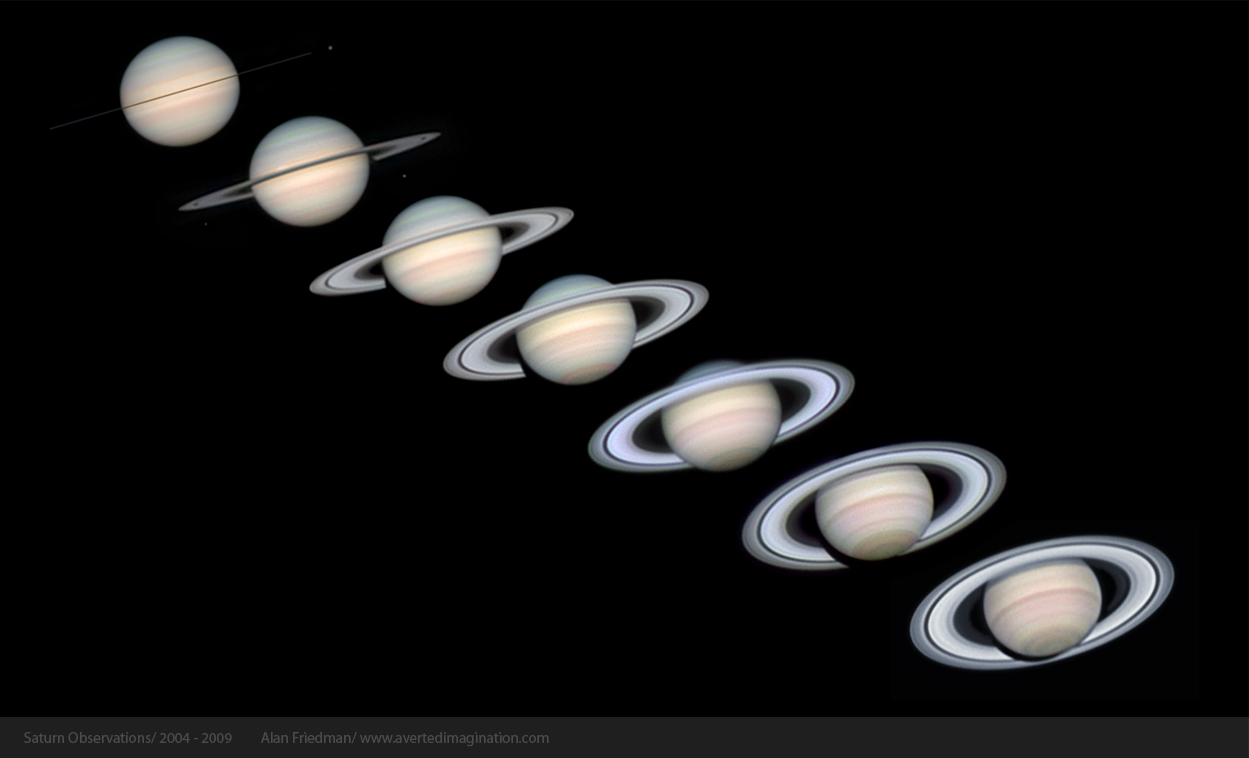
•September 4, 2009 • Leave a CommentToday is “Saturn’s Ring Plane Crossing” day – the day when our Earth crosses through the plane of Saturn’s Rings. Thus, if you are standing on Earth (I believe we all do except for the few astronauts floating in ISS, but that won’t make any different though), we will see the rings edge-on; and because the rings are so thin, they basically disappeared from view.

Edge-On View of Saturn’s Rings
Previously, Saturn’s south pole is tilted towards us. After today, after we crosses the ring plane, the north pole will be increasing visible, and its south pole will be hidden from us in the coming years until the next plane crossing in 15 years’ time.
Unfortunately, Saturn now is lying low in the western horizon after sunset in Leo. The thicker atmosphere, and thus more turbulence, which the light has to go through prevents clear, sharp image of Saturn.
But you still can give it a try and see if you can spot its “no rings”.
Carnival of Space #118
•September 2, 2009 • Leave a CommentGo over to Cumbrian Sky for this week Carnival.
It has my post on the Erlanger Crater… it’s had been half a year since I submitted my last post to the Carnival… wow, how time flies…
External Darkness – Erlanger Crater
•August 28, 2009 • 3 CommentsWhat on Earth is this? (sorry, it’s not on Earth)
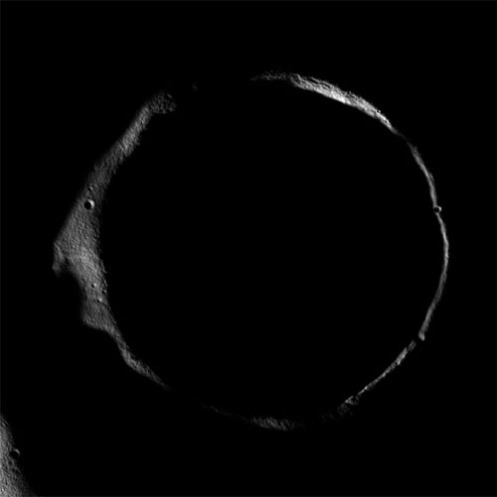
This beautiful image is a lunar crater called Erlanger. The “bright ring” is the rim of the crater poking into the sunlight. Erlanger is located at latitude of 87 degree north, which means it is very near to the lunar north pole, and this making the crater interesting…
We always heard about looking for water on the Moon, why is it important? Because water can be a useful resource for future lunar inhabitants and we need to determine where are the best places to send our lunar explorers.
But then, can water exist on the Moon? The Moon practically has no atmosphere, thus its surface is exposed to the vacuum of space. Furthermore, the surfaces that are bathed in sunlight can reached a temperature up to 120 deg C. Over the course of a lunar day, its entire surface will see sunlight and thus any ice exposed will be turned into water vapour and lost in space.
The catch here is, if the ice sees the Sun then it will be evaporated. If it never sees the Sun, then it may continue to be ice. So, where on the Moon can this be?
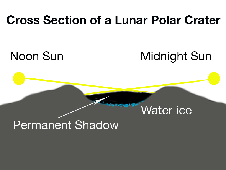 The answer is the poles. The Moon’s rotational axis is only tilted 1.5 degrees with respect to the ecliptic. This means that the Sun will always be low at the horizon at the poles. The low Sun will therefore have no chance to illuminate the polar craters’ floor and these craters can have permanently shadowed floors where water ice can exist. The temperatures within the craters do not go above -170 deg C, so the ices do not have enough energy to evaporate.
And Erlanger is one of these craters. The bottom of the crater is in eternal darkness, but its rim is just high enough to get some sunlight, as seen in the image above that was beautifully captured by the Lunar Reconnaissance Orbiter (LRO).
LRO had team-up with Chandrayaan-1 to take a look at Erlanger last week, hoping to find evidence of water there. So far, we only hypothesise that water ice may be there, which may be the leftovers from comet impacts long long time ago, but still lack of strong evidence.
LCROSS, another probe which is launched together and then later separated with LRO, is also another mission to search for water on the Moon, but in a different way. Instead of collecting data using radio pulses, LCROSS will impact the lunar pole hoping that this will kick up some evidence of water in the debris plume.
Will they find water? Maybe yes, maybe no… I think we just have to wait…
In the meantime, let’s enjoy the picture.
Carnival of Space #117
•August 28, 2009 • Leave a CommentCarnival of Space #117 is on at Simostronomy. It have pieces on spacecraft, spectacular amateur imaging, talking to aliens, software used in space missions, light pollution, space elevators, asteroids, cosmology and space squirrels, just to name a few. Go and take a look!
Spirit – 2004 Sols on Mars
•August 22, 2009 • Leave a CommentImagine getting something that was initially designed to last 90 days, but after 2000 days, it’s still functioning well… what do you have to say to the designers who designed it?
Fantastic! Unbelievable! Excellent job! Congratulations!
This are what I want to say to our little robot Spirit’s mission designers, engineers and controllers. Spirit was initially planned as a 90-sol (Martian day, which is about 40 minute longer than Earth-day) mission, but until today – after 2004 sols since its landing in January 2004 – it is still alive and kicking, although unfortunately it is currently stuck on a patch of soft sand on the Martian land called Troy.
Since it landing on the red planet, Spirit has driven 4.8 miles and together with its twin Opportunity on the other side of the planet, they have returned more than 246,000 images to planet Earth.

Spirit’s traverse map through Sol 2000. Click the image for complete route since Sol 1.
Spirit’s team members are now working hard to free Spirit from the Martian sand trap and hopefully they will be able to get it out soon.
Go Spirit! Go!

This is the first color image of Mars taken by the panoramic camera on Spirit.
Credit: NASA/JPL/Cornell.



 My Dark Sky
You must be logged in to post a comment.