Saturn’s Equinox – The Play of Sunlight and Shadow

•August 20, 2009 • Leave a Comment

We are all familiar with the Vernal Equinox and the Autumnal Equinox. These are the two times of the year when the Sun shines directly at the equator. Equinox is not a speciality of planet Earth; all planets that are tilted with respect to their orbits will experience equinox, including Saturn. But unlike Earth, where equinox happens every 6 months, Saturn’s equinoxes is about 15 years apart.

Saturn is always famous for its rings. But anyone who points a telescope at it this year and expects to see its magnificent rings is in for a disappointment – the rings have disappeared

This is due to the equinox; Saturn’s rings are around its equatorial plane, thus during equinox, sunlight will hit the rings edge-on, and since the rings are so thin, it seems that the rings have disappeared. Like this:

Cassini-Equinox1

Equinox had finally arrived at Saturn last week on August 11. This equinox was different from the past, at least to us earthling, because we had Cassini there to give us spectacular view of the play between sunlight and shadow on the planet. We can clearly see that the rings had narrowed down to a very thin line.

The shallow angle of the Sun on the ring plane as a result of the equinox also means that moons and structures that are not in the same plane as the rings – the lumps and bumps – will cast long shadows across the rings. This is just like the Sun will cast long shadows on trees and you and me when is low at the horizon during sunrise and sunset.

Let’s sit back and enjoy the shadows.

Cassini-PIA11533

The shadow of the moon Epimetheus is cast onto Saturn’s rings, striking the outer-most part of the A ring and only just nipping the F ring.

Cassini-PIA11529

Saturn’s moon Pan, orbiting in the Encke Gap, casts a slender shadow onto the A ring.

Cassini-PIA11541

The shadow of the moon Mimas is seen through the unlit side of the Cassini Division of Saturn’s rings.

Cassini-PIA11666

An object, seen as a bulge within the bright core of the F ring (left), casts a shadow that is long enough to reach the A ring. The shadow is barely visible stretching across the top right quadrant of the image. The shadow appears very faint here because this view looks toward the unlit side of the rings.

Cassini-PIA11559

The moon Janus casts a shadow on the F and A rings while the gravity of potato-shaped Prometheus (seen on the left), creates a streamer-channel in the thin F ring.

Cassini-PIA11561

The shepherding moon Pandora casts a shadow on Saturn’s thin F ring as the planet nears its August 2009 equinox.

Cassini_N00133374

More shadows! These are created by the stuffs that made up the rings. We are seeing the shadow of the stuffs that made up the rings! Amazing!


Shadow of Saturn’s Moon Epimetheus Crosses Saturn’s Rings

All images credited to NASA/JPL/Space Science Institute
Carnival of Space #116

•August 18, 2009 • Leave a Comment

Another week had passed, so it’s time for Carnival again.  This week it was held at Habitation Intention.

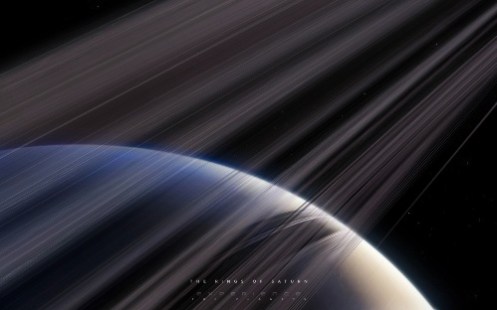
One of the posts I like most is on a project called Experience the Planets – it’s the views of our solar system through the eyes of artists.

RingsSaturnArt

If you like the artwork shown above, then head over to the carnival see how to get more of these.

Victoria Crater

•August 13, 2009 • Leave a Comment

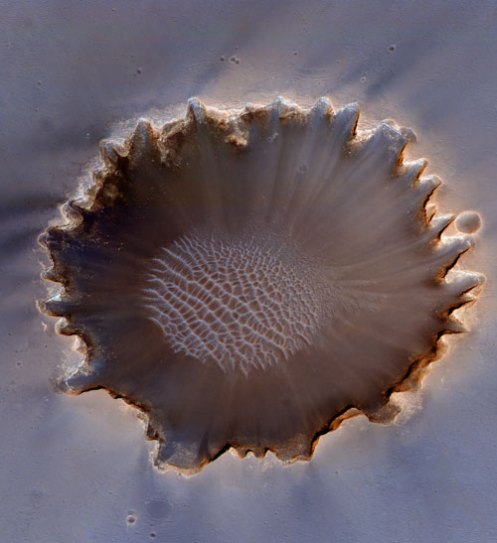
HiRISE-VictoriaCrater
An Oblique View of Victoria Crater
Credit: NASA/JPL/University of Arizona

This is an impact crater on Mars called the Victoria crater, taken by the HiRISE camera aboard the Mars Reconnaissance Orbiter (MRO). Victoria crater is about 800 m wide located in Meridiani Planum on Mars.

A year ago, Opportunity, our little robotic rover on Mars, had spent nearly two years (September 2006 to August 2008) exploring this crater. It had even entered the crater to do some sciences. Click here to see how the crater looks like from Opportunity point of view. Victoria Crater is about five times wider than Endurance Crater, which Opportunity spent six months examining in 2004, and about 40 times wider than Eagle Crater, where Opportunity first landed.

Though Opportunity had now left Victoria crater and headed to its next target – the 22-km wide Endeavour crater 12 km away – some of the rover’s tracks are still visible to the north of Victoria crater (left side of the image), showing the presence of us on Mars.

Imagine you can see earthling activities on another planet millions of kilometres away. Amazing.

HiRISE-VictoriaCrater-tracks

Carnival of Space #115

•August 12, 2009 • Leave a Comment

This week Carnival of Space is now up.  You want some space stories? You want latest astro news? Then head over to New Frontiers News!

My Double Bailey’s Beads

•August 11, 2009 • 4 Comments

As I go through my eclipse photos today, I found a photo of the Bailey’s Beads. As you can see from the previous post, I didn’t have any photo on this… because as I had said earlier, most of the photos were blurred (don’t ask me why… I also don’t know – there may be 101 reasons…), including the Bailey’s Beads one.

It’s a pity, if not for the shake and thus the double image, this can be a photo I can show off…

Suddenly something crossed my mind: look at the bright side, why not take this as a special effect? Who else have a “double beads” before? So here, I “proudly” present my “special effect double Bailey’s Beads”…

TSE2009-DSC_2996

My China Total Solar Eclipse Trip – Part 2

•August 3, 2009 • 4 Comments

So 2 o’clock in the morning, we departed from our hotel to Baoshi Shan…

And there are already four people up there since 1 am…

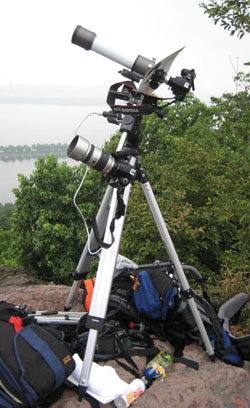
We zoom in on a good spot, setup our stuffs and waited patiently…

TSE2009-IMG_6239TSE2009-IMG_6213

These were our setup. I have one camera for wide-field and another one for zoom-in shot (mine was at the bottom of the equatorial mount; the one on top belonged to my friend)

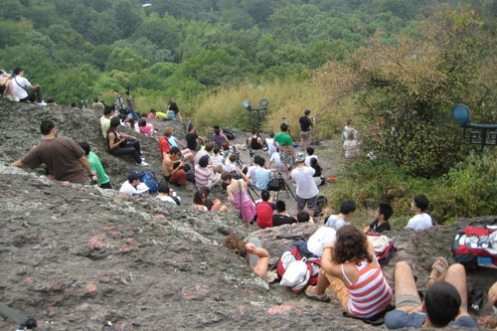
5 am: There was already a small crowd at the hill now…

TSE2009-IMG_6201

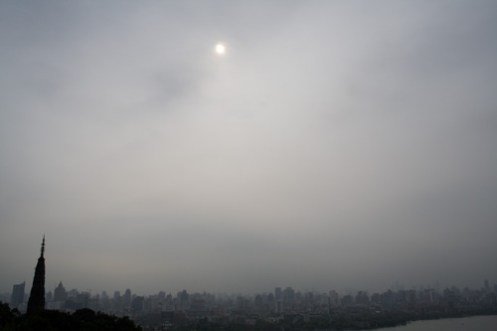
7 am: The sky condition is not good… hazy and cloudy… the Sun was not visible at all…

TSE2009-IMG_2560

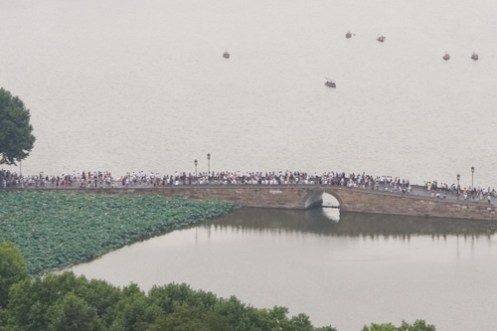
7:30 am: The crowd grew bigger and bigger. The hill and the bridge at West Lake were now full of people. The Sun was still hiding behind the cloud. Don’t lost hope yet, the best was yet to come…

TSE2009-IMG_6229

TSE2009-IMG_6233

TSE2009-IMG_2563

8 am: Finally! Finally! The Sun poked out from the cloud!

TSE2009-IMG_2567

8:21 am: The eclipse began…

The sky darkened as we approached totality. City lights were switched on.

TSE2009-DSCN1845

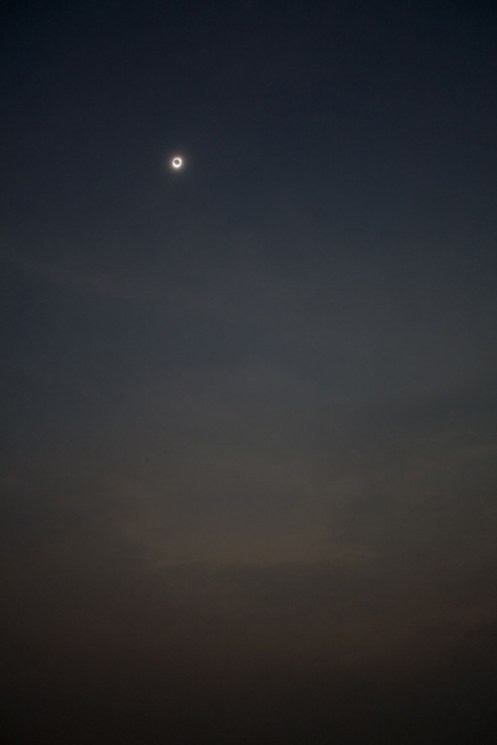
9:34 am: Totality!

TSE2009-IMG_2676

11 am: The End…

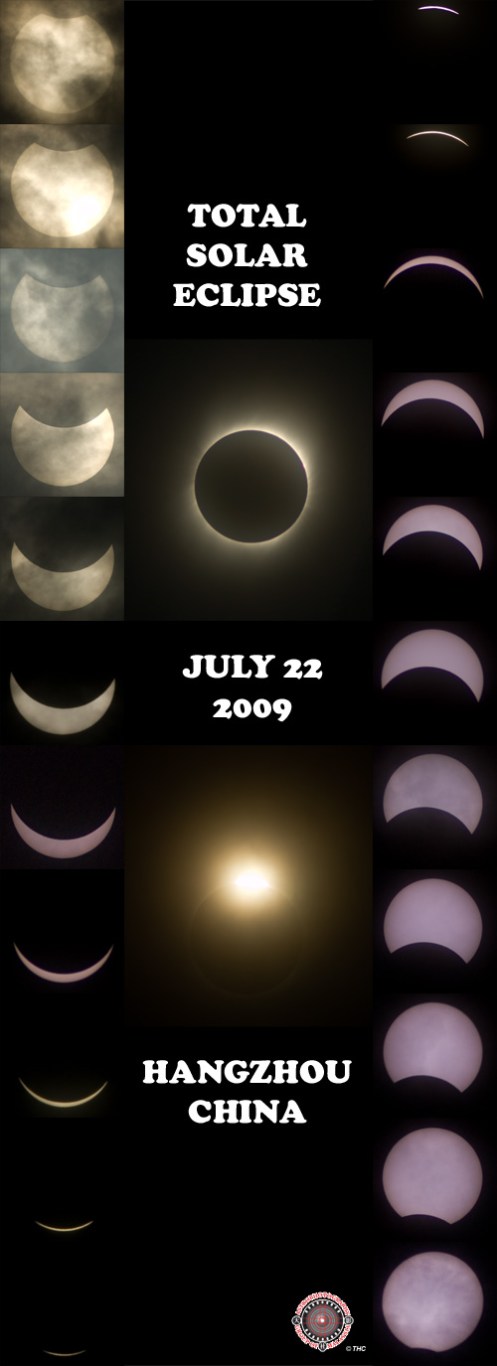
TSE2009a-thChieh

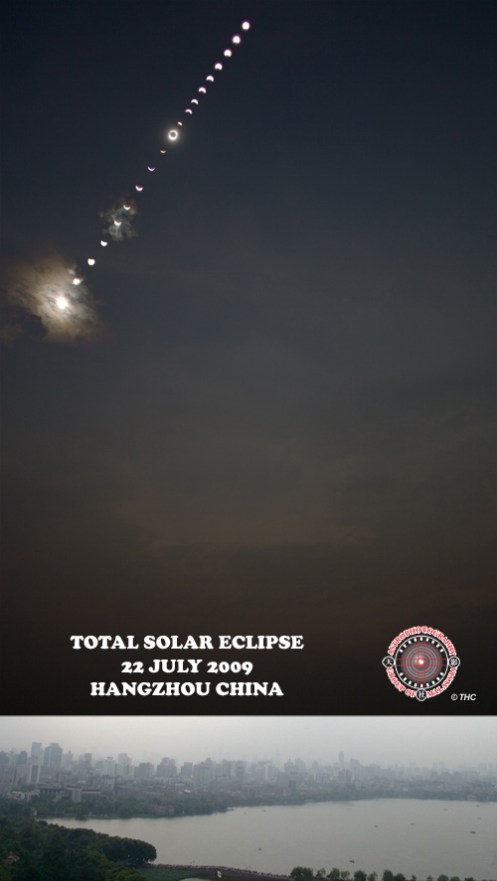
Click here for the animation.

TSE2009b-thChieh

So, how do I felt during totality? I’m not sure… everything happened so fast… I was busy pressing the shuttle – remember? I’ve two cameras to look after (actually I shouldn’t be greedy). But somehow I do manage to take my eye off the camera and look at the sky. There it was – a bright ring hanging in the sky. It looked so much like the one we seen in pictures (it also reminded me of the Ring Nebula). So naturally my first impression was it looked like a big picture hanging in the sky – I need to keep on telling myself that I was looking at the real thing – the real eclipse that I’ve been longing to see, and now it was there, right in front of my eyes.

The experience was unforgettable.

TSE2009-_MG_2269

My China Total Solar Eclipse Trip – Part 1

•August 2, 2009 • Leave a Comment

TSE2009Banner

I reached Hangzhou on 20 July, two days before the big day. It was hot! The temperature was 38 degC. Imagine yourself standing in front of an air-con compressor, and you know how uncomfortable it was.

TSE2009-GroupPhoto

We started to survey our observation site the next day. We have a few plans; the best is of course a place where we can include the famous West Lake as our foreground in our photos. The candidates were somewhere around the West Lake or one of it bridges, or a hill overlooking the Lake.

Our worry was that there may be too big a crowd if we observed in the vicinity of the West Lake. We hope to find somewhere not so famous, but still has a view of the West Lake (or any of its pagodas).

Having said that, we still ended up at a famous hill… Baoshi Shan 宝石山 (what to do, this is not our territory; if we can think of a place, surely the local will also know about that!). From our survey, the Sun position was too high in the sky to include the Lake (if you plan to have one frame from start to end), unless you have a very wide lens.

WestLake
View of West Lake and Hangzhou City from Baoshi Shan

At first, we give up this location… remember? this is a hill! If we have to carry 20 kg of stuffs up the hill and still can include the Lake in our wide field photos, then is worth it, right? But if we just plan to do a shot without or unable to include any foreground, then observing anywhere in Hangzhou will be the same. And also, we are “afraid” of the crowd…

But eventually, we still ended up at this hill.

Route-BaoshiShan1
Route-BaoshiShan2
Route to Baoshi Shan with 20 kg of stuffs on our back!

To ensure that we will get a good spot, can you guess what time we went up there? 6 am? 4 am? No. We were there by 2 am! We climb all the way to the top in the dark…

And guess what? There were already some people up there!

to be continue…

BaoshuHangzhou-5am
Pagoda Baoshu 保俶塔 and Hangzhou City View at 5 am. The sky was very hazy and cloudy and we were very worried… The weather forecast for 22 Jul is not good – cloudy with chance of a thunderstorm.