Send Your Name to Mars!

•June 19, 2009 • 3 Comments

You are part of History!
Your Name is Heading to Mars!

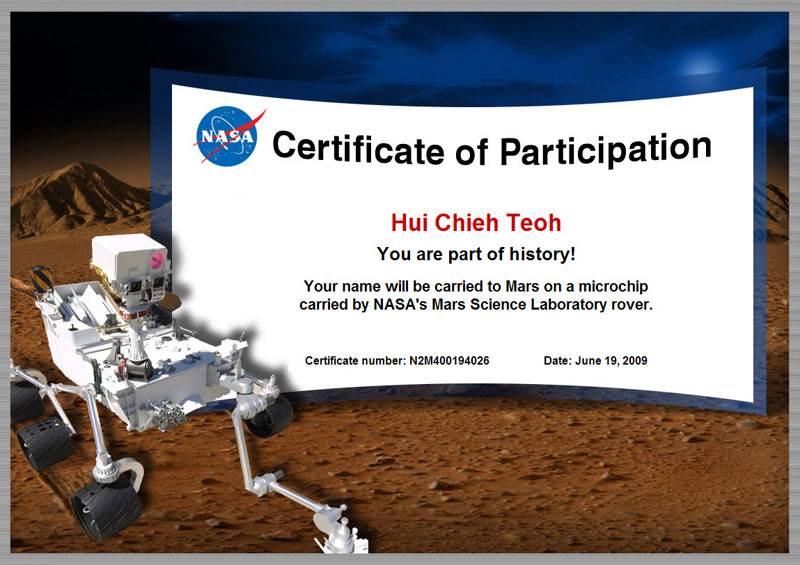
Do you want to be part of history? Do you want your name on Mars? If yes, then sign up here to send your name to Mars aboard NASA’s Mars Science Laboratory (MSL). Your name will be included on a microchip that will be sent to Mars as part of the mission, scheduled to launch in 2011. By signing up, you will also receive a certificate showcasing your support of the mission.

MSLOne very interesting thing is that the site has a “World Participation Map” showing how many people in each country had signed up. But the problem is the country’s name is in short form and I don’t know what they stand for. I think Malaysia is “MY”… if so, as I signed up today, we are quite a long way down the list with only 141 participants…

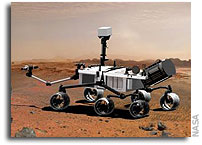
Actually, MSL was the old name. Just last month, it got its new name “Curiosity”, which was proudly named by a 12-year old student Clara Ma. The name was selected by NASA following a student contest in naming the rover.

Curiosity is big… it’s four times heavier than and twice as long as the twin Mars Exploration Rovers Spirit and Opportunity currently on Mars now. Its main purpose to Mars is to determine Mars was, or still is, “habitable” – that is, whether it had an environment that is able to support microbial life.

Click here for a longer version, but without the nice music…

Enjoy the video? Cool? Want your name onboard the rover? Want your name on Mars? Yes? Then go sign up now!

Carnival of Space #107

•June 16, 2009 • Leave a Comment

Carnival of Space number 107 is live now!  Head over to Innumerable Worlds for some space stories.

Carnival of Space #106

•June 7, 2009 • Leave a Comment

Wow! I’ve missed 15 weeks of Carnival of Space! and I didn’t realise that!

This week Carnival is number 106, and is held at Next Big Future.  Go and update yourself with some spacy news.

Galaxy Zoo 2

•June 4, 2009 • Leave a Comment

Almost 2 years ago, Galaxy Zoo was born. This was an interesting project – a project where you and I, just sitting in front of a computer, can contribute to astronomy.

Modern survey telescopes equipped with digital detectors can generate many gigabytes of data every night. One of the big problems in recent astronomy is that we’re collecting data faster than we can analyse them. Sure, we have computers to analyse the data for us, but somehow, computers still can’t beat the human brain at recognising patterns.

So, some jobs are still best done manually. However, no matter how much you like astronomy, if you were task to classify 10,000 galaxy images into spiral, elliptical etc., I bet you will never want to look at a galaxy again! (except maybe some really pretty one).  How long do you think you can finish that job? and along the way you might also made some mistakes…

So, instead just one person to doing it, why not let the whole world do it together? And this is how the Galaxy Zoo works. This Zoo is a data set made up of a million galaxies imaged with the robotic telescope of the Sloan Digital Sky Survey. The public – that means you and me – help to identify the shape of a galaxy; weather it is an elliptical, a spiral or a merger or not a galaxy at all. The same galaxy may be classified by tens of people, thus increases the reliability of the classification.

If you are one of the members, then you are contributing to real science. Many projects are now underway using this data; you can read about the first few in the list of papers published and in progress, on the Galaxy Zoo blog.

Since the Galaxy Zoo project was such a success, and they know that the public can actually provide classifications that are as good as those completed by professional astronomers, they want more from us… and that’s where Galaxy Zoo 2 comes in.

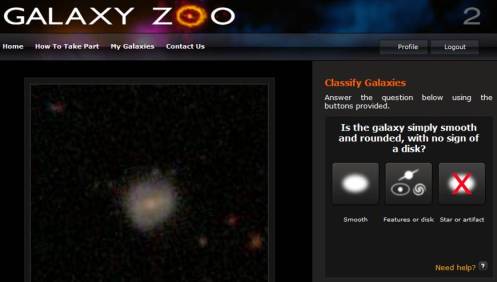
In Galaxy Zoo 2, we are tasked to provide more detailed classifications, rather than just spiral or elliptical. When classifying you will be shown an image of a galaxy and be asked a series of questions about it; for example “it is smooth?”, “does it has a bulge at the centre?”, “how many spiral arms are there?” etc. All you need to do is to look for features that mark out different types of galaxy and answer the questions as well as you can. This is a job that humans are much better at than computers, so most of the questions should be fairly easy.

Galaxy Zoo 2

Go through the tutorial, where there are explanations of each question, along with a selection of examples which you can use to learn and practice your classifying skills. After you’ve finish the tutorial and confident about your new skills, you can start to contribute to Galaxy Zoo science. Before that, remember to register first.

Done?

Now go and do some real science!

The Legendary Wide Field and Planetary Camera 2 – Part 2 of 2

•May 19, 2009 • Leave a Comment

The Wide Field and Planetary Camera 2 (WFPC2) was Hubble Space Telescope “workhorse” instrument. It was originally installed in the first Hubble servicing mission in 1993 with a special optics to solve the spherical aberration in the telescope primary mirror. And because of this it was nicknamed “the camera that saved Hubble”.

Although WFPC2 had became Hubble’s most requested instrument, time has come for it to make way for an improved version camera – the Wide Field Camera 3 (WFC3). During the first spacewalk of Hubble Servicing Mission 4 on 15 May 2009, astronaut Grunsfeld and Feustel removed the WFPC2 and installed the new WFC3. WFPC2 will return to Earth together with Atlantis and hopefully once of these days we will have the chance to see it sitting in a museum.

Planetary Nebula K4-55 by Hubble. Click to enlarge.

The Hubble community bids farewell to the soon-to-be decommissioned Wide Field Planetary Camera 2 (WFPC2) onboard the Hubble Space Telescope. In tribute to Hubble’s longest-running optical camera, planetary nebula K 4-55 has been imaged as WFPC2’s final “pretty picture”. Credit: NASA, ESA, Hubble Heritage Team.

During the camera’s amazing years in space, it provided outstanding science and spectacular images of our universe. Before we say bye bye to WFPC2, let us look at its top five breakthroughs:

Hubble Deep Field. Click to enlarge.

(1) Deepest photograph of the universe. Hubble’s famous “Deep Field” picture left the world with its mouth agape when it was first revealed in 1996. In just a small patch of sky, more than 1,000 galaxies located billions of light-years away could be seen floating in space like sea creatures at the bottom of an endless ocean. Our world and our galaxy suddenly seemed very small.

(2) Observations of comet collision with Jupiter. WFPC2 gave the world a rare, stunning view of Comet Shoemaker-Levy 9 plunging into the gas giant Jupiter in 1994. The images revealed the event in great detail, including ripples expanding outward from the impact.

Jupiter Impact Sites from Comet P/Shoemaker-Levy 9. Click to enlarge.

(3) The birth and death of stars. WFPC2 brought the cosmos down to Earth with its exquisite pictures of stars in all stages of development. Its famed picture of the “Pillars of Creation” and other images of colorful dying stars offered the first, glorious views of a star’s life. The camera also took the first pictures of the dusty disks around stars where planets are born, demonstrating that planet-forming environments are common in the universe.

Eagle Nebula by Hubble. Click to enlarge.

Gas Pillars in the Eagle Nebula (M16): Pillars of Creation in a Star-Forming Region. Credit: NASA, ESA, STScI, J. Hester and P. Scowen (Arizona State University).

(4) The age and rate of expansion of our universe. Our universe formed from a colossal explosion known as the Big Bang, and has been stretching apart ever since. WFPC2 by observing stars that vary periodically in brightness, was able to calculate the pace of this expansion to an unprecedented degree of error of 10 percent. The camera also played a leading role in discovering that the expansion of the universe is accelerating, driven by a mysterious force called “dark energy.” Together, these findings led to the calculation that our universe is approximately 13.7 billion years old.

Centre of Galaxy M87. Click to enlarge.

(5) Most galaxies harbor huge black holes. Before Hubble, astronomers suspected, but had no proof, that supermassive black holes lurk deep in the bellies of galaxies. WFPC2 together with spectroscopy data from Hubble, showed that most galaxies in the universe do indeed harbor monstrous black holes up to billions of times the mass of our sun.

<= Black Hole-Powered Jet of Electrons and Sub-Atomic Particles Streams From Center of Galaxy M87. Credit: NASA and The Hubble Heritage Team.

The scientific and inspirational legacy of the camera will be felt by astronomers and the public alike, for as long as the story of the Hubble Space Telescope is told.

The Legendary Wide Field and Planetary Camera 2 – Part 1 of 2

•May 17, 2009 • 1 Comment

Hubble Space Telescope “workhorse” instrument — the Wide Field and Planetary Camera 2 (WFPC2) which was built by JPL and added to the observatory in December 1993 — is behind most of Hubble’s famous pictures. WFPC2 is the telescope’s main camera. It observes just about everything, recording razor-sharp images of faraway objects in relatively broad views, covering wavelengths from ultraviolet to near-infrared.

NGC2074 in LMC by HubbleYou may not known WFPC2, but I believed you must have seen a lot of its images. If you ever wonder why some of Hubble’s images has a funny wacky shape (see right), then you are looking at a product of WFPC2.

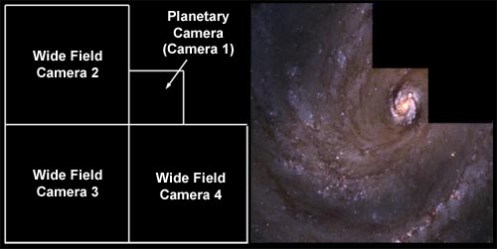
The unique WFPC2 design results in the stair-step appearance of many of its images. The “heart” of WFPC2 consists of four cameras: one high-resolution “planetary” camera and three “wide-field” cameras. Although the planetary camera sees a smaller region of the sky, it delivered a finer-detailed image because it compact the same number of pixels into a smaller area. The difference between the wide-field cameras and the planetary camera is like the difference between a wide-angle lens and a telephoto lens.

Hubble WFPC2

Each of the 4 cameras records a separate image that represents one part of the overall view. After that, the magnified view from the planetary camera is reduced to the proportion of the other 3 wide-field cameras, resulting in one small image and three larger images. And when the four images are stitched together, the wacky shape emerges in the final image. Click here for illustration.

For 15 years, WFPC2 had non-stop producing breathtaking images of our universe. But just like everything else, someday, it has to come to an end. And that someday is now… During Hubble Servicing Mission 4, which is under way now, a new and improved version camera – the Wide Field Camera 3 (WFC3) – will replaced this old workhorse.

NASA’s Wide Field and Planetary Camera 2 is more than just a scientific instrument, it is a tool of artistic expression; it’s “painting” of the universe not only has scientific but also artistic values that can be admired by all of us.

Hourglass Nebula by Hubble

The Hourglass Nebula, taken by the Wide Field and Planetary Camera 2, is pretty enough to frame. Read more: A Universal Art Form: NASA’s Wide Field and Planetary Camera 2.

Atlantis to the Hubble Space Telescope

•May 15, 2009 • 3 Comments

STS125Just last Monday, on 11 May 2009, the Space Shuttle Atlantis launched with a crew of 7 to carry out the final servicing mission of our beloved Hubble Space Telescope. Hubble was already in space for more than 19 years, and with this servicing mission, we hope to extend its life at least for another 5 years.
Hubble Space Telescope was the largest and most sensitive optical-light telescope ever launched into space. While it initially suffered from a focusing problem, it was fixed three years later and since then has consistently beaming back gorgeous images and produced outstanding scientific results.

Hubble was designed in such a way that it can be periodically updated. Old cameras can be taken out and replaced with new ones. Since its launch in 1990, astronauts from NASA and ESA had visited the space observatory four times – in 1993, 1997, 1999 and 2002 – for upgrading and repair works. During this final visit – Servicing Mission 4 (SM4) which last for 11 days, astronauts will make five spacewalks to install two new instruments, repair two inactive ones and perform some component replacements.

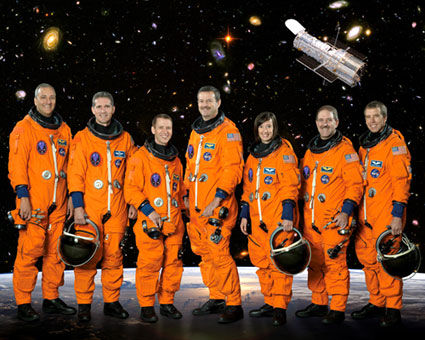
STS125 Crews

The great peoples who are going to service a great observatory. The 7 crews of the STS-125 mission to service Hubble. Credit: NASA.

The two new instruments are the Cosmic Origins Spectrograph (COS) and the enhanced Wide Field Camera 3 (WFC3). Both instruments use advanced technology to improve Hubble’s potential for discovery dramatically and enable observations of the faint light from the youngest stars and galaxies in the Universe.

WFC3 will replace the longest operating camera on Hubble – the Wide Field and Planetary Camera 2 (WFPC2). WFC3 has a higher resolution and a larger field of view than WFPC2. This new camera will be the power behind the studies of dark energy and dark matter, the formation of individual stars and the discovery of extremely remote galaxies previously beyond Hubble’s vision.

COS will be used to study galaxy evolution, formation of planets and the rise of elements needed for life, just to mention a few. COS sees exclusively in ultraviolet light and will improve Hubble’s ultraviolet sensitivity at least 10 times, and up to 70 times when observing extremely faint objects.

Replacing instruments is complicated enough, but there are another two which need fixing – the Advanced Camera for Surveys (ACS) and the Space Telescope Imaging Spectrograph (STIS). ACS had partially stopped working in 2007 due to an electrical short and STIS suffered a power failure in 2004. Hopefully this mission will be able to resurrect these two instruments.

Apart from these cameras, there are other components that also required replacement – the batteries, gyroscopes, insulating blankets, Science Instrument Command and Data Handling Unit (SIC&DH), Hubble’s Fine Guidance Sensors that lock onto guide stars to help the telescope to point. Finally, the astronauts will install a new device called “soft capture mechanism” that will allow robotic spacecraft to attach itself to Hubble someday, to deorbit the telescope once it is at the end of its life.

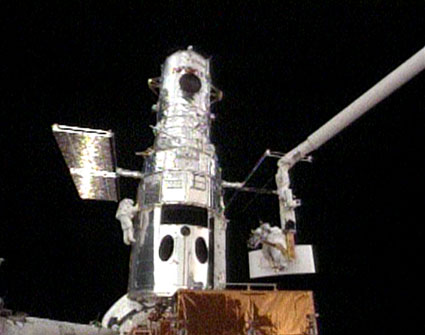
STS125 1st EVA

STS-125 spacewalkers remove the WFPC2 from Hubble. Credit: NASA TV.

Servicing Mission 4 is now under way. Just two days ago, the space telescope has been successfully captured by space shuttle Atlantis’s robotic arm. And yesterday, astronauts John Grunsfeld and Andrew Feustel have completed the first of five spacewalks. They installed the WFC3 and a new SIC&DH unit – which contains the computer that stores, formats, and sends to Earth all the data and images Hubble collects – and also successfully attached the soft capture mechanism to Hubble.

You can follow the mission updates at Hubble Site or NASA Space Shuttle Mission Page.