Total, Annular and Partial Solar Eclipse

•January 18, 2009 • 4 Comments

Solar eclipse is the most spectacular event in all of Nature. Imagine the sky briefly turns into eerie darkness in the middle of the day, and the tenuous corona that is usually invisible suddenly reveals before your eyes…

For those who have ever witnessed one, they say it is so spectacular that you have to be there personally to feel it – no word is ever sufficient to describe the feeling…

So, what is this solar eclipse that is so spectacular?

A solar eclipse happens when our Moon partially or totally blocked the Sun from our view. For the Moon to block the Sun, it has to be between us and the Sun, so solar eclipse only happens during new moon.

New moon happens every month, but not solar eclipse. Why? Because the Moon’s orbit around us is not in the same plane as our orbit around the Sun (the ecliptic) – it is tilted by 5 degrees. So, most of the time the Moon either passes above or below the ecliptic and is not in a position to block the Sun. Only when the Earth, the Moon and the Sun are in a straight line, then solar eclipse will occur.

no-solar-eclipse

When the Moon blocks the Sun in the sky, it actually casts its shadow on Earth. Thus, another way to define solar eclipse is that it happens when the Earth passes through the Moon’s shadow. The shadows cast by the Moon have two parts. One is the darker central region called the umbra, and another one is the lighter outer region known as penumbra.

Solar eclipse comes in three flavours depending on the distance of the Sun and the Moon from us (recall that orbits are elliptical) and their positions.

Total solar eclipse occurs when the Moon manages to completely obscure the Sun. This can happen either when the Moon is near to us so it’ll look bigger than the Sun or when the Sun is far from us so it’ll look smaller than the Moon. However, total solar eclipse only happens if you are in the umbra region. If you are in the penumbra region, you’ll only see a partial solar eclipse.

Partial solar eclipse also can occur without total solar eclipse because the umbra does not intersects the Earth. This happens when the Earth, the Moon and the Sun are not exactly in line and the Moon only partially blocks the Sun.
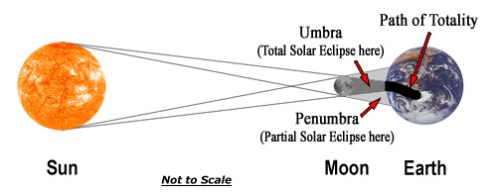
total-solar-eclipse

Annular solar eclipse occurs when the Moon is far from us or when the Sun is near to us so that the Moon’s apparent size is smaller than the Sun. The Moon cannot completely obscure the Sun and the Sun appears as a bright ring around the dark Moon.
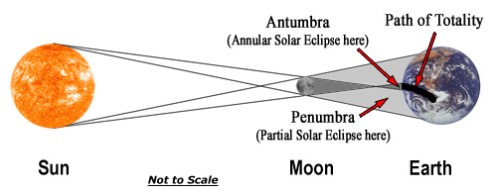
annulus-solar-eclipse

Due to the combined motions of our own rotation and the Moon’s orbit around us, the shadows of the Moon trace out a path on Earth’s surface. This path we called it the “Path of Totality”. The width of this path is quite narrow, typically about 200 km wide or less, because the Moon itself is not that big in the sky. However, the shadows can trace a path of 15,000 km long on Earth’s surface.

NASA. Click for details.

The umbral shadow cast by the Moon as seen by astronaut in the International Space Station. Credit: NASA.

If you understand what have been said above, then you will know why not everyone has the opportunity to see a total solar eclipse. First of all, you have to be in that narrow path of totality. This translates to less than 1% of Earth’s entire surface area. Since 70% of our Earth surface is open seas, the chances of the Moon’s umbral shadow falls on lands is lower. Even if the shadow does traverse through lands, the odd of the shadow passing through a big city is even lower. It will usually pass by some remote or inhabitant areas.

Even if you manage to be in the path of totality, the duration of totality is not the same for all the places. Totality is the best part of a total solar eclipse – it is the moment when the Moon totally covered up the Sun. It only happens briefly, the most is 7 minutes and 40 seconds, and usually it is much much less than that. The further away you are from the Greatest Eclipse, the shorter the duration of totality.

And then you still have to put up with the weather…

Solar eclipse occurs few times a year, so it’s not uncommon. However, if we have the chance to see it, we must grab it because it may not always be accessible to us. With fewer than 70 total solar eclipses per century, the opportunity to see one may be once in a lifetime event!

I can’t finish this post without mentioning one more thing. We are really born at the right time to see total solar eclipse. The matching size of the Moon and the Sun in the sky is really a coincidence in time. The Sun is 400 times larger and yet it’s 400 times further away than the Moon. This translates to the same size of both objects in the sky.

But this is not the situation in the past, and it’ll not be like this forever. In the past, the Moon is nearer, so total solar eclipses last longer. As time goes by, the Moon is slowly moving away from us, roughly 4 cm per year. As it moves away from us, it’ll appear smaller and smaller in the sky, and eventually it’ll be too small to completely block the Sun. No more total solar eclipses then, we’ll only be left with annular solar eclipses.
Cassini: After 4 Years of Adventure at Saturn

•January 14, 2009 • 1 Comment

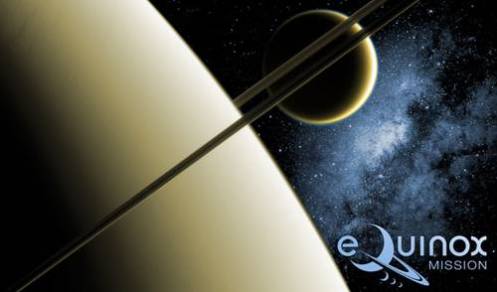
On July 1, 2004, Cassini-Huygens spacecraft arrived at Saturn. Today, four and a half year later, it’s still there, still strong and healthy, still busy exploring the Saturnian world for us.

Cassini is now working “overtime”. It has actually completed its initial four-year mission in June 2008 and is currently working on an extended mission for another two years called the Cassini Equinox Mission.

Cassini Equinox Mission

For the past 4+ years, Saturn, together with its rings and moons, were illuminated from the south by the Sun. Now, Saturn is going to reach equinox in August 2009 and, as with the equinox here on Earth, the Sun is going to shine directly on the equator during that time.

And this very reason of Saturn entering its equinox is why the rings “disappear” when view from Earth now.

After the equinox, the Sun will continue to move northward and is going to slowly light up Saturn’s northern hemisphere and the northern side of its rings. What Cassini will do is observe the seasonal changes on Saturn, and the motion of the rings’ shadow due to the changing angle of the Sun. The moons are not left behind either. There are plans to revisit the moons Titan, Enceladus, Iapetus, Rhea, Dione and Tethys again.

In the past four years, Cassini had showed us worlds that before only exist in our imaginations. Here I would like to share a few fantastic postcards sent back by Cassini.

by cassini. Click for details.
Storms at Saturn’s North Pole

by cassini. Click for details.
Saturn and its moons

by cassini. Click for details.
Mimas, Prometheus and the Rings

by cassini. Click for details.
Enceladus – a moon full with fractures, folds, and ridges

by cassini. Click for details.
Iapetus – a moon with two faces

by cassini. Click for details.
Hyperion – an odd world

All images credit to NASA/JPL/Space Science Institute
For more images, go to the Cassini imaging team (CICLOPS) home page.

I really love the portrait of the moons. Closed-up, we can see their difference faces; some has cracks and spewing out geysers; some can have two-coloured face; some can even looked like something under the sea… They are truly a world by themselves.

The Biggest Full Moon of 2009

•January 10, 2009 • 2 Comments

A new year has just started, and the biggest Full Moon of the year is here.

This is no illusion. Some Full Moons really do look larger than others.

biggest-full-moon-2007

A comparison of the Moon taken on two different months in 2007. The right is the biggest full moon of 2007. You can clearly see the difference in the sizes. Click image to enlarge. Credit: thChieh (APGM)

Don’t worry… our Moon does not expand and shrink. This is not due to the physical change in the size of our Moon. Our Moon will always measures 3476 km in diameter (more or less).

Then what causes the change in size?

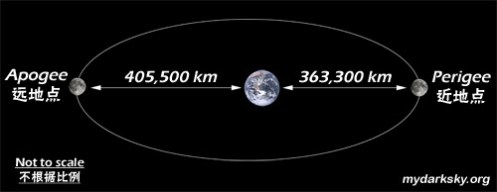
This question was answered 400 years ago by Johannes Kepler. Kepler explained that the Moon’s orbit around us is not a perfect circle but instead is an ellipse, with the nearest side some 42,000 km closer than the farthest side. We call the nearest point “perigee” and this is where the full Moon will be tonight.

perigee-apogee

So, this change in size is just the distance between us and our natural satellite. Our Moon will look big tonight just because it is nearer. It will appear 14% bigger and 30% brighter than the rest of the full moon we’ll see later this year.

Do you think you will be able to spot the difference? It is not so easy visually. But if you snap a picture of it and compare with the lesser Full Moons, you may be able to see the difference.

Clear Skies and enjoy the Big Moon tonight!

Venus and the Crescent Moon

•January 3, 2009 • Leave a Comment

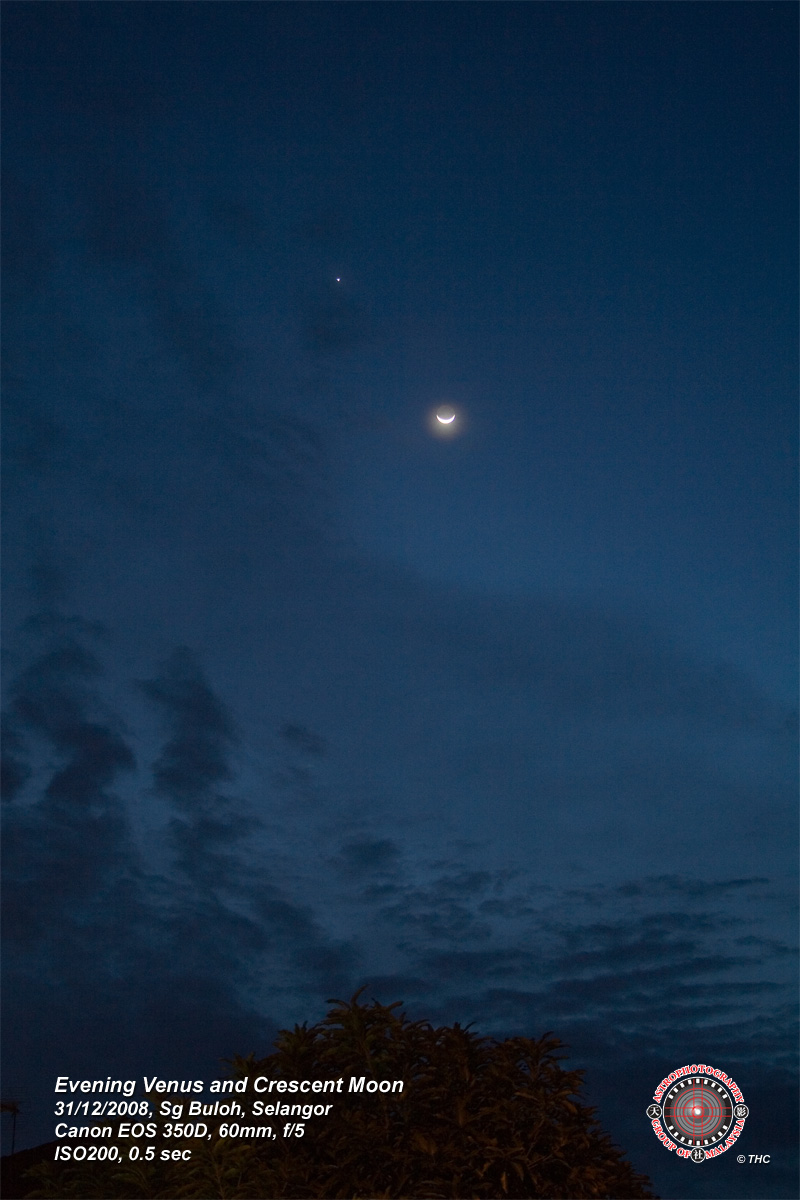
On the very last day of 2008, the sky is smiling at me, again! Though it only left with one “eye” (the other “eye” – Jupiter – had move lower down nearer to the horizon), the view was still very beautiful.

081231-venus moon

Click the image to enlarge and here for another one.

Carnival of Space #85

•January 3, 2009 • Leave a Comment

The first carnival of space 2009 is up! Go over to Cheap Astronomy for some space stuffs to start off the International Year of Astronomy.

My article of ringless saturn is there too.

International Year of Astronomy 2009 is HERE!

•January 1, 2009 • Leave a Comment

Welcome to the Year 2009!

Welcome to the International Year of Astronomy!

The Universe, Yours to Discover

To kick-start the new year, go to 365 Days of Astronomy Podcast. As its name suggested, this project will publish a podcast a day, for each and every single 365 days of 2009. The topics cover basic stargazing to space exploration – anything and everything to do with astronomy.

The podcast episodes are written, recorded and produced by people around the world. You can also contribute a podcast to the project, click here to see how to record and submit your own podcast.

Listen to it every day, and keep astronomy close to your heart.

twanNext site to visit is The World at Night (TWAN). This programme produces and presents a collection of photographs and time-lapse videos of the world’s landmarks against the background sky.

This is to show that although the landmarks may belong to different nations and cultures, the sky above them still looked the same. There is no different between us as Earthlings; we live under the same sky, we live above the same planet.

cosmicdiaryWant to how astronomers live their lives? Then visit The Cosmic Diary. Professionals from over 35 countries and employed by organisations such as ESO, NASA, ESA and JAXA write about their lives, the work they conduct and the challenges they face. The public can see what being an astronomer is really like, and how ground-breaking research is conducted.

There are too many activities for me to list them all here. You can go here to see more of the events and here for the Cornerstone Project. Malaysia national node is here.

Finally, this is something you don’t want to miss – the IYA2009 theme songs: IYA2009 and Shoulders of Giant.

Let us together make this event a success!

Leap Second

•December 31, 2008 • Leave a Comment

timeEver feel like you need more time? Today you are going to get it – 1 extra second.
Tonight, at 23 hours 59 minutes and 59 seconds Coordinated Universal Time (UTC), an extra second (leap second) will be added to the world’s clock. This is the 24th leap second added to UTC, a uniform time-scale kept by atomic clocks around the world, since 1972.

Why we need to do that?

Because we have two types of timekeeping.

Historically, the second was defined in terms of Earth’s rotation as 1/86,400 of a mean solar day although we know that the Earth’s rotation was not sufficiently uniform as a standard of time. Then in the 1940s, someone invented the atomic clock which defined a much more precise “time” that is independent of our planet’s rotation. So in 1970, an international agreement established these two timescales: one that is based on Earth’s rotation and the other one based on atomic clocks.

The problem here is that Earth’s rotation is gradually slowing down but the atomic clocks do not. So leap second needs to be added to keep the atomic clocks synchronised with Earth’s rotation time within one second of each other.

The International Earth Rotation and Reference Systems Service (IERS) is the organisation which monitors the difference in the two timescales and calls for leap seconds to be inserted or removed when necessary.

Since 1972, leap seconds have been added at intervals varying from six months to seven years, with the last being inserted on December 31, 2005.

Source: US Naval Observatory