Geminid Meteor Shower

•December 10, 2008 • 2 Comments

Time for meteor shower again!

When it’s December, it’s Geminids time.

Geminids is one of the best meteor shower of the year and seldom disappoint observers. It usually produces 50 or more meteors an hour, sometimes even up to 100 or more. Unfortunately this year, during its peak on December 13/14, a full moon will washed out all but the brightest meteors.

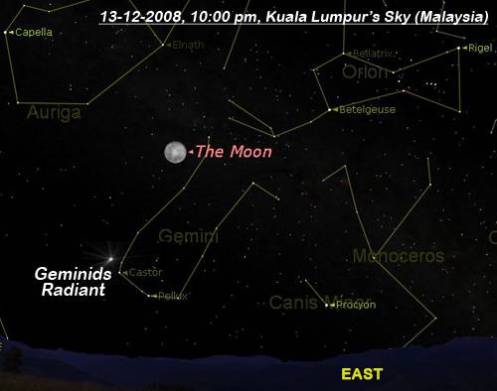
You can start to look out for geminids as the radiant rises in the east around 9:30 pm on December 13/14; or you can wait for an hour or two for the radiant to rise higher in the sky to increase your chances of spotting a geminid. Geminids are medium-speed meteors, about 35 km/s, half as slow as the Leonids. This makes them fairly easy to spot. The brighter ones sometime are coloured.

Not all meteors that you see will be geminids though; some may be sporadic (or random) meteors. How do you differentiate between a geminids and a sporadic?

It’s simple. Just trace back the path of the meteor and see if it ends up in constellation Gemini. If yes, then it’s a geminid; if not, then it is just a sporadic meteor.

You don’t really need to wait for December 13/14 to see geminids; meteor shower, unlike most sky events, happens for a period of time spanning weeks instead of just a day or a few hours. Geminids can be visible as early as December 7 – although the rate is low at about one meteor per hour. The numbers of meteor will slowly build-up until it peak on December 13/14 and then decline. The last can be seen maybe until December 17.
081213-10pm-geminids

Most well known meteor showers, like the perseids and leonids, are old. The geminids, on the other hand, are young; they were first observed only 150 years ago in the mid-1800s. After searching for more than 100 years for geminids’ parent object, we finally discovered a curious object with an orbital period of 1.4 years moving in the same orbit as the geminid meteoroid stream. This was discovered through NASA’s Infrared Astronomical Satellite in 1983.

To the surprise of many it wasn’t a comet, but a rocky asteroid now known as 3200 Phaethon. So geminids are special in the sense that they do not originate from a comet like almost all the other meteor showers.

This then raises a question: how does an asteroid that is made of tougher stuff produce a meteoroid debris stream?

Our common understanding is that as a comet, which is primarily composed of ice and dust, when passes close to the Sun, the heat will evaporate its ice. This icy, dusty debris stream will then be distributed along the comet’s orbit. As our Earth passes through the stream, these left-over comet debris will bombard Earth and cause the rate of meteors to increases, and thus a meteor shower.

But an asteroid doesn’t have ice like a comet…

One of the earliest ideas was that Phaethon might occasionally collide with other asteroids and created a meteoroid stream. It is also possible that when Phaethon passes by the Sun bits and pieces do break off to form the geminid meteoroids. However, now many astronomers believe that Phaethon is an extinct or dormant comet.

Whatever it is, it will not stop up us from enjoying the sky show, right? So hopefully the weather will be fine and clear skies to everyone out there!

~~~~~

Click here for some tips on how to observe meteor shower.  To learn more about meteor and meteor shower, go to Meteor Shower ABC.

Carnival of Space #82

•December 10, 2008 • Leave a Comment

Last week Carnival of Space was held at Space Disco.  It was  a special one this time because it has the first-ever video edition of the Carnival.  Enjoy!

Smiley Face in the Sky!!!

•December 2, 2008 • 3 Comments

Lucky for me.  As the Sun sets, the sky was covered with clouds.  I sort of giving up hope of seeing the conjunction.  But somehow the Moon and planets managed to “poke through” the clouds.  Although they were blurry, it’s better than none, right?

thc1225-conjunction01dec08_sm

thc1234-conjunction01dec08_sm

thc1272-conjunction01dec08_sm

Taken with Canon 350D, ASA400, ~1 sec exposure. Location: Sungai Buloh, Selangor, Malaysia.

Lunar Smiley Face???

•December 1, 2008 • 3 Comments

Oh no… This is just ridiculous.

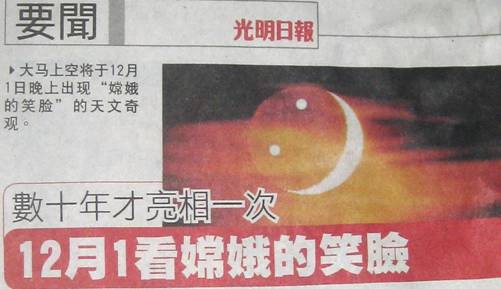
Do you think that it’s possible to see something like this in the sky?

guangming-ven-jup-moon
A cutting from a local newspaper reporting the conjunction of Venus, Jupiter and the Moon on December 1. (I think the Moon may be from a real photo, but the two bright dots are definitely touch-up by some software.)

Oh man, that’s so wrong… (the correct one is here). Just imagine how many people are misled by this photograph…

The brighter part of the big “circle” is the crescent Moon, the part of the Moon that is lit by the Sun. The darker part is also part of the Moon, the part that is not lit by the Sun but instead is lit by the light reflected off the Earth – so it’s called “Earthshine”. The light reflected off our planet to lit up the Moon is sort of “second-hand light” – not straight from the Sun – that’s why is much dimmer compared to the crescent part lit directly by the Sun.

So, basically, the whole “circle” is the Moon.

Those two bright dots in the above photograph are supposed to be Venus and Jupiter. So now can you see why that photo is sooooooo wrong?

We all know that the Moon is the nearest astronomical object to us, and Venus and Jupiter are much much further away. So, is it possible for something further away appears in front of something nearer?

Of course not! So how could it be possible that the two bright dots that supposed to be Venus and Jupiter, that supposed to be much further away, visible in front of the Moon???

Oh man… I just don’t know what to say…

Newspapers are something that most of us read everyday and it’s read by thousands upon thousands of people in the country. If the media doesn’t care of getting some basic facts right, then just imagine how many wrong information and misconceptions get spread out to the public…

Moral of the story: Don’t believe everything you see or read… be it from newspapers, TV, internet, or even from textbook.  Be sceptical…

Carnival of Space #81

•December 1, 2008 • Leave a Comment

Carnival of Space #81 is now up at Tiny Mantras.  Visit it for some space stuffs…

And don’t forget tonight sky show – Meeting of Venus, Jupiter and the crescent Moon.

Outing to see the Conjunction of Venus, Jupiter and the Moon

•November 28, 2008 • Leave a Comment

Monday…
December 1…
Sunset…
Look west…
A smiley face in the sky…
A spectacular view is waiting to be seen and photographed…

The Conjunction of Venus, Jupiter and the crescent Moon

This sky event can be easily visible seen with the naked eye. You can see it right outside your house, your office, your school… anywhere outside as long as your sky is clear – not raining, not cloudy – and an unobstructed western horizon.

So far, I know of two organisations holding a star party for this conjunction:

Starfinder Astronomical Society
Date: 01-12-2008 (Mon)
Time: 6 – 8 pm
Venue: Kepong Ulu, Kuala Lumpur
Contact: Pang 03-62758158

USM Astronomy Club
Date: 01-12-2008 (Mon)
Time: Evening
Venue: Pantai Acheh Observatory, Penang
Contact: Dr. Chong 016-3157318

Clear Skies!

The Meeting of Venus, Jupiter and the Moon

•November 27, 2008 • 7 Comments

If you are wondering what’s that two very bright stars in the west after sunset were, congratulations, you had just witness one of the many beautiful scenes in the sky (a scene which I’m longing to see but was not allowed by the weather…)

The two bright “stars” are not stars – they are the planet Venus and Jupiter. The upper one is Jupiter whereas the one nearer to the horizon is Venus. If you are trying to remember who is on top or who is at the bottom, don’t bother… because they are going to change their position soon anyway. Just know that the brighter one is Venus (magnitude -4.2) and the relatively dimmer one is Jupiter (magnitude -2.0).

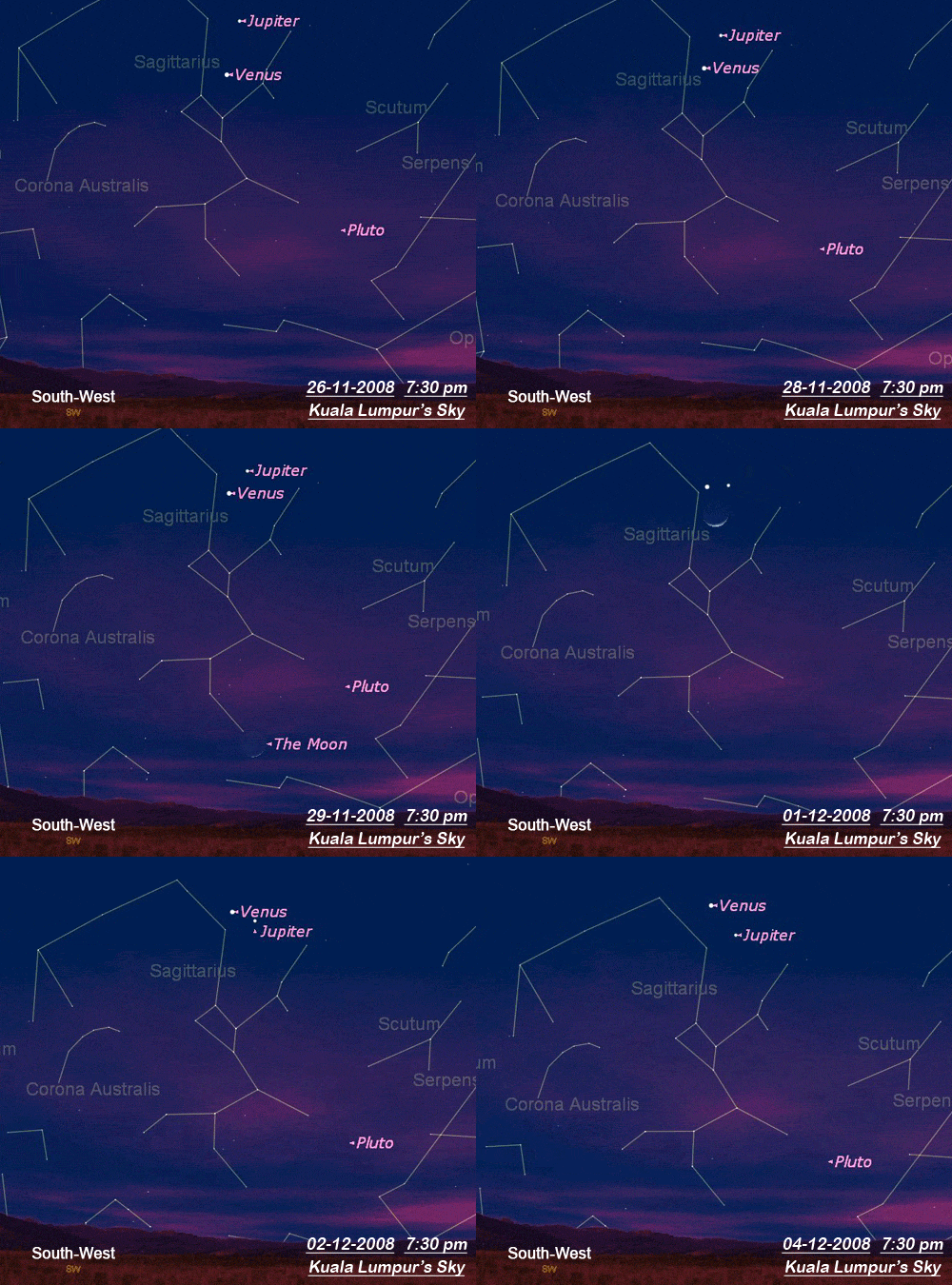
In the days to come, Venus will be climbing higher and higher to meet its big brother, until they are only 2 degrees apart on December 1. The best thing is a crescent Moon will be joining them too, making this conjunction a beautiful scene in the sky, backdropped by the constellation Sagittarius. The positions of the two planets and the crescent Moon form a smiley face in the sky (for Asia). Find a nice foreground to add to the scene, and you can capture the beauties of the sky.

081201-1930-venus-jupiter1

The positions of Venus (left), Jupiter (right) and the crescent Moon form a smiley face in the sky on December 1 (for Asia).  Click the image for animation of the planets’ positions from November 26 to December 4.

After the meeting, Venus will continue to climbs higher, while Jupiter will dip lower and lower into the horizon. These motions are due to the relative motion of us and the planets. Venus, being an inner planet, circles the Sun faster than we do, so it’s “catching up” with us and moves away from the Sun. The outer planet Jupiter, on the other hand, orbit the Sun slower than us, so it’s lagging behind toward a position behind the Sun. Jupiter will remains in Sagittarius whereas Venus will move through Capricornus and ends the year in Aquarius.

Apart from the Sun and the Moon, Venus and Jupiter are the brightest objects in the sky, even brighter than the brightest star in the night sky, Sirius. To find them, just face west after sunset and there they are. They are shinning so brightly that it’s not difficult at all to see them – it’s more difficult not to see them.

Although naked eye view is all you need to enjoy the scene, a view through binocular or telescope can give different experiences. On December 1, our Moon and the two planets will be visible together in your binoculars, an unforgettable view indeed! A look through telescope with the same eyepiece will give a feel of how big Jupiter is. The giant planet, although lies 6 times farther away, appears twice as big as Venus.

Through a telescope, observe the phase changes of Venus. Venus will go through phases just like our Moon because of its orbit that are between us and the Sun. Apart from it phases, that is nothing much to see on Venus – it is featureless due to the thick clouds that enshroud the whole planet.

However, a different story goes for Jupiter… the giant planet’s atmosphere is full of features. The most prominent one is the two dark bands on either side of the equator. The dancing of its four largest moons around it is also fun to observe. But as the planet dips lower and lower into the horizon, it has to go though more and more of our atmosphere – most of the features will be lost to the atmospheric turbulences.

Finally, don’t forget the date with our Moon and the two brightest planets on December 1… and clear skies to everyone out there!