Our Moon as Seen by Chandrayaan-1

•November 25, 2008 • Leave a Comment

ISRO

This image shows a region of the lunar south pole taken by Chandrayaan-1. The bright terrain on the lower left is the rim of 117 km wide Moretus crater.

Another piece of update: the Moon Impact Probe (MIP) onboard Chandrayaan-1 had been released and dropped close to Shackleton crater on November 14. Shackleton crater is interesting to us because deep inside the crater there are areas that are never illuminated by the Sun and we think that ice may exist there, which is important to us if we plan to setup a base there.

Space Telescopes with Gamma Rays Eyes

•November 20, 2008 • Leave a Comment

In the previous posts, we talked about how gamma rays were first detected, how astronomers know that they were located far far away up to distances of billions of light-years, and also what are the types of gamma ray bursts and what causes them.

If we want to detect gamma ray bursts (GRBs), unfortunately, we can’t do it on the ground. Gamma rays coming to Earth cannot penetrate through our planet’s atmosphere and thus do not reach the ground. So, if we want “see” gamma rays, we have to go to space, up above the atmosphere, and this is why all our gamma-rays telescope are in space.

Swift-NASACurrently, we have a few gamma-rays telescope around Earth. We have Swift Gamma Ray Burst Explorer, High Energy Transient Explorer 2 (HETE 2), International Gamma Ray Astrophysics Laboratory (INTEGRAL) and Astrorivelatore Gamma ad Immagini LEggero (AGILE). The latest addition to our list of gamma ray telescopes is Fermi (previously known as GLAST), launched just about half a year ago.

As we’ve mentioned before, afterglows are important for further analysis and understanding of GRBs. For example Swift, as it detected a GRB in the sky, it’ll quickly turns its X-ray camera to the source. The purpose is to get a more accurate position of the GRB. You see, gamma rays don’t like to be focused… so it’s hard to pinpoint exactly where a GRB came from. All we can get is the GRB came from somewhere there, and that “somewhere there” might be an area of the sky few degrees across; an area which is not small enough for some telescope to point at the sky and find something new and interesting.

So we use X-ray cameras to give us a more precise position. Once we have that, these coordinates will be sent down to Earth, allowing both ground-based and space-based telescopes around the world the opportunity to observe the burst’s afterglow. For Swift to detect, get the coordinates, and relay the information to Earth only took it less than a minute to finish; you don’t called it “Swift” for nothing…

Fermi, on the other hand, will provide detail observations of the burst over the gamma ray spectrum, giving scientists a complete view of the total energy released in these events.

With all these observatories, we hope to solve some of the GRB’s mystery. As the data keep pouring in, we may find ourselves in a situation where trying to solve one mystery, we end up with more mysteries… but then, isn’t that’s where all the fun lies?

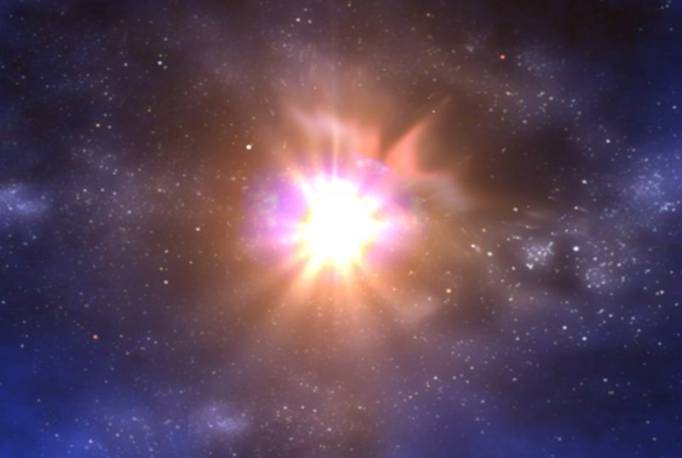
GRB 031203

gamma-ray-burst-01Gamma rays bursts don’t give off their radiation uniformly in all direction. The energy were concentrated and funnelled out the two poles in narrow beams – we called them the jets.

We can only detect the burst if the jets are pointing at us, if not, they’ll go unnoticed. =>


Farewell Phoenix…

•November 18, 2008 • Leave a Comment

 We knew this day will come…

Phoenix had sent its last signal to us on November 2 and since then, we have never heard from it again…

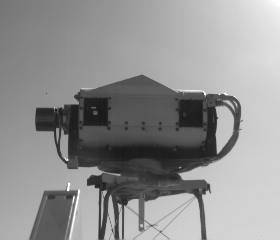
phoenix-mast-camera=> This is Phoenix mast-mounted camera. The two “eyes” enable Phoenix to have 3D view of the landing site. Credit: NASA / JPL / UA / MPI

Winter is approaching… daytime is getting shorter and shorter at Phoenix location on Mars. In addition to that, the sky became dustier and cloudier, and temperature is dropping. All these cause lesser and lesser sunlight for the solar arrays to collect the power necessary to charge batteries that operate the lander’s instruments.

Phoenix, which was designed to last three months, had spent about five months on Mars. During these five months, the lander dug, scooped, baked, sniffed and tasted the Red Planet’s soil. It verified the presence of water-ice in the Martian subsurface, finding small concentrations of salts that could be nutrients for life, revealing at least two distinct types of ice deposits, observing snow descending from clouds, providing a mission-long weather record and returned more than 25,000 pictures of Mars.

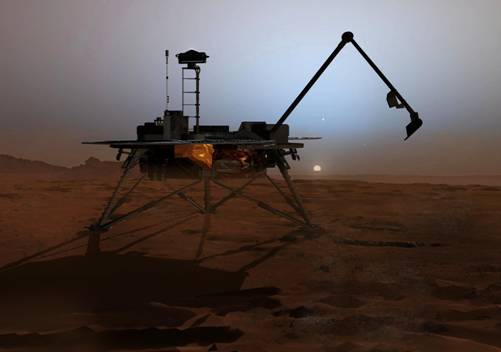
phoenix-artist1

Phoenix begins to shut down operations as winter sets in. This rendition of Phoenix was created by artist Corby Waste of JPL.

I’ve been following Phoenix since its launch, landing, operations, and finally its struggle to stay alive… Feels like not long ago we talk about Phoenix’s launched on 4 August 2007. And it only seems like yesterday we talk about its landing, and today, we talk about it demise…

It’s sort of sad, but think of the surprises Phoenix has given us; our understanding of Mars will never be the same again.

A Tribute to Phoenix


Click here for higher resolution

Carnival of Space #79

•November 17, 2008 • Leave a Comment

Another week had past… so it’s time for Carnival of Space again… this week the carnival was held at One Astronomer’s Noise.

A Pool of Distant Galaxies

•November 11, 2008 • Leave a Comment

ESO/Mario Nonino, Piero Rosati, ESO GOODS Team.

At one glance, the image above doesn’t look special… a bunch of galaxies, few brighter stars and lots of dimmer stars peppering the image. However, if you click on the image for a larger version, or here for a super large one (32 MB!), you can see that all the dim “stars” turned into galaxies, galaxies much like our own Milky Way which is home to hundreds of billions of stars.

Scroll through the full-resolution image and you’ll see that the galaxies come in all shapes and sizes. These galaxies were a billion times fainter than what your naked eye can see and they are so far away that they are seen as they were when the universe was only 2 billion years old (our universe is 13.7 billion years old now).

This image, released by the European Southern Observatory, and was the deepest ground-based picture of the Universe ever taken. Obtained in part with the Very Large Telescope, the image contains more than 27 million pixels and is the result of 55 hours of observations.

Source: European Southern Observatory (ESO)

India Reaches the Moon

•November 10, 2008 • 2 Comments

Just late last October, India launched the Chandrayaan-1 spacecraft to the Moon. After two weeks cruising in space, the spacecraft finally entered into the lunar orbit on November 8.

When we say we launch a spacecraft to an object, say the Moon, in a layperson’s mind the spacecraft will go from Point A (the Earth) straight to Point B (the Moon). No, we don’t do that because it’ll be very fuel consuming if we were going to launch that way (although it’s the fastest way to get there). Instead we use what we called transfer orbits to transfer the spacecraft from Earth’s orbit to the Moon’s orbit. In this way, we can save some fuel but it’ll take longer time to reach our destination.

ISRO. Click to enlarge.

In the past two weeks since its launch, Chandrayaan-1 has successfully increased its orbital height five times from its initial apogee (farthest point from Earth) of 22,860 km to the Lunar Transfer Tracjectory with an apogee of 380,000 km.

Then on November 8, Chandrayaan-1 entered the lunar orbit. As the probe passed about 500 km from the Moon, its liquid engine was fired to reduce its velocity to a point that the lunar gravity was able to capture it into orbit around the Moon.

In the coming days, the height of Chandrayaan-1’s orbit will be gradually reduced to achieve a final polar obit of 100 km from the lunar surface. After that, the Moon Impact Probe (MIP) will be released and, as its name suggested, impact the Moon to kick up some dust for the onboard instruments to analyse.

Congratulations India!

Here’s an animiation showing the whole mission.

Carnival of Space #77 and #78

•November 9, 2008 • Leave a Comment

This week Carnival of Space is held at Simotronomy.  Check it out!

I missed out the Carnival of Space last week. Here is it at Tomorrow is Here.