What is a Gamma Ray Burst? Its types and causes…

•November 7, 2008 • Leave a Comment

 …continue from Part 1 – its history and Part 2 – its location

Now we know that gamma ray bursts (GRBs) are far far away and releasing extremely HUGE amount of energy. They are by far the brightest and most energetic phenomena in the known universe, second only to the Big Bang itself.

What could possibly cause them?

In fact, we are not really sure…

But we have good guesses…

Before we go into what could possibly cause a gamma rays burst, let us first look at the types of GRBs because different types of bursts are created fundamentally by different processes. In general, GRBs are separated into two classes – short-duration bursts and long-duration bursts.

The short-duration bursts last less than 2 seconds and range anywhere from a few milliseconds to 2 seconds with an average duration time of about 0.3 seconds. The long-duration bursts are those last more than 2 seconds and up to few minutes. The average time for long-duration burst is about 30 seconds. 
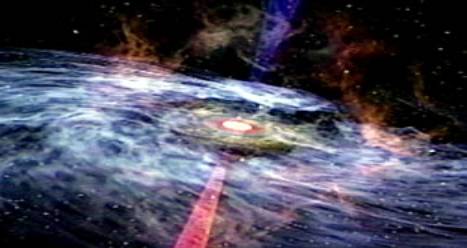
A gamma-ray burst heralds the birth of a black hole – an artist’s concept. Taken from Science@NASA.

Astronomers now are quite sure what causes the long-duration GRBs. The explanation was first put forth by Dr. Stan Woosley of University of California in his “collapsar” model. At the end of the life of a very very massive star, about 50 to 100 times more massive than our Sun, its core collapsed and formed a black hole. At the same time, the star’s outer layers exploded energetically and it funnel the energy out through the two poles and form a GRB. The energy outputs of these so-called “hypernovae” are much greater (by about 100 times) than a normal supernova.

Although we are now fairly confident of what drives the long-duration GRBs, the short-duration ones still remains a mystery. The durations of the bursts are too short to be supernovae, and the energies involved do not add up to an exploding star. It was found that the short-duration ones release more energy relative to the longer ones.

Our best guess is that short duration GRBs are caused by the extremely violent collisions of two compact objects, such as colliding of two neutron stars or merging of a neutron star and a black hole. When these very compact objects merged, there are going to release a huge amount of energy and ended up as a new black hole (in the case of two colliding neutron stars) or a bigger black hole (in the case of a neutron star and a black hole merging).
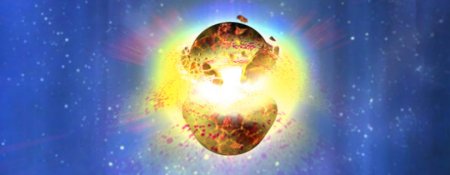

An artist’s concept of a neutron star-neutron star collision. Taken from Science@NASA.

We never “see” these kinds of collisions in action, so how do we know that this explanation is true?

Before the two objects collide, they would orbit each other as a binary system. At the same time, they lose their rotational energy to gravitational energy, i.e. their orbit decays, and they spiral in toward each other. As they spiral in, these dense objects intense gravitation field will cause ripples in the fabric of spacetime and can be detected as gravitational waves. The frequency of these waves would ramp up in a characteristic pattern as the objects get closer and closer to each other until… bang! they collided in a fiery explosion, and release burst of gamma rays.
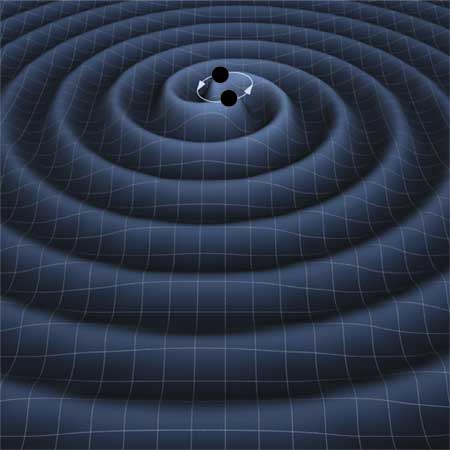
 

<= Gravitational wave – “ripples” in the curvature of space-time – generated by the motion of massive objects. Credit: K. Thorne (Caltech) , T. Carnahan (NASA GSFC)

Astronomers are trying to detect these waves now. The Laser Interferometer Gravitational-wave Observatory (LIGO) and future Laser Interferometer Space Antenna (LISA) hopefully will be able to detect these gravitational waves and help verifying the model.

These are currently some of our best guesses. It may also be that GRBs originated from something that we have not thought of yet.

Next, we are going to look at the space telescopes with gamma rays eyes.  …to be continued…

What is a Gamma Ray Burst? Its location…

•November 4, 2008 • 1 Comment

continue from last week: What is a Gamma Ray Burst? Its History…

We now know that gamma ray bursts (GRBs) came from space. But exactly where? From our Solar System? within our Milky Way Galaxy? or galaxies far far away?

In 1990s, the Compton Gamma-Ray Observatory (CGRO) was launched. Within a few years, this satellite had detected thousands of bursts. If we plot these bursts on a “sky map”, it turned out that their distribution was uniform across the sky. This means that the bursts should come from outside our galaxy. If they were related to our Milky Way, then they should be more or less confined to the plane of our galaxy, though we weren’t 100% certain because it could be something that was associated with the halo.

BATSE map of GRBsBATSE map of its 2704 detected GRBs. Note that the GRBs are distributed all over the sky.

While many astronomers were convinced GRBs came from far far away, some still think that they should be local because of the extreme energy release. These bursts seemed impossibly powerful: to appear so bright from so far away, they must vastly outshine entire galaxies containing hundreds of billions of stars.

To know the distance of a GRB, we must be able to pinpoint its location and transmit the coordinates fast enough back to Earth so that we can zoom in with our ground-based telescopes to find out what it was, how far it was located and what kind of galaxies it was in (if the bursts occurred in galaxies).

The answer came in 1997. BeppoSAX, an Italian-Dutch satellite, manage to identify the location of a GRB (GRB 970228) fast enough that astronomers on the ground were in time to photograph its optical afterglow. After the burst had faded away, they found a faint galaxy there, took its spectra and figure out that it’s a galaxy far far away.

GRB 970228. Click to enlarge.
BeppoSAX observations of GRB970228. On the left is the original observation of the burst on 28 February 1997. The right image shows the burst object has dimmed 3 days later.

Afterglow is the radiation emitted after a GRB, and can be seen in other parts of the electromagnetic spectrum – X-rays, optical and radio wavelengths. Afterglows can last for days to several years, and they fade away over time in a well-understood manner. Most of what we know about GRBs comes from afterglow observations. That’s why it is important to pinpoint the exact location of GRBs fast enough to observe their afterglows.

Afterglows helped astronomers determine the distance to GRBs. The discovery of afterglow made redshift measurements possible, which can be translated into distance. And we found out that all of the GRBs are really very very far away, at a distance of few billion light-years. The current record-holder is located 12.8 billion light-years away, almost to the edge of the observable Universe.

So, gamma ray bursts are far far away, releasing extremely HUGE amount of energy (GRB only needs a few seconds to release the energy our Sun produce in its entire 10 billion years lifetime). They are by far the brightest and most energetic phenomena in the known universe, second only to the Big Bang itself.

What could possibly cause them?

…to be continued…

Good News! Hubble is Back!

•October 31, 2008 • Leave a Comment

Four weeks ago, the Hubble Space Telescope encountered a major failure and was unable to send any data back to Earth… The failure of the “Side A” control system forced to shut down Hubble’s science operations and put it in safe mode.

But now, Hubble is back in business again on October 25 after overcoming some glitches in restarting the Side B backup system . Hubble then went back to work and sent us a beautiful galaxy pair with a number “10”, telling us that it’s working perfectly.

Arp 147 by Hubble

This galaxy pair is known as Arp 147. The left galaxy is orientated nearly edge-on to us that it shows the number “1” and the one on the right shows the number “0” with its blue ring of intense star formation. Credits: NASA, ESA and M. Livio (STScI).

Arp 147 is a pair of gravitationally interacting galaxies located more than 400 million light-years away in Cetus. It is named after Halton Arp, an American astronomer who had catalogues quite a numbers of unusual or peculiar galaxies in the Arp Atlas of Peculiar Galaxies published in 1966. Almost all of Arp’s galaxies later turned out to be interacting and merging galaxies, which we now know is quite common in our universe.

The blue ring was formed after the galaxy on the left passed through the galaxy on the right. The collision between the galaxies produced shocks waves and dense gases, which in turn triggered huge amount of star formation. The ring (or galaxy) looks blue due to massive stars being born, and young massive stars are blue. The dusty reddish knot at the lower left of the blue ring probably marks the location of the original nucleus of the galaxy that was hit.

Source: HubbleSite NewsCentre

What is a Gamma Ray Burst? Its History…

•October 29, 2008 • 3 Comments

If you ask any astronomer what is the most powerful explosions in the Universe, the answer will definitely be gamma ray burst.

How powerful is it?

Imagine the energy that our Sun put out in its entire 10 billion years lifetime, gamma ray burst only needs a few seconds to release them all!

Basically, gamma rays are just “light” (electromagnetic waves), same as the familiar visible light that we can see but with much shorter wavelengths and thus contains higher energy. In fact, it is the highest energy photons in the electromagnetic spectrum, billions of times more energetic than visible light.

Electromagnetic Spectrum

Gamma ray bursts (GRB) are very intense and short bursts of gamma-ray radiation in the sky. They were actually first discovered by accident. In the 1960s during the Cold War, US launched the Vela satellites to make sure that the Soviet Union (specifically and other nations generally) adhered to the nuclear test ban treaty. The satellites will look for nuclear testing by detecting gamma rays that are given off during nuclear explosion.

And Vela did detected bursts of gamma ray. However, the distributions of these gamma rays don’t look the same as the ones you get from nuclear test; the bursts are not coming from our planet, but from space. They seemed to be coming from all over the universe at random and at unexpected times – they are totally unpredictable.

So, now we know the bursts came from space. But exactly where? From our Solar System? within our Milky Way Galaxy? or galaxies far far away?

…to be continued…

India to the Moon

•October 24, 2008 • 1 Comment

Chandrayaan-1 LaunchSoon, India Chandrayaan-1 spacecraft is going to join the Japanese Kaguya and the Chinese Chang’e-1 at the Moon.

Two days ago on October 22, the Indian Space Research Organisation’s (ISRO) Polar Satellite Launch Vehicle, PSLV-C11 successfully launched the 1380 kg Chandrayaan-1 spacecraft from Satish Dhawan Space Centre (SDSC) SHAR, Sriharikota in Southern India.

Chandrayaan-1 is India’s first spacecraft mission beyond Earth’s orbit. Its plan is to study our Moon for two years using 11 scientific instruments where five instruments entirely designed and developed in India, three instruments from European Space Agency (ESA), one from Bulgaria and two from United States (NASA).

The primary objectives of Chandrayaan-1 are:

  • To place an unmanned spacecraft in an orbit around the moon,
  • To conduct mineralogical and chemical mapping of the lunar surface,
  • To upgrade the technological base in the country.

Chandrayaan-1 will orbit the Moon at an altitude of 100 km from the lunar surface. As soon as it reaches its intended orbit, the 29 kg Moon Impact Probe by ISRO will be ejected from Chandrayaan-1 spacecraft at the earliest opportunity to hit the lunar surface and kick up some dust while the instruments onboard the probe analyse the particles.

ISRO Telemetry, Tracking and Command Network (ISTRAC) at Peenya in Bangalore will be the focal point of all the operational activities of Chandrayaan-1 during all the phases of the mission.

Carnival of Space #75

•October 19, 2008 • Leave a Comment

This week Carnival of Space is held at Lounge of the Lab Lemming.  There are “tents” encompasses the planet Earth, tent of the inner solar system, tent of the outer solar system and ultimate the big tent covering the entire universe.

Enjoy!

Send Your Name Around the Earth

•October 17, 2008 • Leave a Comment

Now is another chance for you to send your name to space again. This time, your name will be part of NASA’s Glory satellite, scheduled for launch in June 2009. Anyone and everyone can take part, go to the “Send Your Name Around the Earth” website and place your name in orbit for years to come. As usual, you will get a certificate of participation.

The deadline is 1 November 2008. Act fast!

Glory is a satellite dedicated to understand the effects of airborne particles in the atmosphere and the Sun’s variability on our climate. The particles, known as “aerosols” are tiny particles suspended in the air. Some occur naturally, such as from volcanoes and dust storms, but human activities, such as burning of fossil fuels and industrial activities, also contribute (about 10%) to the amount of aerosols in our atmosphere.

Glory SatelliteSince most aerosols reflect sunlight back to space, they tend to cause cooling of the surface immediately below them. We know that aerosols affect our climate, but we still have a lot to learn about the ways they affect our regional and global climate.

Glory satellite will carry two scientific instruments, the Aerosol Polarimetry Sensor (APS), and the Total Irradiance Monitor (TIM), and two cameras for cloud identification. It will allow scientists to measure airborne particles more accurately from space than ever before. These data will help scientists draw conclusions about the effects of aerosols on Earth’s atmosphere and climate system.

To quoto Michael Mishchenko, the Glory project scientist: “Undoubtedly, greenhouse gases cause the biggest climatic effect, but the uncertainty in the aerosol effect is the biggest uncertainty in climate at the present.”

~~~~~~~~~~

If you have not yet sent your name aboard the Kepler spacecraft, better do it now! The deadline is also 1 November 2008.