Storms on Jupiter

•July 25, 2008 • 2 Comments

Jupiter is now well placed in the sky to observe, visible in the east as the Sun sets in the constellation Sagittarius. When we observed with our naked eyes, we see a very bright point of light. When see through binoculars, we can easily spot its moon and with big enough telescopes, we can spot a storm over 300 years old, called the Great Red Spot.

The Great Red Spot may look small on Jupiter, but remember, Jupiter is HUGE, so relatively it looks small. In reality, it is so big that it can fit in two Earth!

In year 2000, three smaller storms on Jupiter merged and grow. Two years ago this previously white storm turned red and became the same colour as the Great Red Spot. This smaller storm is nicknamed Red Spot Jr. or Oval BA, roughly the size of Earth.

And two months ago, a previously white oval-shaped storm changed its colour to red indicates its swirling storm clouds are rising to heights like the clouds of the Great Red Spot. One possible explanation of the change of colour is that the storm is so powerful that it dredges material from deep beneath Jupiter’s cloud tops and lifts it to higher altitudes where solar ultraviolet radiation – via some unknown chemical reaction – produces the familiar brick colour.

Since this new red spot is much smaller than its two bigger brothers above, it was nicknamed “Baby Red Spot”.

Jupiter's Red Spots. Click to enlarge.

Unfortunately for Baby Red Spot, it was born at the wrong place. Unlike its second brother Red Spot Jr. which is located at quite a safe distance below the monstrous Great Red Spot, Baby Red Spot is in the same latitudinal band as the Great Red Spot.

This means that one of these days, Baby Red Spot is going to encounter the Great Red Spot.

And that day is here now…

Time Series of Jupiter Red Spot. Click to enlarge.

This sequence of Hubble’s images shows the meeting of Red Spot Jr. and Baby Red Spot with Great Red Spot. For Red Spot Jr., this is the second time it skirted past its big brother apparently unscathed.

But for the Baby, it seems to be the end… the baby gets too close to its big brother and was “eaten up”! It is caught up in the anticyclonic spin of the Great Red Spot and is gone for good. In the final frame the Baby is deformed and pale in colour and has been spun to the right (east) of the Great Red Spot.

So this may be how the monstrous brother sustained for centuries… by eating up others if they ever wander too close.

Source: HubbleSite NewsCenter

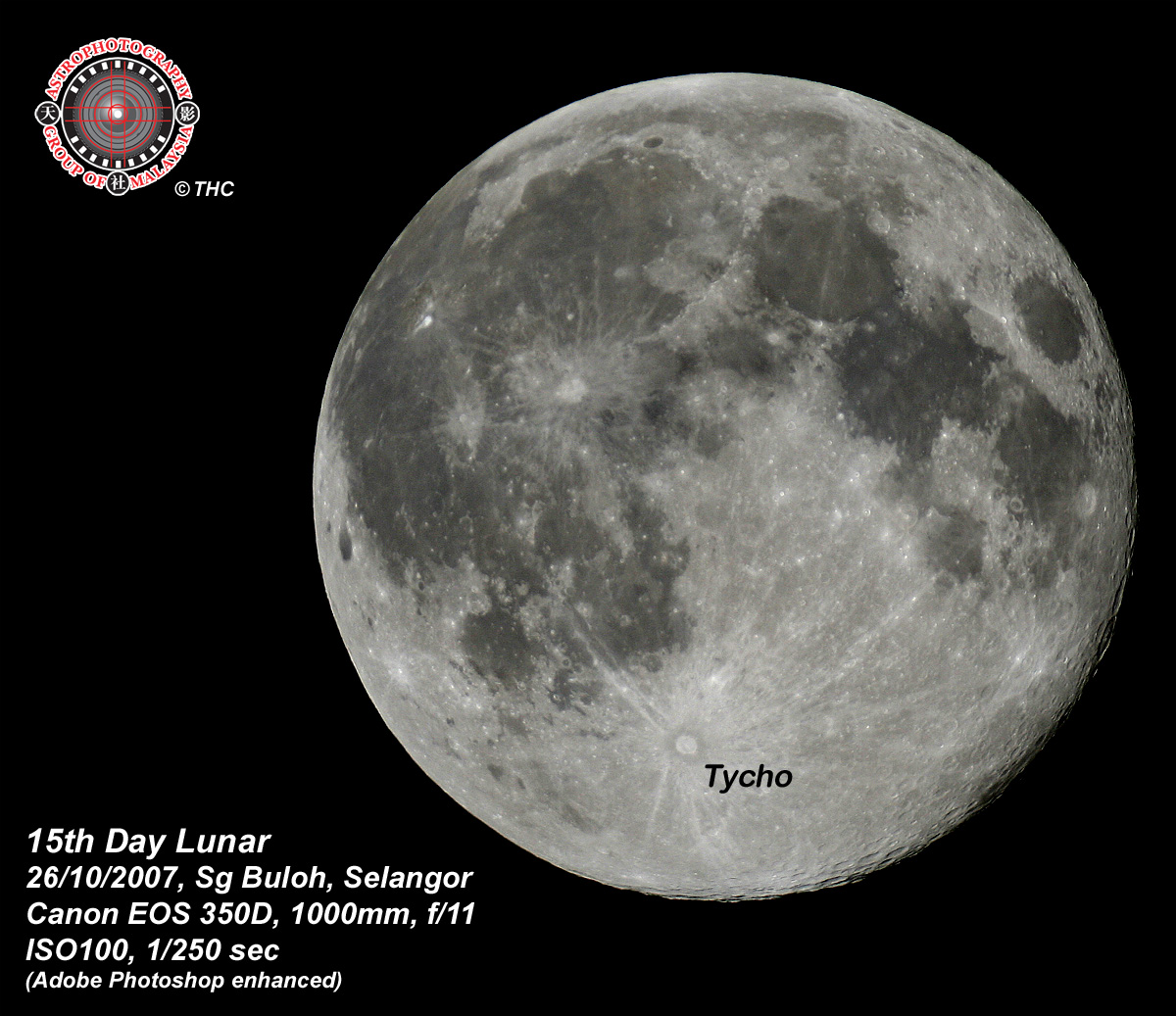
A Tour of Tycho Crater

•July 23, 2008 • 3 Comments

This is just… just… I can’t find a word for it…

tc_012_c_l_TychoRim

I set the image as my wallpaper and suddenly I felt like I was standing on the Moon. Really. Try it, and you know what I meant.

This lunar image is from Kaguya, a Japanese lunar spacecraft currently in orbit around the Moon. It shows the rim of one of the most prominent craters on the Moon – Tycho Crater, named after the Danish astronomer Tycho Brahe.

Tycho Crater, about 84 km across and 4.6 km deep, is located in the southern hemisphere of our Moon. It is one of the youngest large craters on the near side of the Moon, with spectacular rays that are easily visible in any telescopes. These rays were caused by chunks of rock that were ejected when something hits the Moon. And the freshness of these rays tells us that Tycho is young since there has been little time to erode them. If Tycho were old, these rays may have been eroded or erased by later impacts.

Did you click on the images for the high-res version?  No? You have to click it, really, and in no time you will be transported to the Moon…

tc_012_d_l_TychoN

This is the rim on the northern part of the crater.

tc_012_b_l_TychoPeak

This is the central peak of Tycho Crater, about 2 km high. Central peak is formed when the ground rebounds from the compression shock of the initial impact, similar to drop of water bounds up when dripped into a bowl full of water.

After you finish “reading the brochure”, now is time to “start the tour” – a 3D tour into Tycho Crater! (this is a massive file – 20MB, but is worth the waiting)

Less than one year since it was launched, Kaguya has been bringing us unprecedented images of our nearest companion, and sometime even amazing picture of us. Still, I never have enough… keep them coming Kaguya!

Source: Kaguya Image Gallery

Congrats Makemake, you are now no longer just a number

•July 21, 2008 • 2 Comments

How many of you pronounce Makemake as “make-make” or “maki-maki? Hahaha… no, the correct pronunciation is “MAH-kay MAH-kay”.

Artist's conception of Makemake by Ann Feild (STScI)

Makemake, a Kuiper Belt Object (KBO), may have been around our Solar System for billions of years. But only few years back we discovered its existence. And only a few days back it has this officially name.

Formerly it was known as 2005 FY9, 136472 and unofficially called Easterbunny because it was discovered just a few days past Easter in 2005. Makemake was discovered by Mike Brown, Trujillo and Rabinowitz at Palomar Observatory in 2005.

Makemake is not just a Kuiper Belt Object, it is also a trans-Neptunian object, it is also been officially classifed as a dwarf planet, and also a plutoid as well. It is the fourth member of the dwarf planet category after Pluto, Eris and Ceres, and the third plutoid after Pluto and Eris.

Who is this Makemake in mythology? From the official citation:

“Makemake is the creator of humanity and the god of fertility in the mythology of the South Pacific island of Rapa Nui. He was the chief god of the Tangata manu bird-man cult and was worshipped in the form of sea birds, which were his incarnation. His material symbol, a man with a bird’s head, can be found carved in petroglyphs on the island.”

Rapa Nui is also known by its English name of Easter Island.

Makemake is big (I mean big around its neighbourhood. Big is relative, depends on what you compare it to), probably about two-third the size of Pluto. And it is bright (of course this is relative also), the next brightest object in the Kuiper Belt after Pluto. So far, no moon has been found around Makemake.

Because most searches for minor planets are conducted relatively close to the ecliptic, due to the greater probability of finding objects there, one reason Makemake was missed earlier despite its brightness may be due to its 29-degree highly inclination orbit to the ecliptic (Pluto inclination is 17 degrees, whereas the other planets are less than 7 degrees).

Makemake is currently at a distance of 52 AU from the Sun, almost as far from the Sun as it ever reaches in its orbit. In this extremely low temperature environment, its surface is covered with large amounts of almost pure methane ice.

Carnival of Space #63

•July 19, 2008 • Leave a Comment

Carnival of Space #63 is now live at the Angry Astronomer.  As usual, a lot of articles to keep you busy reading.

Movie of Our Moon Transits our Earth!

•July 19, 2008 • 2 Comments

Transits are everywhere in our universe – transits of Mercury or Venus across the Sun, transits of moons across their parent planet, transits of exoplanets across their parent stars.

But the transit I’m going to show you below is nothing we have ever seen before.

Click here for higher resolution.
This is the transit of our Moon across the globe of our home planet! During a full Earth rotation, images obtained by the NASA’s EPOXI spacecraft some 50 million km away at a 15-minute interval were combined to make a colour video. From the video, we see the Moon enter the scene, transits Earth, and then leaves the scene.

Moon transits Earth by EPOXI

This is not the first time we saw our planet and Moon together through the eyes of spacecraft, but this is the first time we were to see them in motion, and to actually see the Moon slowly moves in front of us, and to think back how far we have advance since the first satellite was launched, and to remind us how beautiful and unique our planet is, really make me gasp in awe.

The video above is produced using an infrared-green-blue filter to make the land masses much more visible because plants reflect more strongly in the near-infrared. There is another version of the video which uses a red-green-blue filter, showing how it’ll appear to a human eye.

EPOXI is a new mission using an old spacecraft. The spacecraft is previously used for the Deep Impact Mission, which hurled a 370-kg copper impactor at Comet 9P/Tempel back in July 2005. After it completed its prime mission, proposals were made to utilise the spacecraft further for other purpose – don’t waste, recycle…

So now the spacecraft has not one, but two new extended missions. And these are two very different projects. One is the Deep Impact Extended Investigation (DIXI) of comets where it will observe comet 103P/Hartley 2 during a close flyby in November 2010. The other half is called Extrasolar Planet Observation and Characterisation (EPOCh), where it will observe stars with known transiting giant planets.

Combine EPOCh and DIXI and we have EPOXI.

The video above is going to be useful to help scientists develop techniques to study alien worlds.

“Making a video of Earth from so far away helps the search for other life-bearing planets in the Universe by giving insights into how a distant, Earth-like alien world would appear to us,” said University of Maryland astronomer Michael A’Hearn, principal investigator for the EPOXI mission.

Once in a while, we’ll have to look back at ourselves, so that we can understand others better…

Source: NASA Mission News

Don’t Forget: USM Convention 2008 Starts Tomorrow

•July 17, 2008 • Leave a Comment

“Astronomy and Space – Open Your Hearts”

If you are around the northern region in Malaysia, why not drop by the USM Astronomy Convention and Expo 2008. Lot of interesting activities will be held.

The events will be held from 18 to 20 July 2008 (Fri – Sun) in Main Examination Hall and Padang Kawad of Universiti Sains Malaysia, Penang.

Click here for more infomation.

Star Cluster with 3 Different Birthdays

•July 15, 2008 • Leave a Comment

Introducing NGC6791, a beautiful open cluster located 13,300 light-years away in the constellation Lyra. This is a ground-based telescopic view, taken by Digitized Sky Survey (DSS).

NGC6791 by DSS. Click to enlarge

When we turned Hubble’s eye to this cluster, we see more. Not just thousands of glittering stars in the cluster but also some background galaxies (no, our story today has nothing to do with these galaxies; they are mentioned here only because they are just beautiful).

NGC6791 by Hubble. Click to enlarge.

We know that stars in a cluster formed almost together from the same cloud of dust and gas, thus they are all about the same age. So, if we can determine the age for a couple of stars in the cluster, then we can know when the cluster was formed. Simple, huh?

And as usual, the universe always has surprise waiting for us.

Astronomers, using the Hubble Space Telescope (that gives us the fabulous picture above), found that there are three different age groups in the cluster – 4, 6 and 8 billion years old. Two of these age groups (4 and 6 billion years) were obtained using dead stars known as white dwarfs and the other age group was obtained using the turn-off point of normal stars in Hertzsprung-Russell (H-R) diagram (8 billion years old).

White dwarfs are the demise of low and medium-mass stars like our Sun. When these stars finally run out of fuel, they will start to expand and puff off their outer layer. This will continues until the star eventually blows its outer layers off forming a beautiful planetary nebula, and leaves behind a hot core – a white dwarf.

Once a white dwarf is formed, it’ll not generate any more heat. It’ll just hang around, radiating heat into space for billions of years, as it slowly cools off and finally fades into a black lump of carbon. The best part is that white dwarfs cooled down at a predictable rate – the older the white dwarf, the cooler it is going to be. So by knowing how cool a white dwarf is, we can back-calculate the age of the cluster.

The astronomers got a picture of the cluster, analyse the white dwarfs in it, and they found some are 4 billion years old and some are 6 billion years old. Oh…

NGC6791-white dwarf by Hubble. Click to enlarge

A blow up view of a small region of the above image reveals very faint white dwarfs. The blue circles identify hotter dwarfs that are 4 billion years old. The red circles identify cooler dwarfs that are 6 billion years old. Credit: Hubble Space Telescope.

After extensive analysis, it turns out that probably the “younger” white dwarfs have companion – binary-star systems, where two stars orbit each other. Because of the cluster’s great distance, astronomers see the paired stars as a brighter single star, and brighter star makes the white dwarf looks younger. So these white dwarfs should be 6 billion years old and the problem of two age groups among white dwarfs in the cluster is considered resolve.

Then how about the discrepancy between the 6 billion years old white dwarfs and 8 billion years old normal stars?

Maybe we don’t really understand how white dwarf cooled off… maybe white dwarfs have other ways to evolve that we don’t know… maybe they have different chemical composition than other white dwarfs that we know of… or maybe it is those normal stars are not “normal”…

The mystery is still waiting to be solved…

Source: HubbleSite NewsCenter