Carnival of Space #61

•July 4, 2008 • Leave a Comment

This week theme is Tunguska Edition, marking the 100th anniversary of the Tunguska Event.  100 years ago, a space rock (or ice?) streaked across the sky in Siberia and exploded.  The explosion were heard for great distances, the blast flattened trees for hundreds of square kilometres and the heat can be felt tens of kilometres away. 

Go to Mang’s Bat Page, who host this week’s Carnival of Space, to read more on the event and also lots of other space articles.

USM Astronomy Convention and Expo 2008

•July 2, 2008 • 1 Comment

Again, it’s time for USM Astronomy Convention.

The theme for this year’s “USM Astronomy Convention and Expo 2008” is

“Astronomy and Space – Open Your Hearts”

The events will be held from 18 to 20 July 2008 (Fri – Sun) in Main Examination Hall and Padang Kawad of Universiti Sains Malaysia, Penang. (map to USM, map inside USM).

It is organized by the Astronomy and Atmospheric Science Research Unit of Universiti Sains Malaysia together with the Mufti Department of Penang and the Penang Matriculation College.

Again many activities will be held for teachers, students and members of the public. Many schools, colleges, astronomy organizations and astronomy enthusiasts from all over Malaysia and neighbouring countries have been invited to take part in this year’s event.

The activities include:
  – Academic Seminar on Astronomy
  – Space Exploration Exhibition
  – Telescope Exhibition and Promotion
  – Telescope Clinic
  – Astrophotography Exhibition
  – Public Talks
  – Planetarium Shows
  – Sunspots and Solar Flares Observation
  – Quizzes on Astronomy and Space Exploration
  – Workshop on “Do-It-Yourself Radio Astronomy”
  – Workshop on “Amateur Telescope Making”
  – Workshop on “Water-Rockets”
  – Water-Rockets Launching Competition
  – Two nights of stargazing

The organisers would also like to invite you to bring your telescope/telescopes and other astronomical equipment to Universiti Sains Malaysia for this convention and expo.

Teachers, students and astronomy enthusiasts who are interested to take part in the “USM Astronomy Convention and Expo 2008” can contact the following persons:

(1) Assoc. Prof. Dr. Chong Hon Yew, USM
(e-mail: pearl_of_orion@yahoo.com, h/p: 016-3157318)

(2) En. Jamil Zakaria, USM
(e-mail: jamilzakaria@notes.usm.my, h/p: 012-4577990)

(3) En. Abdul Jalil B. Yahya, Mufti Department of Penang
(e-mail: apocot.80@yahoo.com.my, h/p: 013-5313898)

Attachment:
(1)  Invitation Letter
(2)  Programme

Goodbye Ulysses

•July 1, 2008 • 2 Comments

Still remember Ulysses?

Few months ago, we talk about Ulysses – a spacecraft designed to look at the Sun, and has been out there for over 17 years. After all these years, the spacecraft’s power sources are unable to support its instrument and will cease operations in these few days.

Ulysses

“When the last bits of data finally arrive, it surely will be tough to say goodbye,” said Nigel Angold, ESA’s Ulysses mission operations manager. “But any sadness I might feel will pale in comparison to the pride of working on such a magnificent mission. Although operations will be ending, scientific discoveries from Ulysses data will continue for years to come.”

Ulysses ends its career after revealing that the magnetic field emanating from the sun’s poles is much weaker than previously observed. This could mean the upcoming solar maximum period will be less intense than in recent history.

“Over almost two decades of science observations by Ulysses, we have learned a lot more than we expected about our star and the way it interacts with the space surrounding it,” said Richard Marsden, Ulysses project scientist and mission manager for the European Space Agency (ESA). “Solar missions have appeared in recent years, but Ulysses is still unique today. Its special point of view over the sun’s poles never has been covered by any other mission.”

Ulysses was launched aboard space shuttle Discovery on Oct. 6, 1990. From Earth orbit, it was propelled toward Jupiter by solid-fuel rocket motors. Ulysses passed Jupiter on Feb. 8, 1992. The giant planet’s gravity then bent the spacecraft’s flight path downward and away from the ecliptic plane to place the spacecraft in a final orbit around the sun that would take it past our star’s north and south poles.

Source: JPL News Release

Huge Lenses to observe Dark Energy

•June 29, 2008 • 1 Comment

Dark energy is one of the stuffs in the universe we know what we don’t know. Out there in the universe, we know there is gravity trying to pull things together, but there also exists another mysterious force – we called it “dark energy” – that is trying to pull things apart, which we’re not really sure what it is.

Dark energy entered the scene in 1998. That year, two teams of astronomers, the Supernova Cosmology Project and the High-Z Supernova Search, who were making a survey of supernovae in very distant galaxies in order to measure the expansion rate of the universe with time, found that instead of slowing down, the universe expansion is accelerating!

Supernova in NGC4526

Supernova 1994D in Galaxy NGC4526. Credit: NASA, ESA, The Hubble Key Project Team, and The High-Z Supernova Search Team

We can use supernovae, specifically type Ia supernovae, to measure distances to galaxies. Type Ia supernova happens when a white dwarf in a binary system stealing mass from its normal companion star reaches the Chandrasekhar limit (critical mass) and explode.

Since all white dwarfs achieve the same critical mass before exploding, their luminosities are almost the same and hence can be used as “standard candles” to determine their distances. If they appeared fainter, then it means that the supernova is further away. If we know the distance to a supernova (say 1 billion light-year away), then we can know how long ago it occurred (1 billion years ago).

To measure the expansion rate of the universe with time, we required another piece of information: the redshift of the supernovae. As the universe expands, the light from the supernova is stretched or redshifted (its wavelengths become longer). By looking at how much the light is stretched, we can know how fast the supernova is moving away from us.

redshift

In 1916 Vesto Slipher observed about 50 nearby galaxies, spreading their light out using a prism, and recording the results onto film. The results confounded him and the other astronomers of the day. Almost every object he observed had its light stretched to redder colors, indicating essentially everything in the universe was moving away from us. Here we show the spectrum of a galaxy as Slipher would have seen it. The light is stretched in the bottom spectrum, so that the dark lines (the colours where elements such as sodium absorb light), are stretched to redder colors. Image and caption by Brian Schmidt (leader of the High-Z Supernova Search Team).

Now, by combining the distance and the redshift of a supernova, we can know at a point in time (given by the distance) how fast a supernova is moving away from us (given by the redshift).

If the universe expansion is slowing down, a supernova 1 billion years ago should be moving slower than a supernova 2 billion years ago and a supernova 2 billion years ago should be moving slower than a supernova 3 billion years ago. The expansion is getting slower and slower over time. The opposite goes if the universe is accelerating. Hence, by studying many supernovae at different distances, we can know the rate of expansion with time.

Another way to look at the expansion rate is that if the supernovae are brighter than their redshift indicate, it means that they are nearer than they should have been, hence they are moving away slower than expected, so the expansion of the universe is slowing down.

What the two teams of astronomers found completely changed the way we look at the universe. We long know that the universe is expanding since Hubble’s discovery in 1929, but we are expecting the universe expansion to gradually slow down due to gravity. Instead, the astronomers found that the supernovae are fainter than expected, meaning they are farther away than they should have been and further means that the expansion of the universe was accelerating instead of slowing down as what we expected!

This mysterious force that is causing the universe to fly apart faster and faster is something everyone now calls dark energy. No one understands what it is…

At first, the result was questioned by other researchers: is it possible that the supernovae were dimmed by obscuring interstellar dust lying between us and them? Or maybe the supernovae themselves were intrinsically dimmer and different in the past. But with more data and careful checking, those explanations were discarded; the universe is accelerating, and the dark energy hypothesis has held up.

Another piece of evidence comes from the observation of the Cosmic Microwave Background (CMB) which also strongly suggests that the universe is speeding up.

This stunning discovery told us that there is a whole lot of the universe we don’t know what it is. The result suggests that 4% of the universe is made of ordinary matter – meaning you and me and planets and stars and galaxies and everything we know. The other 22% is dark matter – matter that is weakly interacting and invisible but its presence can be felt by its gravitational effects on surrounding visible matter; something that we’re still trying to figure out what is it. And lastly we are left with a big portion of what we don’t know – 74% is dark energy.

Astronomers are not happy. How can we be comfortable that we only know 4% of our universe?

And we determine to seek for answers…

Enter the Dark Energy Survey

This is a next generation sky survey aimed directly at understanding the mystery of dark energy. An international group of astronomers are constructing a huge sophisticated camera to look for it, with the largest one at one metre in diameter, making it one of the largest in the world.

Recently they have reached a milestone in the construction of the camera. The pieces of glass for the five unique lenses of the camera have been shipped from the US to France to be shaped and polished into their final form. Each milestone will brings us closer to the understanding of dark energy.

The lenses will be polished to a smoothness level of one millionth of a centimetre. Then they will be sent to the Optical Science Laboratory at UCL in London for assembly into the camera and from there to the telescope in Chile, where observations will start in 2011 and will continue until 2016.

Click to enlarge
The largest of the five lenses

The Dark Energy Survey (DES) camera will map 300 million galaxies using the Blanco 4-meter telescope – a large telescope with new advanced optics at Chile’s Cerro Tololo Inter-American Observatory. The vast DES galaxy map will enable the astronomers to measure the Dark Energy far more precisely than current observations.

Prof. Ofer Lahav, head of the UCL Astrophysics Group, who also leads the UK DES Consortium, commented “Dark Energy is one of the biggest puzzles in the whole of Physics, going back to a concept proposed by Einstein 90 years ago. The DES observations will tell us if Einstein was right or if we need a major shift in our understanding of the universe.”

Extra: Hubble Dark Energy Site

Two Galaxies Holding Hands

•June 27, 2008 • 1 Comment

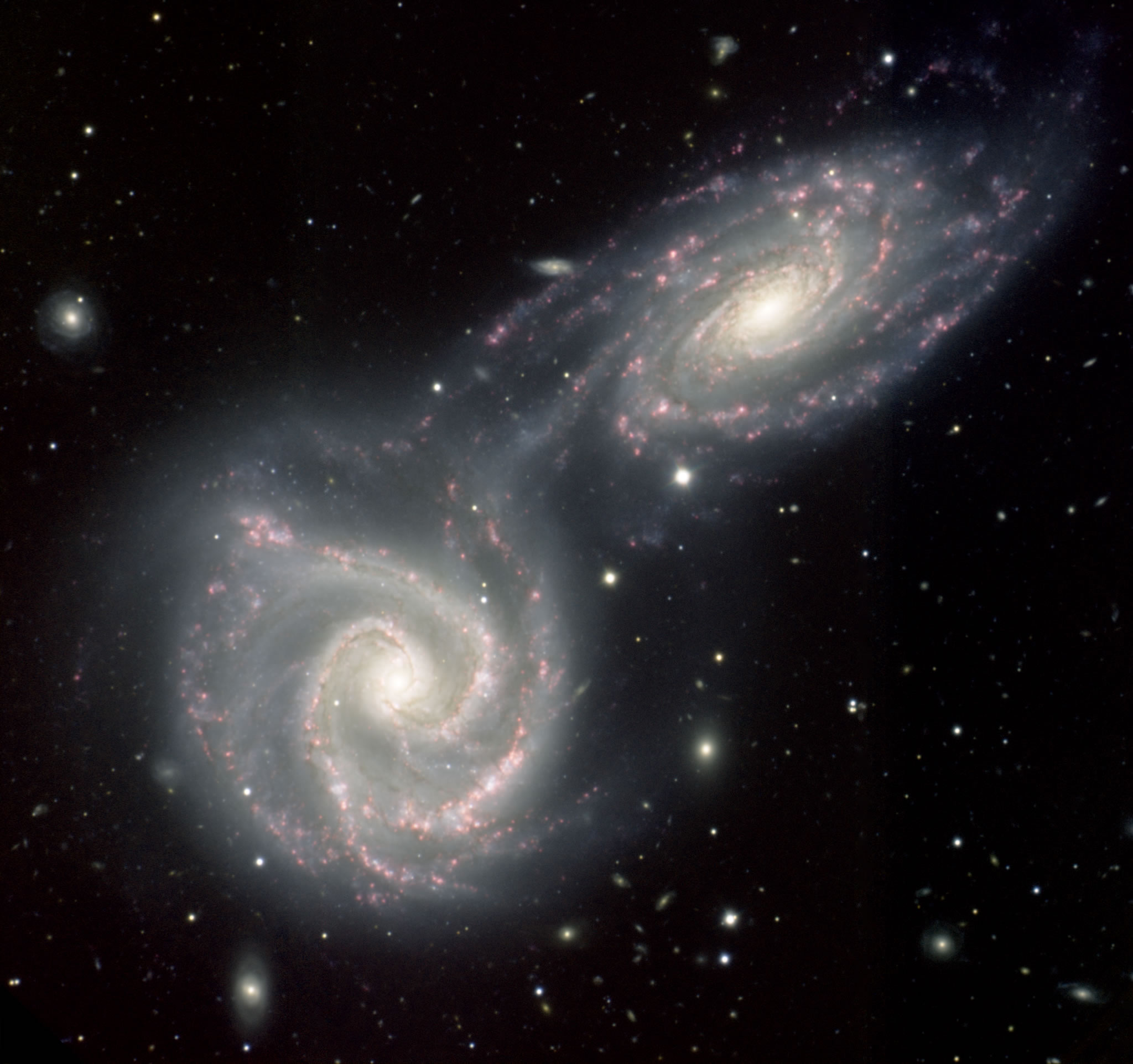
Arp 271 by Gemini South Telescope. Click to enlarge

These two beautiful and almost identical spiral galaxies in Virgo, imaged by the Gemini South telescope in Chile, are NGC5427 (the faced-on spiral galaxy at lower left) and its twin NGC 5426 (upper right). Together, they are known as Arp 271, named after Halton Arp.

Halton Arp is an American astronomer who had catalogues quite a numbers of unusual or peculiar galaxies titled Atlas of Peculiar Galaxies, which almost all of them later turned out to be interacting and merging galaxies, which is quite common in our universe.

At a glance, the galaxies above appear undisturbed and the spiral arms are still intact and distinct. However, mutual gravitational interaction has already begun to alter and distort their visible features. Take another closer look and you will see a bridge of material connecting the two galaxies. This is a tell-tale sign of gravitational interaction between them.

Another sign of interaction between the galaxies is the pinkish knots that trace out the spiral arms in each galaxy. These are the star-forming regions. Where two galaxies gravitationally interacting, the disturbance causes the gases in them collide. This in turn causes the gases to compressed and collapsed to form stars, but not one or two stars, but a whole lot of them – bursts of star formation, or sometime is referred to as starbursts.

Although star-forming regions are common in many spiral galaxies, the ones in Arp 271 are forming at a higher rate, and more plentiful, than expected. Starburst activity can also be seen across the galaxy’s 60,000 light-years connecting bridge.

Arp 271 now is only at their beginning of a violent encounter that will take 100 million years to complete. Over millions of years, the twin galaxies will pass each other, pull back, tangle again… this repeats several times, and finally they will end up as a large and featureless elliptical galaxy, leaving no sign that once upon a time they were a pair of beautiful spiral (except in our pictures on Earth, if we are still around…).

One last thought: The galaxies are 90 million light-years away from us, meaning that the image above was what they looked like 90 million years ago. Today, as we are admiring their beautiful spiral structures in the picture, in reality they may be so distorted that what was left is only a mess, gradually settling down to become an elliptical galaxy.

Source: Gemini Observatory

Gem Island Night Sky

•June 24, 2008 • 3 Comments

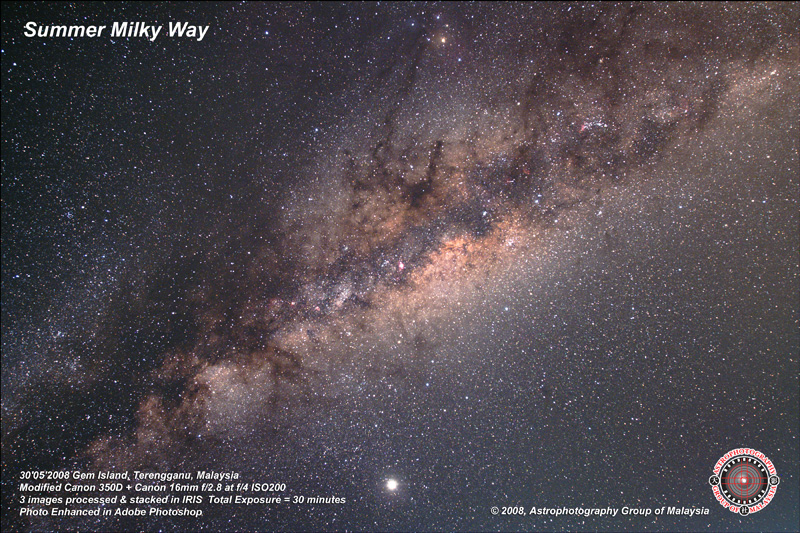
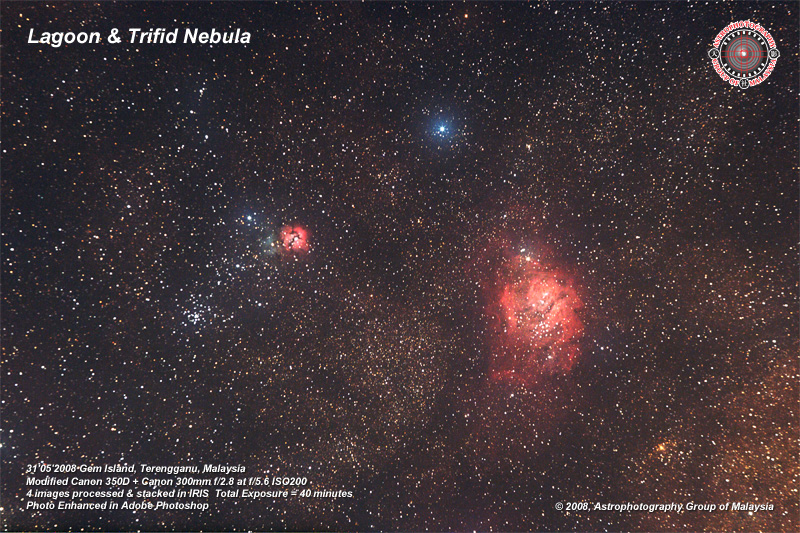
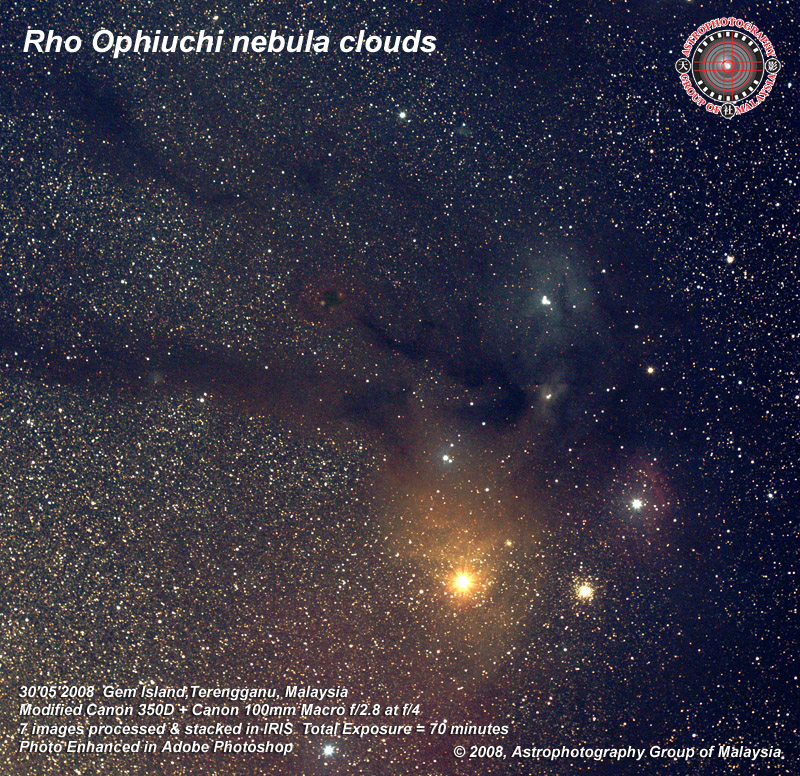
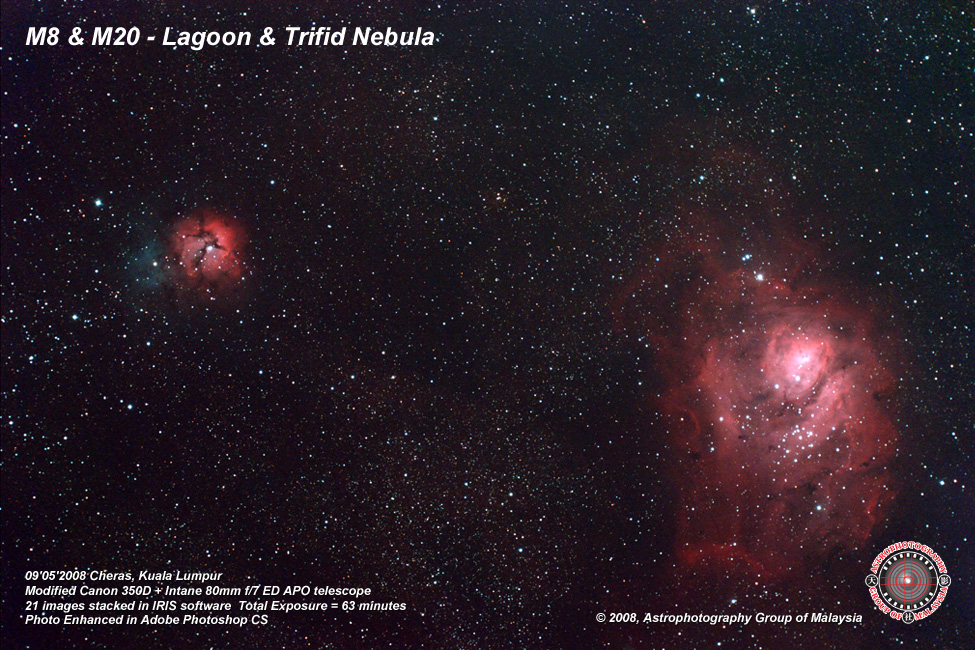
Last month, Astrophotography Group of Malaysia (APGM) went to Pulau Gemia (Gem Island) near Pulau Kapas in Terengganu, for its fantastic night sky.

And they are not disappointed. The night was clear and the Milky Way stretches across the night sky from one end to the other with dust bands visible to the naked eye. So the members setup their equipment and “fired away”.

And these are the astrophotos they captured during that trip.  How much I wish I was there…

Summer Milky Way. Click to enlarge

M8 & M20. Click to enlarge

Rho Ophiuchi. Click to enlarge

It’s a pity… I was supposed to be one of them, but unfortunately, the trip was planned during working days… so… ai…

Summer Solstice

•June 20, 2008 • 3 Comments

Let me remind you of a scary truth…

Second quarter of 2008 is almost gone! How many items in your “to-do-list of 2008” were completed?

This reminder came from the Summer Solstice.

~~~~~~~~~~

Astronomy bugs are all over me, especially reminders of the time of the year. When I look at the calendar, I don’t feel much, but when I look at the night sky, I can have a shock.

“What? That’s Orion in the west? Oh no, another month is gone…”

“What’s that bright thing in the east? Jupiter? in Sagittarius? Oh no, it’s June now!”

“What? Venus in the evening sky now? Oh no, time really flies…”

So today, when I saw the sentence “Tomorrow is Summer Solstice”, you can bet I just went “oh no” again… What have I completed this year? How many items in my to-do-list are marked “DONE!”? What are my plans to “save” the rest of the year so that I’ll not regret that I’ve done nothing when winter solstice is here?

~~~~~~~~~~

So, what is this summer solstice that give me a shock?

Summer solstice (or June solstice) is the time when the position of the Sun is farthest north of the celestial equator.  It happens in June, around the 21st.

In the northern hemisphere, it is widely recognised as the beginning of summer and the beginning of winter in the southern hemisphere. Here at the equator, we will not feel any different, except when you look at the position of the Sun, it will rise in the farthest north of east and set farthest north of west.

The reason why the motion of our Sun seems to move from south to north and back to south again during the course of a year is due to the 23.5-deg tilt of our planet’s rotational axis and our motion around the Sun.

The word solstice is derived from Latin word “solstitium”; “sol” meaning Sun, and “sistere” meaning stand still. When the Sun touches its farthest point north/south, it will “u-turn” back. It is during this changing of direction that the Sun seems to stand still momentarily; hence this point of time is called the solstice.

This year summer solstice happens on 20-Jun, 23:59 UT. This is the first time since the year 1896 that the summer solstice has occurred before June 21.

However, it is 21-Jun, 7:59 am for us in Malaysia.