GLAST Ready for Launch!

•June 2, 2008 • 3 Comments

GLAST means Gamma-ray Large Area Space Telescope. So, in simple words, GLAST is a space telescope looking at gamma-rays.

Gamma-rays are electromagnetic waves just like the type of light we can see, but with much shorter wavelengths and hence much much higher energy. In fact, it is the highest energy photons in the electromagnetic spectrum, billions of times more energetic than visible light.

Electromagnetic Spectrum

The problem is that most gamma-rays coming to Earth cannot penetrate through the Earth’s atmosphere and thus do not reach the ground. So one way to see them is to go to space, up above the atmosphere. That’s why we need a space telescope.

But why do we want to “see” gamma rays?

Our universe is an energetic place; it is full of violent events. These include exploding stars, merging neutron stars, black holes eating materials, streams of hot gas moving close to the speed of light… all these and many more violent events generate gamma-ray radiation.

Observing these extreme high-energy objects can help us to understand some of their mysteries:

  • What is happening to produce this much of energy?
  • What happens to the surrounding environment near them?
  • How do black holes accelerate jets of material to nearly light speed?
  • What is the mysterious dark matter?
  • What mechanism produces the stupendously powerful explosions known as gamma-ray bursts?
  • What else out there is shining gamma rays?
  • What is the origin of cosmic rays?
  • How do pulsars work?
  • How do solar flares generate high-energy particles?
  • How will studying these energetic objects add to our understanding of the very nature of the Universe and how it behaves?

There are so many questions waiting to be answered… and GLAST will help us answer a lot of these questions.


There are a couple of other interesting videos on GLAST at Bad Astronomy.

GLAST is scheduled to launch no earlier than this Thursday, June 5, during a window that extends from 11:45 am to 1:40 pm EDT. Once launched, GLAST will reside in a low-earth circular orbit at 565 km altitude. At this altitude, it will circle Earth every 90 minutes and will be able to view the entire sky in just two orbit, or about 3 hours. And this is important because the gamma-ray sky is constantly changing in stunning ways.
Carnival of Space #56

•May 30, 2008 • Leave a Comment

The #56 Carnival of Space is up now, over at the Lifeboat foundation.

If you think you have not enough of Phoenix and Mars, then you should visit the carnival, there are tons of articles on them to keep you busy.

I think I’ll try to stop talking about Phoenix for the moment unless something very very exciting came about. If you want to follow the progress, then you should visit The Planetary Society Weblog or the Phoenix website.

Phoenix again…

•May 29, 2008 • Leave a Comment

I just came across a very exciting video on the descent and landing of Phoenix by JPL.

Ok, I know the lander has landed safely and also has sent back images, but this video is too exciting not to share it. It shows animations and interviews with engineers on the science of descent and landing of the lander. It really makes my heart beats faster…

Phoenix on Mars by HiRISE

•May 28, 2008 • Leave a Comment

I think this week is going to be a “Phoenix week”.

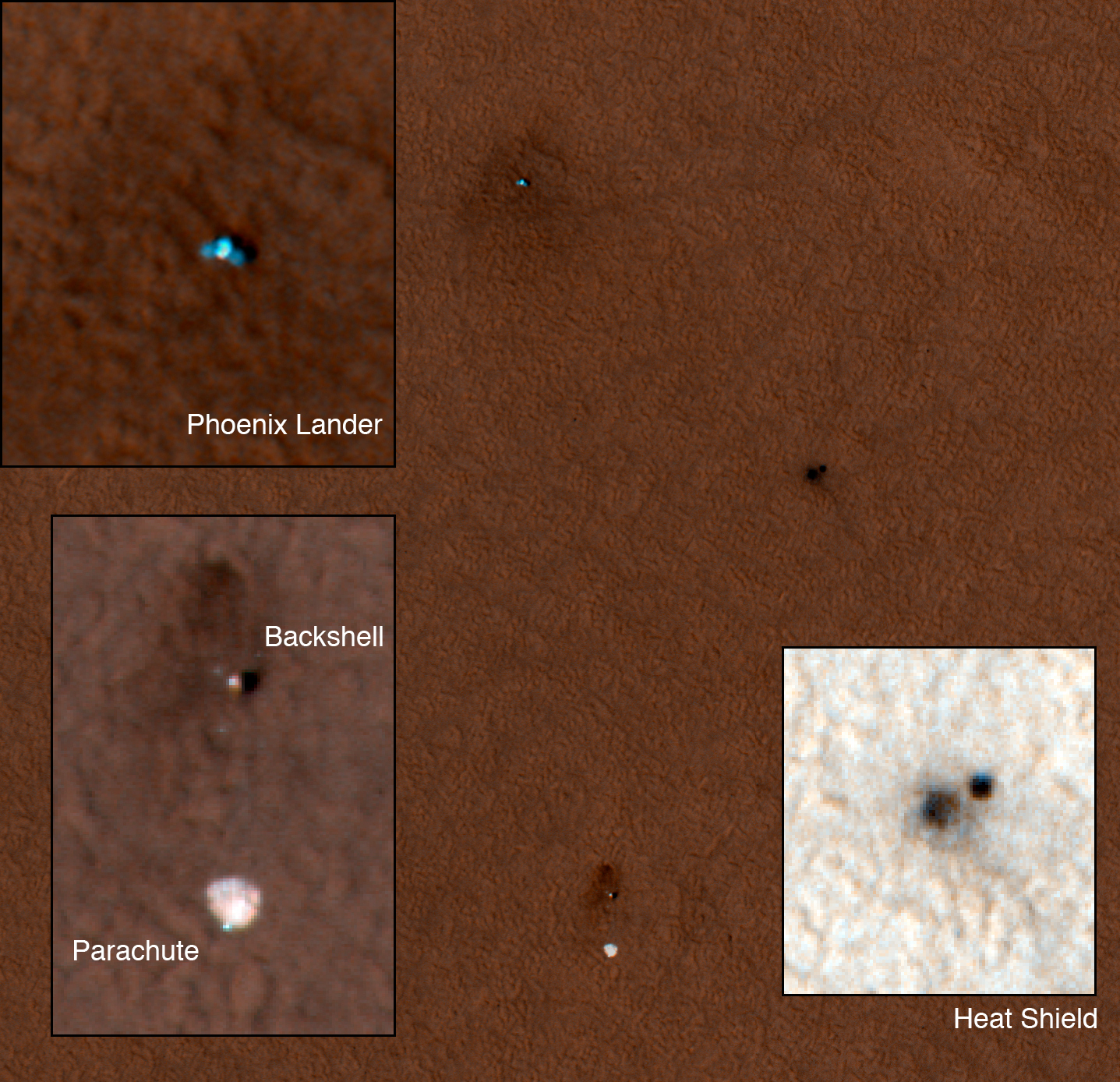
Yesterday we saw Phoenix on its way down to Mars. And today we see the lander sitting on the surface of the Red Planet, together with its parachute, backshell and heat shield, taken again by MRO‘s HiRISE camera.

Phoenix Landing Site & its Hardwares. Click to enlarge.

The Phoenix lander is the bluish object at the top of the image. The solar arrays on each side of the lander are clearly visible, which are 5.5 m across.

The white patch at the bottom of the image is the parachute. Slightly above of the parachute is the backshell, the part that connected the lander to the parachute.

To the centre right is the heat shield. As the heat shield hit the ground, it bounced and landed slight to the upper right (the more defined patch in the inset). The impact and the bouncing left a blurry black patch on the surface.

Look carefully and you will see that there is some disturbance of dust around each object.

The image above shows the view from the top. How about an image of the hardware from the surface?

Phoenix sees it parachute

The white patch near the horizon is the parachute as seen by Phoenix.

For a sense of scale, the parachute is about 300 m away from Phoenix.


A picture that will take your breath away…

•May 27, 2008 • 1 Comment

WOW! This is just fantastic!

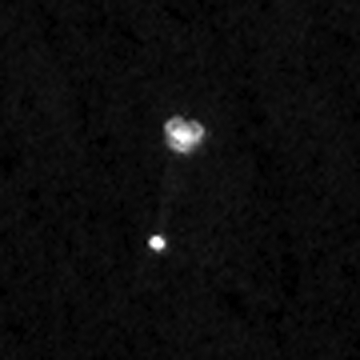
Can you figure out what is that in the image below?

Phoenix by HiRISE-MRO. Click to zoom in.

That is the Phoenix Mars Lander on its way parachuting down to the surface of Mars, taken by the HiRISE camera onboard the Mars Reconnaissance Orbiter (MRO).

A man-made robot orbiting Mars taking a photo of another man-made robot on its way down to Mars! And all this happened at a place hundreds of million kilometres away from us! Wow!

The parachute and the lander are clearly visible, and the most amazing part is that you can even see the lines connecting the lander and the parachute!

This picture is too breath-taking that the Bad Astronomer Phil Plait needed to say something…

Congratulation! Phoenix Landed Successfully on Mars!

•May 26, 2008 • 2 Comments

I know this piece of news is late… I had just came back from outstation…

The good news is that Phoenix Mars Lander had successfully landed in an arctic region called Vastitas Borealis on Mars yesterday.

And the first image of the horizon from Phoenix:

This image, one of the first captured by NASA’s Phoenix Mars Lander, shows the vast plains of the northern polar region of Mars. The flat landscape is strewn with tiny pebbles and shows polygonal cracking, a pattern seen widely in Martian high latitudes and also observed in permafrost terrains on Earth. The polygonal cracking is believed to have resulted from seasonal freezing and thawing of surface ice. Credit: NASA/JPL-Caltech/University of Arizona.

This image shows a polygonal pattern in the ground near NASA’s Phoenix Mars Lander, similar in appearance to icy ground in the arctic regions of Earth. Credit: NASA/JPL-Caltech/University of Arizona.

The image shows Phoenix’s octagonal solar panels, which opened like two handheld, collapsible fans on either side of the spacecraft. Beyond this view is a small slice of the north polar terrain of Mars. The successfully deployed solar panels are critical to the success of the 90-day mission, as they are the spacecraft’s only means of replenishing its power. Credit: NASA/JPL-Caltech/University of Arizona.

This view of a portion of the spacecraft deck and one of the footpads shows a solid surface at the spacecraft’s landing site. Each footpad is about the size of a large dinner plate, measuring 11.5 inches from rim to rim. The base of the footpad is shaped like the bottom of a shallow bowl to provide stability. Credit: NASA/JPL-Caltech/University of Arizona.

The Missing Supernova in our Galaxy

•May 22, 2008 • Leave a Comment

Astronomers always say that our Milky Way Galaxy is long due for supernova – a violent stellar explosion when a star much more massive than our Sun dies, or when a white dwarf pile up sufficient materials from its stellar companion and causes a runaway nuclear fusion and explode.

According to observations of supernovae in other galaxies, astronomers estimated that there should be about three supernovae per century in our galaxy. But the last supernova known in Milky Way was Cassiopeia A, occurred around year 1680.

If the rate of supernova estimation is correct, we should be seeing about 10 supernovae between now and then. But we see none…

Where are they?

These missing young supernovae may imply that that our understanding of the relationship between supernovae and other galactic processes was in error, meaning the estimation was wrong; or maybe the problem lies in our galaxy – although it appears “normal from the outside”, it may be different from other galaxies in some unknown way.

Or maybe the supernovae were there, but we just haven’t found them… maybe they are hiding from us… and this seems to be the case, at least for one of them…

Recently, astronomers from NASA’s Chandra X-ray Observatory and National Radio Astronomy Observatory’s (NRAO) Very Large Array (VLA), have found a supernova remnant as young as only 140 years old, hidden behind a thick veil of gas and dust near the centre of our galaxy.

That’s why we have not optically seen this object before. All the gas and dust there made it about a trillion times fainter, in optical light, than an unobscured supernova. This supernova remnant, called G1.9+0.3, can hide itself in optical, but it cannot hide itself in radio and x-ray; radio and x-ray could see through the murk easily.

This young supernova remnant is known by an uninteresting name: G1.9+0.3, located about 25,000 light years from us. This is a composite of the radio (blue) and X-ray (orange) images. Credit: Radio (VLA) and X-ray (Chandra).

This is not the first time astronomers observe G1.9+0.3. It was identified in 1985 as a supernova remnant, aged between 400 and 1000 years, by using the VLA. In 2007, another team of astronomers led by Stephen Reynolds observed the object again, this time using the Chandra X-Ray Observatory. To their surprise, their image showed the object to be about 16 percent larger than in the 1985 VLA image.

“This is a huge difference. It means the explosion debris is expanding very quickly, which in turn means the object is much younger than we originally thought,” Reynolds explained. However, this expansion measurement came from comparing a radio image to an X-ray image.

To make an “apples to apples” comparison, the scientists sought and were quickly granted observing time on the VLA and their new VLA observations confirmed the supernova remnant’s rapid expansion.

Comparison of VLA images of G1.9+0.3 in 1985 (left) and 2008 (right) clearly show the rapid expansion. Circle for size comparison. Credit: NRAO/VLA

But how does the rapid expansion tell us that this remnant is young?

We know that G1.9+0.3 expanded 16% in 23 years’ time and by extrapolating that backward to a point, we can find all the expanding stuffs were in one point roughly 144 years ago. This is actually the maximum age – if the initial expansion was faster and was slowing down over time, maybe due to slamming into surrounding materials, G1.9+0.3 may be younger.

Now we know that young supernovae do exist in our galaxy, we can be sure that astronomers will look even harder to dig more of them out.