When Mars meets Beehive Cluster (M44)

•May 20, 2008 • Leave a Comment

Mars nowadays is only best observed using the naked eye. With an angular size of a mere 5.8″, it is not at all impressive through telescope.

However, this doesn’t mean we shouldn’t pay attention to it…

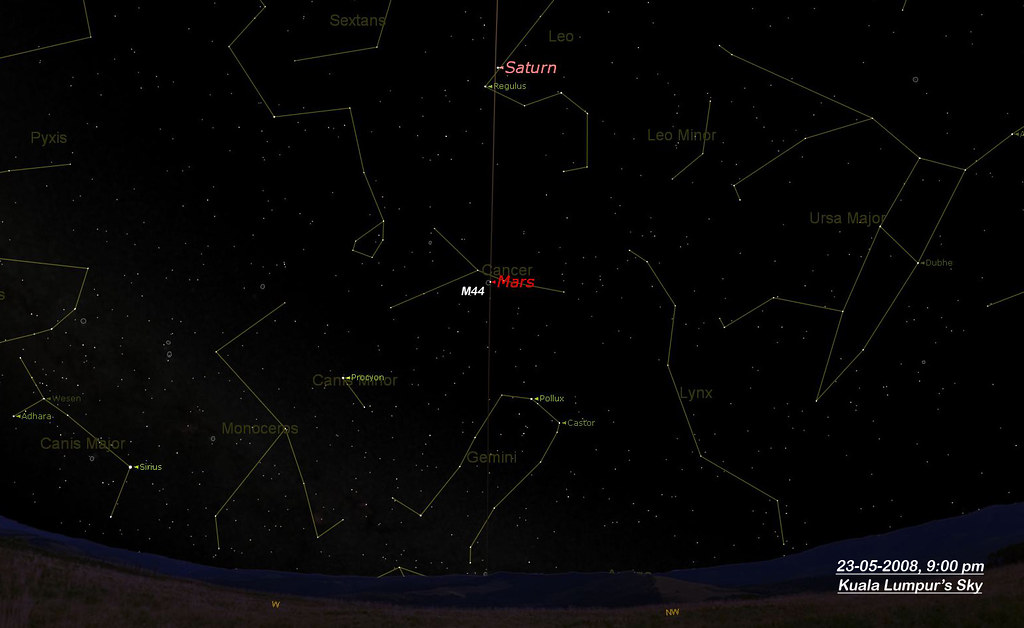
Mars will be meeting up with the Beehive Cluster (or M44) in Cancer. It lies on the northwestern edge of the cluster on May 22. It will pass through northern M44 the following night.

This is definitely going to be a beautiful sight through binoculars or low-power telescope. If you have a dark enough sky, you do not even need any equipment to see them. Mars is shining at magnitude 1 whereas M44 is about magnitude 3.

Mars & M44. Click to enlarge

This “meeting” also offers great opportunity to shoot some nice astrophotographs.

25 May 2008: Phoenix is going to Land on Mars

•May 18, 2008 • Leave a Comment

Time really flies…

It seems like just not long ago Phoenix was launched. And now, it only left days before the landing.

Phoenix Mars Lander is going to join Spirit and Opportunity rovers on the surface of Mars. However, unlike the rovers that can roam around, Phoenix will only stay put in one location during the whole mission.

If everything goes according to plan, the Phoenix will enter the Martian atmosphere at 21,000 km/h. It must then slow itself down by aerobraking, parachutes and retro-rockets, so that it can touch down softly on the surface of Mars.

A short movie showing the launching and landing (animated) of Phoenix by Davin Flateau. (Remember to turn on your speakers)

The greatest risk present on the landing site is large rocks. If Phoenix lands near a large rock, it may tip over, or the rock may prevent the solar panels from deploying properly. This problem, however, seems like not a problem anymore since mission planners have blanketed every corner of the landing area using the HiRISE camera on NASA’s Mars Reconnaissance Orbiter (MRO) and found that no rocks are large enough to pose a threat to the lander.

Phoenix is expected to last three months. Basically its job is scoping up soil and ice and then analyse them to find the answer to the history of water and habitability potential in the Martian arctic’s ice-rich soil.

Stay tuned for the landing!

Phoenix Mars Lander

For more on progress on Phoenix landing, I would like to recommend you to tune in to The Planetary Society Weblog by Emily Lakdawalla.

Carnival of Space #54

•May 16, 2008 • Leave a Comment

This week’s Carnival of Space is hosted at Altair VI. Hopefully it will keep you busy reading for the days to come. Next week I’ll be outstation for the whole week so I won’t be posting much.

However, there are two things to keep track on: (1) meeting of Mars and M44; (2) Phoenix Mars Lander is going to land on Mars on 25-May. I’ll give a brief introduction of them later.

In the meantime, keep yourself busy at Altair VI.

Stargazing Activity at Subang, Selangor on 17-05-2008

•May 16, 2008 • Leave a Comment

Another stargazing activity, this time at Subang, Selangor.

Date: 17-05-2008 (Sat)
Time: 8 – 10:30 pm
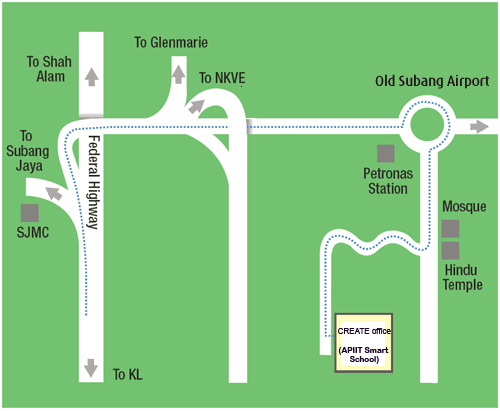
Venue: No. 1, Persiaran A, Off Jalan Lapangan Terbang Subang (near to Selangor Shooting Club, opposite APIIT Smart School)

For further info, contact Bobby 016-2767009 or Pang 03-62758158.

Astrophotography Competition in Negeri Sembilan

•May 15, 2008 • Leave a Comment

Jabatan Mufti Kerajaan Negeri Sembilan with corporation from Jabatan Fizik Universiti Malaya are organising Konvensyen Falak Negeri Sembilan (Astronomy Convention Negeri Sembilan) this weekend.

Date: 16-18 May 2008 (Friday – Sunday)
Time: 10 am to 10 pm
Venue: Masjid Kariah Sikamat, Seremban, Negeri Sembilan

In conjunction with this convention, Jabatan Mufti together with Falak-Online will hold an Astrophotography Competition.

Pertandingan Astrofoto May08

The participation form and more details on the competition can be obtained here.

The submitted astrophotos must be taken only on 16 & 17 May and at Masjid Sikamat, Seremban. The photos have to be submitted by 18 May 2008, 8:30 am.

Deadline for registration is on 17 May 2008, 5 pm.

There will be a total of 8 prizes. First prize is RM1000 cash.

For more info on the competition, please contact En. Shahrin 016-2333565 or En. Muzamir 012-5900943.

Summary of the Astronomy Day in Melaka

•May 13, 2008 • Leave a Comment

Last weekend, I went to the Astronomy Day Celebration in Melaka at Al-Khawarizmi Observatory Astronomy Complex.

I had been to the observatory few years back; from my memory it is a small building with an observatory on top housing a 16″ RC telescope by the seaside.

Old observatory Al-KhawarizmiSo when I drove down to Melaka on Friday night, that was what I’m expecting to see.

Not familiar with the Melaka road, I got lost on the way to the observatory. The map I posted earlier was oversimplified. Luckily there was a roadsign writing “Kompleks Falak Al-Khawarizmi”. I wondered why it was “kompleks falak” (astronomy complex) instead of “balai cerap” (observatory) as what it used to be…

When I finally reached the place, then I know why. I thought I went to the wrong place! The place is no longer just an observatory; there are so many new buildings: auditorium, planetarium, exhibition halls, hostels, cafeteria and another NEW observatory housing a 24″ RC telescope (piggyback 6″ Takahashi)! It’s even bigger than the one in Langkawi (20″ RC) who once hold the record in Malaysia! wow!

Kompleks Al-Khawarizmi

The activities went as planned. A lot of school buses with a lot of students flooded the place. I missed the opportunity to see our angkasawan Dr. Faiz in person (so no picture here :-( because I had to attend a meeting in Melaka town with USM people, to discuss another big astronomy event in Melaka at Dataran Pahlawan, tentatively from 8-10 August 2008. Stay tuned!

Saturday weather was clear. It seems such a long time I didn’t see a blue blue sky… During the stargazing session, we can see the Moon, Mars, Saturn, and a handful of constellations. The public attending the star-party were amazed by the craters of the Moon and the rings of Saturn.

Mars & Moon before Occultation. Click to enlargeMars and Moon before Occultation at 9:17 pm. Credit: thChieh (APGM)

Actually there was an occultation of Mars by the Moon at 11pm last Saturday. I manage to get a shot of the duo together with Castor and Pollux before the occultation. About 10pm the clouds rolled in but on and off we still manage to see them through telescope. I still saw them minutes before the occultation, but I missed the moment when Mars went behind Moon, arrrrggggh…

Overall, it was an enjoyable weekend. I met some people and make new friends. It’s just fun to be surrounded by people who share the same interest.

Send Your Name to Space Again

•May 10, 2008 • 3 Comments

So, you have sent your name to the Moon

Now, how about sending your name again to space, this time on board a spacecraft named Kepler that is dedicated to look for Earth-like planet beyond our Solar System?

Kepler missionBut this time it is more than just fill in your name and hit submit. To let you know more what Kepler Mission is all about, you have to do some homework and write in 100 words or less why you think the Kepler Mission is important. As usual, you will get a certificate for your participation. Your name and message will then be stored on a DVD and Kepler will carry it into space.

Planets outside our Solar System are called extrasolar planets or exoplanets for short. They are nothing new nowadays; astronomers have found hundreds of them since 1994. However, apart from pulsar planets, these exoplanets are gas giant, not a bit earth-like.

So now the question is: “Are there other planets like our Earth out there?”

Kepler will be able to answer that question. It has the capabilities of detecting Earth-size or even smaller planets in the habitable zone of sun-like stars. The habitable zone is the distance from a star where liquid water can exist on the surface of a planet. If is too near, all the water will vaporised; if is too far, the water will be frozen ice.

Kepler will use a technique known as the transit method to find Earth-like planets. When a planet passes in front of a star, we called that a planet transit. (From Earth, we have Mercury or Venus Transit when they pass in front our Sun). When that happens, the planet will blocks a very very small fraction – only 1/10,000 – of the light from its parent star, causing tiny dips in the brightness of the star. (This is like seeing a drop in brightness of a car’s headlight when a fly moves in front of it!). If we see the dips repeating at regular times, we found a planet!

So as not to miss any of these transits, Kepler will stare at the same star field in the Cygnus-Lyra region for the entire four-year mission.

planet transit

We can calculate the size of the planet from the change in brightness. The interval between transits will tell us the size of the planet’s orbit and estimate the planet’s temperature. These qualities determine possibilities for life on the planet.

The deadline to submit your name is 1 November 2008. You have about half a year to really think of the importance of this mission.

This “Name in Space” is an activity in association with the International Year of Astronomy 2009 (IYA2009). Both “Name in Space” and IYA2009 are celebrating the 400th anniversary of the achievements of two giants in astronomy; Johannes Kepler‘s publication of his first two laws of planetary motion and the first astronomical use of telescope by Galileo Galilei respectively.

Johannes Kepler, whom this mission was named after, was well known for his laws of planetary motions. He is the first person to recognise that the orbit of planets around the Sun is an ellipse instead of a perfect circle by using the data collected by his mentor, Tycho Brahe, which were the best available before the invention of telescope.

Go and read the mission and send your name in. Imagine years later you can tell your friends: “Kepler spacecraft has just found the first Earth-like planet around a sun-like star capable of supporting life as we know it… and the cool thing is my name is on it!”

Personally, I think this is a good way to let the public know more about the mission and follow its progress.  It feels like we are also part of the mission, a sense of belonging…