This week’s Carnival of Space is at Space Cynics.
Enjoy the reading!

This week’s Carnival of Space is at Space Cynics.
Enjoy the reading!
 There are so many ways that dangers can fall from the skies. Impact by asteroids and comets, radiations from the Sun, stars exploding nearby, gamma rays burst, cosmic rays attack…
As if all these were not enough…
A recent study by scientists at the Cardiff Centre for Astrobiology found that as our Solar System revolves around the Galactic centre, it does not stay “obediently” in the plane of our Milky Way; it keeps “bouncing” up and down through the plane every 35 to 40 million years.
So what does this has to do with dangers from the skies?
As the Solar System pass through the densest part of the galactic plane, due to gravitational interaction with surrounding gas and dust clouds, it can disturb the orbit of comets and might send them flying our way, towards the Earth, increasing our chances of collisions with comet 10-fold!
And our present position in the galaxy suggests we are now very close to another such period!
Evidence of increase collisions in this time period can be seen on the ground. Craters on Earth suggest that we suffer more collisions approximately 36 million years. The comet that believes to wipe out the dinosaurs 65 million years ago also match the periods of comet bombardment.
When the Solar System is at its “maximum” bounce towards the galactic north, it’s about 100 light years above the plane. This is not a good place to be because of the weakening magnetic fields of our galaxy, in which the magnetic fields are important in protecting us from cosmic rays from outer space. These radiations are bad; they can damage our ozone layer or induce genetic mutations.
On the brighter side, the scientists suggest that impact may have thrown debris containing micro-organisms out into space, helping life to spread across the universe.
This is not totally bad news, at least for the micro-organisms.
This coming weekend – 10 and 11 May – Al-Khawarizmi Observatory in Melaka will be organising the Astronomy Day Celebration.
All are welcome to join in the celebration!
Our angkasawan Mejar Dr. Faiz bin Khaleed will also be there. He will be giving a talk on “Perjalanan Angkasawan Negara ke ISS”.

Where is it?
Kompleks Falak Al-Khawarizmi, Kg. Balik Batu, Tanjung Bidara, 78300 Alor Gajah, Melaka, Malaysia.

~~~~~~~~~~
If you can’t make it to Melaka, it’s ok… you still can go to the Astronomy Week organised by Planetarium Negara in Taman Tasik Perdana, Kuala Lumpur.
As expected, cloudy sky…
So, no eta aquarids for me…
However, I do have a clear sky that I didn’t see for a long time last Sunday night…
I was on my way back from Penang to Kuala Lumpur and the sky along the highway is good, especially near to Ipoh. Before I went to sleep in the bus, I actually saw Orion’s belt and a bright star or two, but that’s it. Then I felt asleep. But when I woke up and look out of the window, wow, staring right at my face is the familiar seven brighter stars of Ursa Major – the Big Dipper.
An old “friend” that I’ve not seen for some time…
Following the arc of the handle, I found Arcturus, very different from the stars around it because of its reddish colour. I tried to continue the arc to Spica, but it was block by the top of the bus. Then I press my face to the window, hoping to catch Leo somewhere higher up in the sky. Yeah… it’s there… the “opposite side question mark” and Saturn also. The person beside me must be wondering why I keep sticking my face to the window.
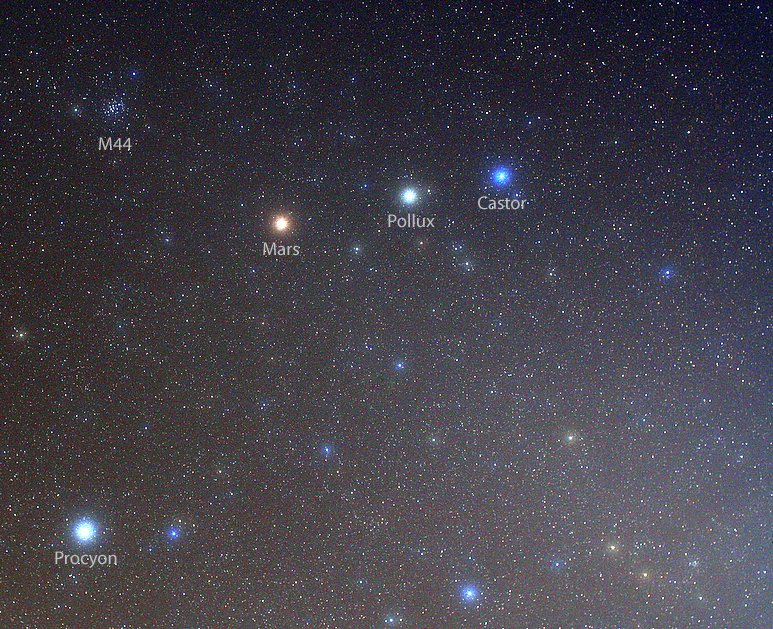
Hoping to catch other constellations, I turned my head the other way. There I saw Castor and Pollux in Gemini, with another reddish bright star nearby, forming a straight line – Mars. There were also some dimmer stars between Big Dipper and Gemini, but I can’t recall what constellations.
Then I reached Ipoh toll plaza. The bright spotlights drown everything. So I went back to sleep.
Later, when I woke up, somewhere around Sungkai, the stars were smiling at me again. This time was the stars from the opposite hemisphere. At first, I couldn’t make out the constellations because some trees were blocking my view (and also still blur blur), but as the trees cleared (and I’m becoming more alert), no mistake that they were the Southern Cross and Centaurus. Very nice! I also managed to see Scorpius and its “bright reddish heart” – Antares.
Then, I started to wonder… I was heading south from Penang to KL, so when I look out of the window, I should be seeing stars from the east (I was sitting on the left side of the bus). Instead, I saw stars sometimes from the north, sometimes from south and other times from the east. This shows that the highway is not a straight north-south route, but a road with curves and turns that are heading different directions some other times.
This is nothing new – there are no 100% straight roads to anyplace, there are hills and rivers and trees to avoid – but it’s fun to think that you can actually prove it by just sitting in a bus and looking at the stars.
Of the five planets known since ancient times, Mercury is the most difficult to see. Because it is the closest planet to the Sun, it always appears in the direction of the Sun in our sky. It can never appear more than 28 degrees away.
Since Mercury is always near the Sun, it can either be seen in the west just after sunset or in the east just before the Sun rises. Not knowing that these two are actually the same objects, the ancient Greek called it Hermes (or Mercury by the Romans) when it appears in the evening and Apollo when it appears in the morning sky. Mercury moves between the morning and evening skies about half a dozen times each year.
 The inferior planets (Mercury and Venus) go through phases just like our Moon because their orbits are between the Earth and the Sun. When these planets, the Sun and the Earth are in a straight line with the planets on the other side of the Sun, we have a superior conjunction. This is the time when we have “full” Mercury or Venus. However, the planets are in the glare of the Sun and thus are not visible.
As they move out behind the Sun, most of their illuminated surface can be seen from Earth, hence they are gibbous phase. As they reach greatest eastern elongation, half of their surface can be seen, hence quarter phase. After that, they will be moving toward the point between the Sun and the Earth – toward the inferior conjunction. Their phase will become crescent and eventually when they reach inferior conjunction, they again lost in the glare of the Sun.
From superior conjunction to inferior conjunction, the angular size of the planets is increasing because they are moving toward us, but their magnitudes are decreasing because lesser and lesser surface are illuminated from Earth point of view.
After inferior conjunction, as the planets move toward greatest western elongation and toward superior conjunction, the opposite applies. The inferior planets are now visible in the morning sky, before the Sun rises.
This month, Mercury will be an evening “star”. It had just coming out behind the Sun and heading towards its greatest eastern elongation. When inferior planets reach their greatest elongation – eastern if visible after sunset and western if visible before sunrise – they are at their maximum angular distance from the Sun in the sky and this is the best time to try to spot them, especially true for Mercury. Greatest elongation for Mercury varies between 18 degrees to 28 degrees due to its elliptical orbit and orbital inclination.
As Mercury emerges behind the Sun, it is gibbous in phase, shining at magnitude -0.9. When it reaches its greatest eastern elongation on May 13, lying 22 degrees from the Sun, its phase changed to quarter, and its magnitude drop to 0.4.
After that, Mercury will “make a U-turn” and heading back toward the Sun again. Its illuminated surface will continue to decrease – getting more and more crescent and fainter – as it moves between us and the Sun. Eventually, it will disappear from our view again below the western horizon by end of the month.
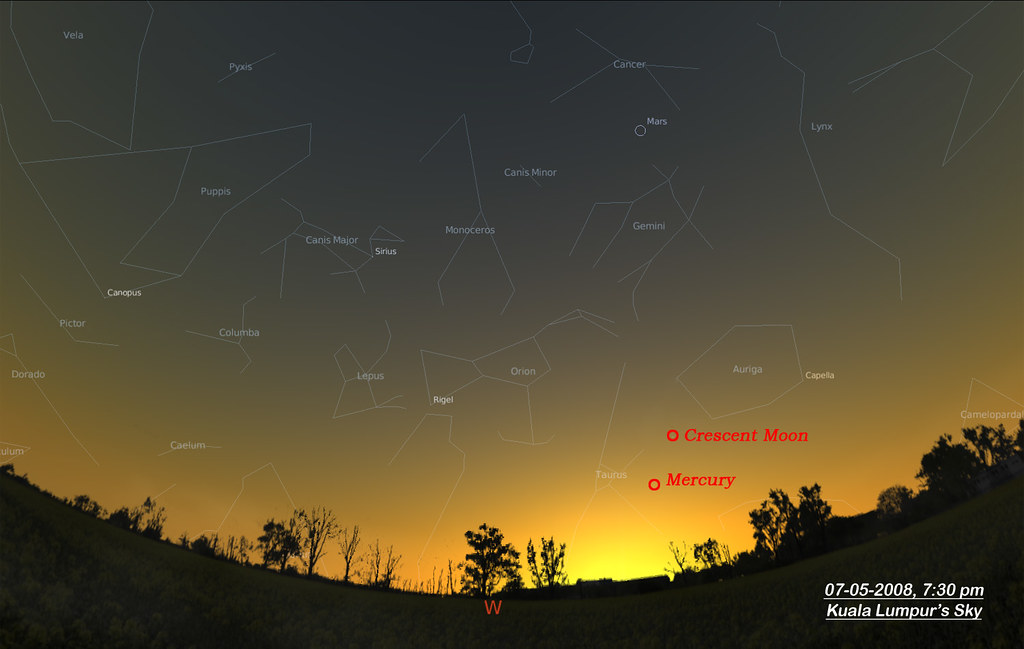
Bonus on May 7: a very thin crescent Moon is about 7 degrees to the northwest of Mercury, barely fit into the same field of view of a binoculars. Click image to enlarge.
Mercury is in Taurus now, not far away from Pleiades or “Seven Sister” but is pulling itself away from the cluster. Mercury is easily visible to the naked eye, provided you have a clear and unobstructed west-northwestern horizon. Binoculars and telescopic view can also be very rewarding. You can follow the phases of Mercury as it thinning to a crescent and growing bigger at the same time.
Let’s go and catch this elusive planet!

This image was taken in Kuala Lumpur in year 2005 during the conjunction between Mercury, Venus and Saturn in the evening sky. Credit: Tang KH (APGM)
After ignoring the Moon for so long, NASA will be returning to it soon, through the Lunar Reconnaissance Orbiter (LRO).
NASA plans to setup a permanent base on the Moon, where it can be a stepping stone for humans to travel to Mars and beyond. This, however, requires detailed understanding of the lunar environment, including finding safe landing sites, locating potential resources and characterise the radiation environment.

And all these will be the jobs of the Lunar Reconnaissance Orbiter. The orbiter, comprised of six instruments and one technology demonstration, will provide the most comprehensive data set ever returned from the Moon. LRO will focus on the factors for human survivals on the Moon, create a comprehensive atlas of the Moon’s features and resources necessary to design and build a lunar outpost.
Scheduled for launch on 31 October 2008, LRO will take only 4 days to reach the Moon. It will first enter an elliptical orbit from which it will move into its final near-circular polar orbit, approximately 50 km above the Moon’s surface. It is plan to be there for at least a year, collecting all the necessary data on lunar conditions.
Now, your name can fly together with this spacecraft to the Moon. NASA invites everyone to join this lunar exploration journey. Sign up here to send your name to the Moon. The database of names will be placed on a microchip that will be integrated onto the spacecraft. By signing up, you will also receive a certificate showcasing your support of the mission.
The deadline is 27 June 2008. Do it now!
It’s time for another meteor shower! The Eta Aquarid meteor shower.
The Eta Aquarids is one of the two meteor showers that originated from the dust released by Comet Halley. The other one is the Orionids, which occurs in October.
Why Eta Aquarids and not just Aquarids, like the Perseids or Leonids? This is because there is more than one meteor shower in Aquarius, so each of the meteor shower is named after the bright star nearest to its radiant. One of them other than Eta Aquarids is the Delta Aquarids, which occurs between mid-July to mid-August.
Every year, Eta Aquarids is visible between April 21 and May 12 and peak on May 5/6. This year is no exception. Wake up early on next Monday morning when this annual meteor shower reaches its maximum activity.
With the Moon out of the way, we can expect to see more meteors. Additional bonus: astronomers think that this year Eta Aquarids could produce more than twice the usual number of meteors. Usually the ZHR is about 30 meteors per hour, but this year the rate could reach 70.
The increase in the shower’s rates may be due to Jupiter. Studies suggest that the rate rise and fall in a 12-year cycle, about the same time it takes for Jupiter to orbit the Sun once. Jupiter, with its strong gravitational pull, may affect the dust streams every time is passes the Eta Aquarid track, sending extra dust particle to Earth.
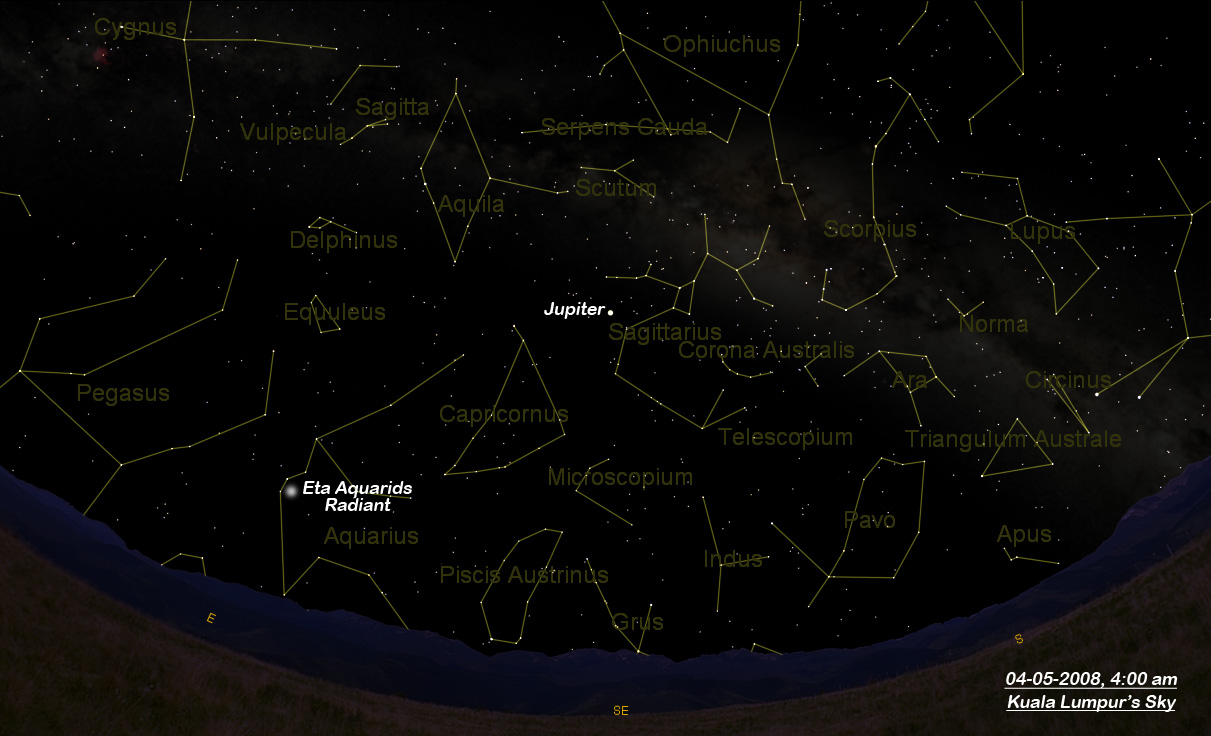
The Eta Aquarids radiant rises to reasonable height about 4:00 am, but you can start observing the shower anytime before that. Click on image for larger star chart.
Eta Aquarids often produces fast and bright meteors. Averagely, the meteors enter the atmosphere at a whopping 67 km/s. About 30% of the meteors leave behind dimly glowing trails called persistent trains. Some can be seen for as long as a minute.
To observed, find a group of at least 5 people, go to a safe, dark and unobstructed site, away from city light or any man-made light polluter. The darker the site, the more dimmer meteors is going to be visible (although in the end the number of meteor visible is strongly dependent on the weather).
Remember, you don’t need any equipment such as telescope to see meteors. All you need is just your naked eyes, which provide you the widest field possible.
To make yourself comfortable, bring along mat to lie down. Lying down flat on the ground is the best position so that we can cover the maximum area of the sky. This position is a bit “dangerous” though, because this is also the best position to fall asleep and the next thing you know might be the Sun rising. Try chit-chatting with friends, this will help to keep you awake, but make sure that your eyes are glue to the sky; you won’t want to miss the show.
Sometime it may be cold in the middle of the night, so a jacket may come in handy. Better still if you can prepare some food and drinks to fill up your empty stomach during the night. Mosquito repellent may also be something useful to bring along.
Hopefully the weather will be fine. I doubt it, however… I can’t even recall when was the last time I see a “clear” moon…
Anyway, clear skies to everyone out there!
To learn more about meteor and meteor shower, go to Meteor Shower ABC.
 My Dark Sky

 My Dark Sky

You must be logged in to post a comment.