Planets Marathon – April 2008

•April 17, 2008 • 1 Comment

Now is a good time to observe planets. All the planets are visible either after dusk or before dawn, except for Mercury, which is too near the Sun to observe this April.

Just after dark, Mars and Saturn are high up in the sky in Gemini and Leo respectively. Mars, although is bright, shining at magnitude 1, is not at all impressive through telescope. Its angular size has shrink since its opposition last Christmas, from 16 arc-second to a mere 6 arc-second now. Currently, Mars is best appreciated just with the naked eye, as a bright red beacon in the sky.

The next planet is more interesting. Saturn, shining brightly at magnitude 0.4, is 2.5 times brighter than Regulus, the brightest star in Leo, which is slightly to the west. Even through a small telescope, Saturn’s rings are easily visible. However, its appearance will change significantly in a couple of years. Saturn rings are “closing” now. We are approaching the “ring plane crossing” period, when the planet’s ring system will tilts edge-on to Earth. Since the rings are so thin, when they are edge-on to us, it seems that the rings have disappeared when view through small telescopes.
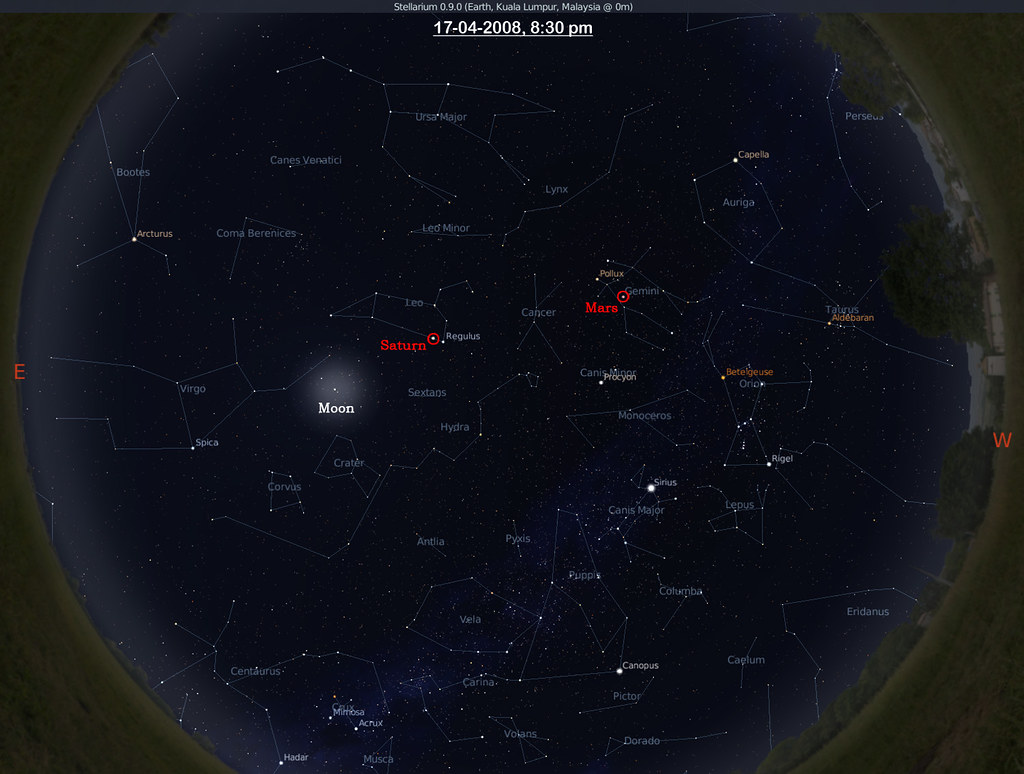
080417 2030

Saturn’s gorgeous rings span 44″ in diameter. Look for the dark Cassini Division that divides the A ring and B ring. Saturn’s disk itself is about 19″. Larger telescope and steady seeing will reveal subtle atmospheric features on Saturn. Also look for the planet’s shadow as it falls on the rings’ far side.

Another easy target when observing Saturn through any telescope is Titan, Saturn’s largest moon. 8th-magnitude Titan will appear as a point of light somewhere near Saturn. Other moons that are also visible are Rhea, Tethys, Dione, Iapetus and Enceladus. Click here to find the location of the moons.

Bonus: Not far to the southeast from Saturn, we have a gibbous Moon. Although the Moon will not disturb our observation of Saturn, the bright glow from our Moon may drown the light from Saturn’s moons. So this may not be a good time to see Saturn’s moons.

Finish? Then go to sleep now. You have to wake up early tomorrow morning to continue the marathon. Set your alarm clock to 6 am.

Let’s continue…

By 6:30 am Jupiter, Neptune and Uranus are up in the sky, whereas Venus is just rising from the east. If you can’t wait until 6 am to see Jupiter, you can actually start observing Jupiter when it rises to reasonable height about 3 am.

Although Jupiter rises at about 1:30 am, it is too near the horizon for detail observation. Usually the best view of a planet is when it is high up in the sky, clear from the horizon. When a planet is low near the horizon, it has to go through more atmosphere and hence more turbulent which tends to blur out details. Light pollution and obstructions such as buildings, trees and mountains near the horizon also hinder observations.

080418 0630

Jupiter now lies in eastern Sagittarius, shining at magnitude -2.2. Jupiter’s disk is about 39″, slightly smaller than Saturn’s rings. It is now big enough to show lots of details in small telescope. Especially prominent is Jupiter’s dynamic atmosphere, featuring parallel bands to the equator across its disk.

Any telescope will show the four biggest moons of Jupiter: Io, Europa, Ganymede and Callisto. They are known as the Galilean moons, because they are first discovered and observed by Galileo. As the moons orbit around Jupiter, there will be times when they pass in front of Jupiter – this is known as transit – and times when they pass behind – occult by Jupiter.

The positions of the moons change every night. It is actually fun to watch them dance around the giant planet: sometimes three moons on one side and one on the other side, sometimes two on each side, sometimes only three moons are visible while another one is “hiding” behind Jupiter.

The next planet is Neptune, which lies in Capricornus, one constellation east of Sagittarius. Neptune shines at magnitude 7.9, so it is not visible to the naked eye. A binoculars or telescope is needed to spot it. It’s not easy, because Neptune appears star-like in binocular; it looks the same as the background stars. However, due to its nearer distance to us, it can actually give itself away by moving against the background stars. So observe the same area for few nights up to a week or two while plotting down accurately the stars in the field of view. Compare those plots and find the “star” that moved. The “star” that moved is Neptune.

Another constellation east in Aquarius is Uranus. Shinning at magnitude 5.9, Uranus is barely visible to the naked eye. Uranus, same as Neptune, appears star-like in binocular.  However, since Uranus is bigger than Neptune and also nearer, a medium-sized telescope under reasonably steady skies will show its small greenish-blue disk, revealing it as a planet and not a star.

And lastly, the brightest of all planets, is the morning “star” – Venus, shining at magnitude -3.8. If the eastern horizon is clear, Venus is too bright to be missed. Even as the sky brightens, Venus still be able to pierce through, usually mistaken by many people as a man-made satellite.

Oh oh, one more… as the Sun rises, look down at your feet, and you will see the most familiar planet of all – mother Earth.
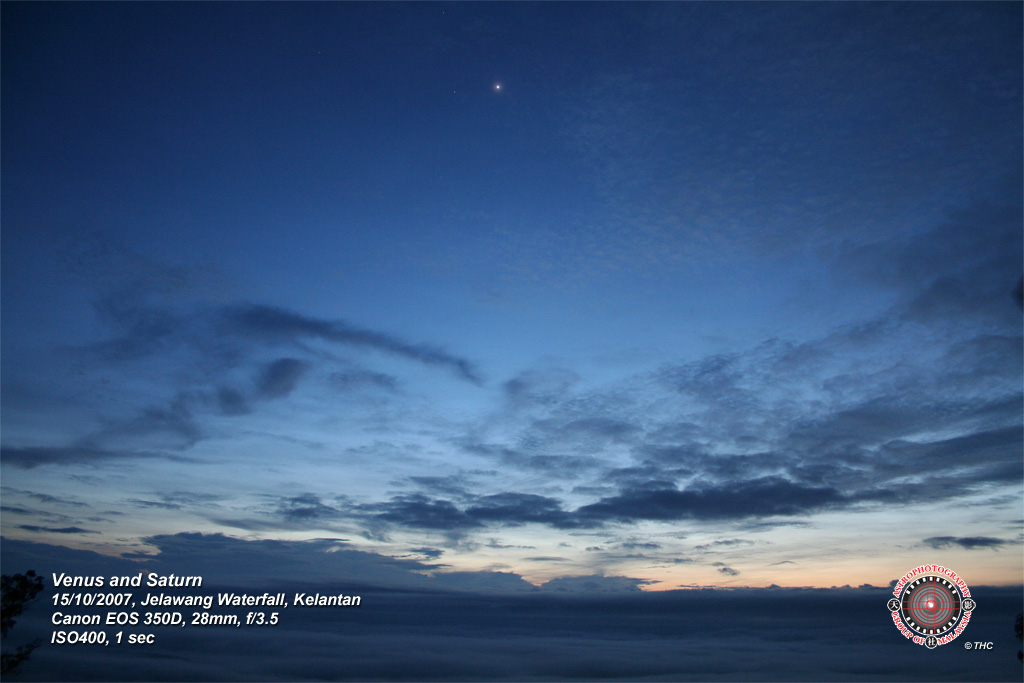
Venus Saturn Kelantan
Click on photo to enlarge

This picture is taken last October during a trip to Jelawang Waterfall and Gunung Stong in Kelantan, Malaysia. This is a view on top of the Jelawang Waterfall where the campsite is located. The very bright point of light near the top of the picture is Venus, and to the left, barely visible, is Saturn.  Credit: thChieh (APGM).

Common Stargazing Terms #2

•April 16, 2008 • Leave a Comment

Magnitude
This is a number (unit) used to indicate the brightness of astronomical objects. This measurement is a bit funny because the smaller the number, the brighter the object. Some very bright objects can have negative magnitudes. For example, the brightest star in the night sky, Sirius, shines at magnitude -1.4.

Each step in magnitude corresponds to a brightness difference of a factor of 2.5. For example, 1st magnitude is 2.5 times brighter than 2nd magnitude and so on. The limit of our naked eye under good sky condition is about 6th magnitude.

Usually when we talk about magnitude, we meant the magnitude of an object as view from Earth regardless of their distance. We called that the apparent magnitude. But if we want to know which object is intrinsically luminous, all the objects have to be at the same distance from us before we can compare them. What we do is we let all the objects “stand” at a standard distance of 10 parsecs from Earth and we determine their magnitude. This is known as the absolute magnitude.

When we say an object is bright, what are we trying to say? Is it because it is near, that’s why it looks bright? or because intrinsically it is very luminous, although it is very far away, it still appears bright as view from Earth? This is where the apparent magnitude and absolute magnitude can tell us something. For example, our Sun has an apparent magnitude of -26.8, but its absolute magnitude is only +4.8. So we know that our Sun is not that luminous intrinsically, it appears bright in our sky only because it is very near.

This magnitude system was introduced around 129 BC by Greek astronomer Hipparchus. Click here for more info and the history of the magnitude system.

Angular Distance and Angular Size
The angular distance between two objects or the angular size of an object is given in degree (°), arc-minute (‘) or arc-second (”). 1 degree is equal to 60 arc-minute and 1 arc-minute is equal to 60 arc-second.

angular distance_size

The diagram below gives an estimation of the distance by using our fingers or the big dipper .

sky measure

Common Stargazing Terms #1

•April 15, 2008 • Leave a Comment

The universe is too big, the kilometre unit for distance is no longer sufficient to conveniently represent the vast distances between stars and galaxies. We need new units, units that are much much larger than the kilometre to avoid too many zeros at the back. Introducing the astronomical unit (AU), light-year (ly), and parsec (pc).

Astronomical Unit (AU)
This is equal to the mean distance between the Earth and the Sun. 1AU = 149,598,500 km, or simply 150 million km.

Light-year (ly)
This is equal to the distance light travels in one year. 1 ly = 9.5 x 10^12 km.
Light travels at about 300,000 km/s, so it travels 300,000 km/s x 3600 s/hr x 24 hr/day x 365.24 days/year = 9.5 x 10^12 km/year.

ParsecParsec (pc)
This is the distance at which an object would have a parallax of one arc-second (1″). 1 pc = 3.26 light-year.

Parallax is a common phenomenon; it is the apparent difference in the position of an object when an observer’s position is changed. The simplest test you can do is close your right eye and place a finger in front of you, now open your right eye and close your left eye, you can see that the position of your finger seems to change. It is not that your finger is moving, it is the eye’s position that had changed (right eye to left eye).

The same thing happens in the sky. Our Earth is constantly revolving around the Sun. Hence the position of some nearby stars will have parallax as we changed our position in space. The distance at which a star would have a parallax of one arc-second is called one parsec. Parsec actually is short for “parallax of one second of arc”.

This distance, d is derived using simple trigonometry. 1″ = 1/3600 deg. Hence tan (1/3600) = 1AU / d => d = 1AU / tan (1/3600) = 206264.8 AU = 3.26 light-years.

For larger distance, kiloparsec (kpc) or even megaparsec (Mpc) is used. 1 kpc = 1000 pc and 1 Mpc = 1000 kpc.

Expedition 7 to ISS

•April 15, 2008 • Leave a Comment

Today while I was browsing through the pictures in APOD, I came across this picture that I really must share it with you…

Expedition 7
Click on the picture to enlarge.

This is a view of Earth’s horizon as the sun sets over the Pacific Ocean. It was taken by the Expedition 7 crewmember on board the International Space Station (ISS). Especially caught my attention is the long shadows cast by the clouds.

Here we are at the terminator (the day-night line). The bottom part of the picture had just entered into the night, and the top part is still at dusk, where it will turn dark soon as our Earth rotates. Also visible are the golden reflection of the Sun on the sea, the whitish cloud tops, the bluish airglow layers at Earth’s horizon and the darkness of space.

Since I was in the Expedition 7 archive pictures, I went through some of them and found some beautiful one.

Expedition 7

Backdropped by Earth’s horizon, an unpiloted Progress supply vehicle approaches the International Space Station (ISS).

Expedition 7

Close-up view of the eye of Hurricane Isabel.

Expedition 7

A gibbous moon is visible in this view of Earth’s horizon and airglow.

Expedition 7

This image shows the limb of the Earth at the bottom transitioning into the orange-coloured troposphere, the lowest and most dense portion of the Earth’s atmosphere. The troposphere ends abruptly at the tropopause, which appears in the image as the sharp boundary between the orange- and blue- colored atmosphere. The silvery-blue noctilucent clouds extend far above the Earth’s troposphere. The sliver of the setting moon is visible at upper right.

~~~~~~~~~~

Expedition 7 is an old expedition to ISS, launched on 25 April 2003. The current expedition is Expedition 17 launched on 8 April 2008.

John Archibald Wheeler, 1911 – 2008

•April 14, 2008 • Leave a Comment

John Archibald Wheeler, an American great theoretical physicist, died yesterday.

I’m not in the field of physics, so I do not know this giant, until I read a book by Kip Thorne – Black Holes and Time Warps: Einstein’s Outrageous Legacy. I got the book from Borders bookstore few months ago at about RM80. This book centres around the history of black hole research, and the other area of science such as relativity, nuclear physics, astronomy, astrophysics that led to breakthroughs in black hole research.

This may be an old book (published in 1994), but it’s still a good read if you are really interested in the history of black hole. It told the story of how black hole at first was rejected, people just can’t believe that such an exotic thing exist in the universe, to how people begin to accept it, to understand it, to search for it, to… I have not yet finished the book, so that’s all I can say…

Wheeler was Kip Thorne’s mentor; the book I mentioned above by Thorne is dedicated to him. Wheeler was mentioned quite a lot in the book, because of his great contributions to the research of black hole and other aspect of general relativity. In fact, he was the one who invented the term “black hole”. Wheeler was also involved in the development of the atomic bomb during World War II and later in the development of hydrogen bomb. (It was all mentioned in the book, that’s why I know :-))

Wheeler will be remembered not only as a great physicist, but also as a fine mentor and friend to his many students. I do not know him well to give much comment, so I’ll just point you to a reference.

A tribute to Wheeler by one of his students – Daniel Holz – at Cosmic Variance.

Omega Centauri in Infrared

•April 13, 2008 • Leave a Comment

Another beautiful image of Omega Centauri, a globular cluster (or dwarf galaxy?) in the southern sky. This image is taken by NASA’s Spitzer Space Telescope, which study the universe in infrared light, that’s why the colour looks different to the one taken by Hubble Space Telescope.

Omega Centauri by Spitzer

In this false colour view of Omega Centauri, Spitzer’s infrared observations have been combined with visible-light data from the Blanco 4-meter telescope at Cerro Tololo Inter-American Observatory in Chile. Credit: NASA/JPL-Caltech/ NOAO/AURA/NSF

This image is a combination of visible light (near the red end) and infrared light, relatively the visible light is “bluer”, thus it is represents by blue colour and the red represent the infrared data. So the “blue” stars actually are not blue, according to our eye they will look orange red.

Globular clusters are one of the oldest objects in the universe. In some cases, they can be almost as old as the universe itself. Since high-mass stars live a shorter life*, all of them in the cluster have already died by now, going supernovae and leaving behind black holes (if they were massive enough) or neutron stars. Those of medium-mass may have long blown off their outer layer and became planetary nebulae, leaving behind white dwarfs.

So what are left now are only low-mass stars, which can live up to billions of years. But most of them by now may have also evolved into red giants, puffing off their outer layers, contributing dust to the cluster. However, Spitzer found very little dust around any but the most luminous, coolest red giants, implying that the dimmer red giants do not form significant amounts of dust. The space between the stars in Omega Centauri was also found to lack dust, which means the dust is rapidly destroyed or leaves the cluster.

The red giants seen by Spitzer are the yellow and red dots in the image above. The stars that appear blue are less evolved. Red giants emit most of their light in infrared because they are cooler and because of the reddening of lights by the dust that surrounds them.

~~~~~~~~~~

*High-mass star needs to burn its fuel faster in order to produce enough energy to keep it from collapsing under its own huge gravity (bigger mass bigger gravity). Burn fuel faster = run out of fuel faster = die faster. The opposite goes for low-mass stars.

Subscribe to My Dark Sky by Email

•April 11, 2008 • Leave a Comment

Some of you may not be free to visit this blog everyday.  So, to keep you all up-to-date of the latest posts, I have added a new feature “Subscribe to My Dark Sky by Email”.

At the top of the sidebar on the right, you will see the new feature “Updates by Email”, click on the “Subscribe to My Dark Sky by Email” link and it will bring you to a page where you can fill up your email address and submit.  Then go to your email inbox, activate your subscription and you are done.  All updates now will be sent to your inbox directly.

Thanks for your support!