Beautiful Martian Moon – Phobos in Colour

•April 11, 2008 • Leave a Comment

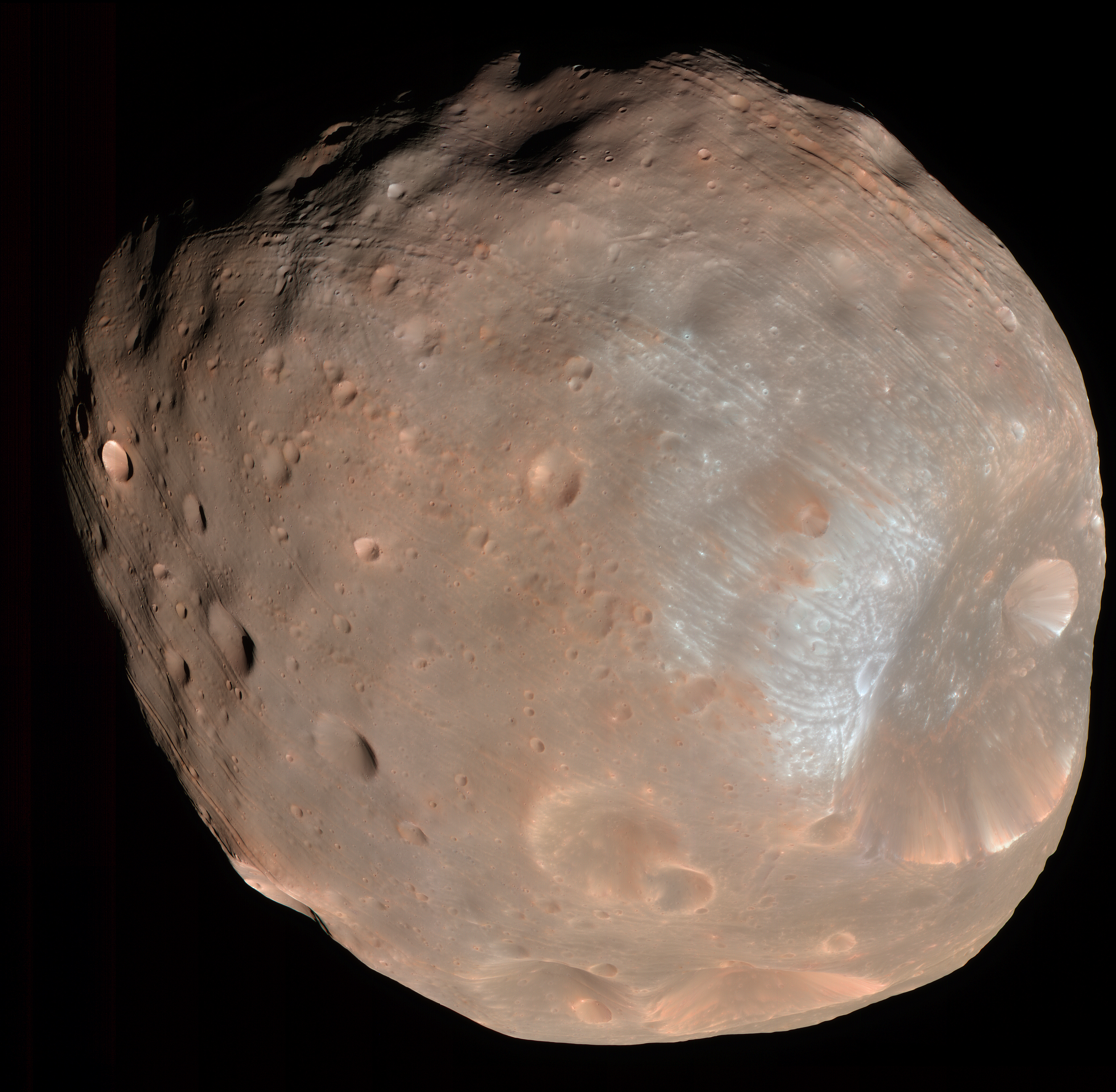
Mars has two moons, Phobos and Deimos, which are very tiny and potato shaped.  The bigger and the inner one is Phobos, about 22 km across. 

A lot of images of Phobos have been taken before, but the recent one by HiRISE camera onboard the Mars Reconnaissance Orbiter (MRO), a spacecraft currently orbiting Mars, is really breathtaking!

Phobos_HiRISE

On 23 March 2008, HiRISE took two images of Phobos 10 minutes apart.  Phobos was 6800 km away when the HiRISE camera took the first photograph and 5800 km away when the second picture was took minutes later.  The different angle of these two images was combined to give a stereo view.  Credit: NASA/JPL/University of Arizona.

“Phobos is of great interest because it may be rich in water ice and carbon-rich materials,” said Alfred McEwen, HiRISE principal investigator at the Lunar and Planetary Laboratory at the University of Arizona, Tucson.

The most prominent feature in the images is the large impact crater Stickney, in the lower right. With a diameter of 9 km, it is the largest feature on Phobos.  A series of grooves and crater chains is obvious on the other parts of the moon.  Although many appear radial to Stickney in the images, previous studies show that the grooves radiate from a different point on Phobos.  Some scientists believe the grooves and crater chains are related to the formation of Stickney, whereas others think they may have formed from ejecta from impacts on Mars that later collided with Phobos.

Source: JPL News Release

~~~~~~~~~~

If you like to have” your own Phobos”, you can actually make one.  Visit The Planetary Society Weblog to see how.

Phobos modelPhobos model_done

Constant-scale natural boundary map of Phobos
This map of Phobos can be cut out and assembled into a good three-dimensional representation of the odd-shaped moon of Mars. The map was produced through a technique called constant-scale natural boundary mapping, developed by Georgia architect Chuck Clark. Credit: Chuck Clark / Phobos base image by USGS.  Images copied from The Planetary Society.

Spring Sky Observation at Ulu Yam, Selangor

•April 10, 2008 • Leave a Comment

Starfinder Astronomical Society is organising a Spring Sky Observation this coming saturday.  Details as follow:

Date: 12/04/2008 (Saturday)
Time: 9 pm onwards
Venue: P2 car park, Ulu Yam, Selangor

For more information, please contact Pang 016-9531210, Mo 019-3520592, Tommy 016-2230048 or Tang 019-3313240.

Click here for some desciptions of the spring sky by Starfinder, unfortunately, it is only in Chinese.  I will not translate the whole article here, but basically it is describing the constellations and stars that are visible such as Leo, Virgo, Corvus, Centaurus, Crux, Bootes, Big Dipper (Ursa Major), Spring Triangle etc.

Clear Skies!

Always look up… n u will be rewarded with the beauty of the night sky…

Solar Flare by STEREO

•April 10, 2008 • Leave a Comment

On 25 March 2008, three big sunspots materialized on the Sun and one of them, sunspot 989, unleashed an M2-class solar flare, an intense, rapid release of energy from a localised region on the Sun.  It was also associated with a coronal mass ejection (CME), which are huge bubbles of materials that erupt from the Sun’s corona.

This flare was captured by STEREO, a twin spacecrafts designed specially to observe the Sun.  Movie: MPEG (10MB), Quicktime (2MB, 30MB).  The movie shows about 14 hours of activity.

STEREO-Flare

Three active regions were lined up across the centre of the Sun.  The one on the far left produced the flare and CME.  A careful look at the middle region reveals a burst of activity just before the flare blasts from the area to its left.  This image is taken in extreme ultraviolet “light”, the light that our eyes cannot see, that’s why the Sun is not the familiar yellowish reddish colour.  Credit: NASA/STEREO

STEREO header

STEREO (Solar TErrestrial RElations Observatory), launched in 25 October 2006, is a 2-year mission employing two nearly identical space-based observatories to provide the first-ever, 3-D “stereo” images of the Sun.  One observatory will be placed ahead of Earth in its orbit around the Sun and the other behind.  Just as the slight offset between your eyes provides you with depth perception, this placement will allow the STEREO observatories to obtain 3-D images and particle measurements of the Sun.

Click here for STEREO fact sheet.

Automated Transfer Vehicle – Jules Verne

•April 8, 2008 • Leave a Comment

Spaceships are getting smarter and smarter… oops… I mean the humans who created them.

Currently the “visitor” at International Space Station (ISS) is Jules Verne, European Space Agency’s Automated Transfer Vehicle (ATV).  This robotic cargo uses it own onboard intelligence and optical sensors for navigation, becoming the first spacecraft to perform a fully-automated docking with the ISS.  Human guidance is not required here!

Jules Verne

Jules Verne historic first fully-automated docking with the ISS takes place on 3 April 2008, smoothly and safely.  It was launched on March 9 on board an Arianne 5 rocket from Kourou, French Guiana.  The docking on April 3 ends a 26-day journey for Jules Verne.  Jules Verne is seen here backdropped by the airglow of Earth’s horizon and the blackness of space.
Jules Verne cylindrical body is 10.3 m long with a diameter of 4.5 m.  The solar arrays span 22.3 m.

Jules Verne carried around 8.3 tonnes of wet and dry cargo with an additional 2.3 tonnes of cargo support hardware to ISS.  Among the cargo are 500 kg of food and 270 kg of water for the crews, 80 kg of clothing and 20 kg of oxygen.

Apart from delivering cargo to ISS, this cargo ship will also re-boosts the station to a higher altitude to compensate for the atmospheric drag, where the Station’s natural altitude loss can reach up to several hundreds of metres a day.

Jules Verne will remain attached as a pressurised and integral part of ISS until August.  Eventually when it is leaving in August, it will take away a substantial load of garbage from the station.  After that, it will start a destructive re-entry into the Earth’s atmosphere during which it will break up and burn, together with all the garbage from the station.

From 2008 onward, the Automated Transfer Vehicle (ATV) will be one of the indispensable ISS supply spaceships.   Jules Verne is the first in a series of ATV that will prove crucial to ISS operations after the space shuttle retires in 2010.

Saturn and its moons – Titan & Tethys

•April 6, 2008 • Leave a Comment

Saturn, Titan & Tethys

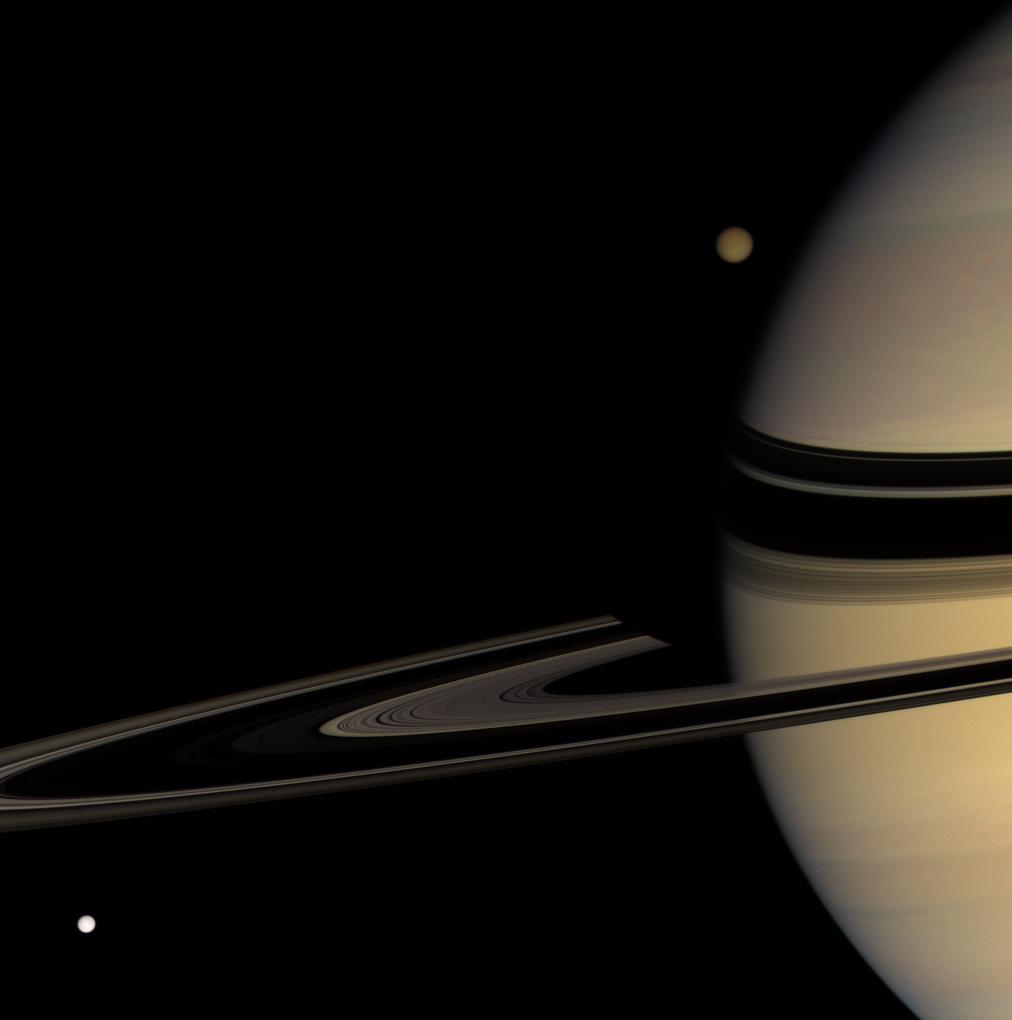
This image was acquired with the Cassini spacecraft wide-angle camera on Jan. 30, 2008 at a distance of approximately 1.3 million km from Saturn.  The view looks toward the unilluminated side of the rings from about 3 degrees above the ringplane.  Credit: NASA/JPL/Space Science Institute

Titan is the largest moon of Saturn, with a diameter of 5,150 km.

Tethys is the 5th largest moon of Saturn, with a diameter of 1,071 km.

Titan (top right) emerges from behind Saturn, while ice-covered moon Tethys (bottom left), streaks into view, in this colourful scene.  Notice that Saturn’s shadow darkens the rings near the limb.  The dark strips on Saturn’s globe are the rings shadow.

The Cassini-Huygens mission is a cooperative project of NASA, the European Space Agency and the Italian Space Agency.

A Globular Cluster turns Galaxy?

•April 4, 2008 • Leave a Comment

Globular Cluster is a group of few hundred thousand to one million old stars tightly bound together by their gravity.  They can be found in the outskirts of many galaxies including our own.

Galaxy is a group of millions to billions to trillions of stars, gas and dust bound together by their gravity.

In simple words, both globular cluster and galaxy are a group of stars held together by gravity.  So where do you draw the line between the two?  Very big globular cluster can look like dwarf galaxy; and dwarf galaxy can look like big globular cluster.

This is what happened to “globular cluster” Omega Centauri or NGC5139.

NGC5139 by CF Kwong

Omega Centauri (NGC5139). 
Credit: CF Kwong (Astrophotography Group of Malaysia).

Omega Centauri is the biggest and brightest globular cluster in our sky, about 17,000 light-years away.  It can be easily visible to the naked eye on a clear dark night, towards the south in the constellation Centarus, near to Crux the Southern Cross.  Now in April, Omega Centauri can be seen rising in the southeast after 9 pm.

Click here for video zooming from Centaurus into the heart of Omega CentauriThe two bright stars embedded in the spring Milky Way Band (below the centre) is alpha and beta Centauri, to the right of the two stars is the constellation Crux.

So what is Omega Centauri?  Nearly 2000 years ago, Ptolemy listed it as a star.  Then in 1677, Omega Centauri appeared fuzzy to Edmond Halley, so he reported it as a nebula.  153 years later, John Herschel realized that this fuzzy ball is actually composed of individual stars, a globular cluster.  And today, new result suggests that Omega Centauri is not a globular cluster at all, but a dwarf galaxy stripped of its outer stars.

NGC5139-HST

Omega Centauri (NGC5139). 
Credit: NASA, ESA, Hubble Heritage Team (STScI/AURA)

Omega Centauri has always been a mystery.  It has several characteristics that distinguish it from other globular clusters: it rotates faster than other globular cluster, its shape is highly flattened and it consists of several generations of stars – more typical globular clusters usually consist of just one generation of old stars.

Moreover, Omega Centauri is about 10 times as massive as other big globular clusters, almost as massive as a small galaxy.  These peculiarities have led astronomers to suggest that Omega Centauri may not be a globular cluster at all, but a dwarf galaxy stripped of its outer stars by an earlier encounter with the our big Milky Way galaxy.

The result obtained by the NASA/ESA Hubble Space Telescope and the Gemini Observatory show that Omega Centauri appears to harbour a 40,000 solar masses intermediate-mass black hole in its centre.  It is unexpected for a globular to harbour a black hole of this mass, but it is normal for a dwarf galaxy.  It seems that we may have to reclassify this jewel in the sky, again.

Source: SpaceTelescope.org News Release

Astronomy = see stars??

•April 3, 2008 • Leave a Comment

When I tell people that I’m interested in astronomy, I usually get two reactions:

1st reaction:  “so you can tell the future lah…”, “you can predict people’s behaviour lah…”, “so you are expert in the horoscope thing lah…”.  A lot of people still cannot differentiate between astroNOMY and astroLOGY.  Once upon a time, astronomy and astrology are the same thing, but not now anymore.

2nd reaction:  “so you see stars, you need telescope for that lor…”, “stars also good to see meh? All look the same one mah…”…

These are the perceptions of astronomy to a lot of people around us.

We don’t learn much about astronomy during our school days; in bits and pieces we learn about the Sun, the Moon, some stars and maybe some galaxies, but we do not know how all these things connected to each other and the universe seems so far out of reach.  People just can’t imagine what astronomy is.

So to most people, astronomy = see stars.

Astronomy is not just about “see stars”.  It’s a science; it’s a subject which studies everything beyond Earth; from objects in our Solar System, out to objects in our Galaxy, out to objects in other galaxies, out to the edge of the universe, to the first moment when our universe is born. 

When we look up at the night sky, we are trying to understand why we see stars and galaxies the way there are, trying to understand the laws which govern them, their nature, their dimensions, their characteristics and their influence they exert upon each other.  And deep in human’s mind, we seek to find the answer how we are here, how do the ingredients created in space ended up on Earth and that make life possible here.

Astronomy is not just about “see stars”.  When we say we are interested in astronomy, we are saying that we are interested in all the happening out in the universe, we hope we can understand how it works, interpret the findings from the experts or hopefully be able to give some contributions, keep ourselves up-to-date of the progress, and finally, we are just stunned by the beauty of the night sky.

~~~~~

Astronomy as a hobby…

We learn constellations by using our naked eye, at the same time learning how the Earth’s motion affect when and what constellations is visible in the night sky.

We know the Sun gives us heat and light, we try to understand how it works.  We observe the Sun, keeping track of its sunspots, and awe at its prominent. Finally, we learn how the Sun activities affect our lives on Earth.

We see the Moon has phases, and through observing, we realised that different parts of the Moon are illuminated at different phases.  Then we learn why there are Moon phases and how are calendars created based on them.

We observe other planets in the Solar System, and understand how the orbits of the planets affect their positions and sizes in the sky.

We look at the stars with the naked eyes and notice that they are not all of the same colour; so we look up the reference to know why is it so.

We enjoy the spectacular show of a meteor shower, and learned that meteor is actually just an atmospheric phenomenon, where the friction between the debris from space and our Earth’s atmosphere causes them to burn.

We see some stars are brighter than the others, and wonder why.  Then we realised that there are a few factors involved.

We see lunar and solar eclipse, and we are not afraid of them because we know that it is not any monster or creature eating our Moon or Sun.  They are just due to the geometry arrangement between the Sun, the Earth and the Moon.

We buy telescope so that we can expand our joy of stargazing.  So, we increase our knowledge on optics, mounts, and telescope operation.

We cruise the sky with our telescope on a clear, dark night, and we come across some blurry patches that do not look like stars, then we learn that apart from stars, there are also gas and dust in space.

We search for deep-sky object within and outside our Milky Way Galaxy, feeling proud of our ability to navigate the night sky, to know where and how to locate a celestial object in the sea of stars.

We see other galaxies through the telescope, and it’s so unbelievable that some of the light we see took millions of years to eventually reach our retina.

We are stunned by the beauty of the night sky, and wish to keep the moment as a remembrance.  So we take our camera and record it down.  We learn how to take astrophotograph.

We suddenly realised that we can actually see our own Milky Way Galaxy, but only from the inside.

~~~~~

These are just my personal experiences.  The more I learn, the more I love it.

I have met a lot of people in the past who tell me that they are interested in astronomy, but they just don’t know where to start because in Malaysia, the exposure to astronomy is so limited.

This is why I started this blog, not only to reach out to people who love astronomy, but hopefully also to the general public and hopefully again that I may be able to change the public perceptions and increase their understanding in astronomy.

And hopefully, in the future, when I say I love astronomy, people will know what I mean.