Earth Hour

•March 24, 2008 • 1 Comment

What can we do to help reduce global warming?

Turn off your light…

At 8 pm, March 29 (Sat), 2008, millions of people in the world will use a simple action of turning off their light for one hour to deliver a powerful message about the need for action on global warming.

And you can be part of the efforts…  Sign up for Earth Hour 2008.

earth-hour.jpg

Earth Hour, run by WWF, the conservation organisation, is a global climate change initiative which calls on individuals and businesses around the world, to turn off their lights for one hour on Saturday March 29 2008 between 8 pm and 9pm.

The aim of the campaign is to express that individual action on a mass scale can help change our planet for the better.  The event itself will clearly demonstrate in participating cities, the connection between energy usage and climate change, showing that we as broader community can address the biggest threat our planet has ever faced.

The last I check, there are a total of 181,593 individual participating with 2489 Malaysian participants.

Sign up now and see how can our small action helps to fight global warming…

Looking over Mercury’s Horizon

•March 21, 2008 • Leave a Comment

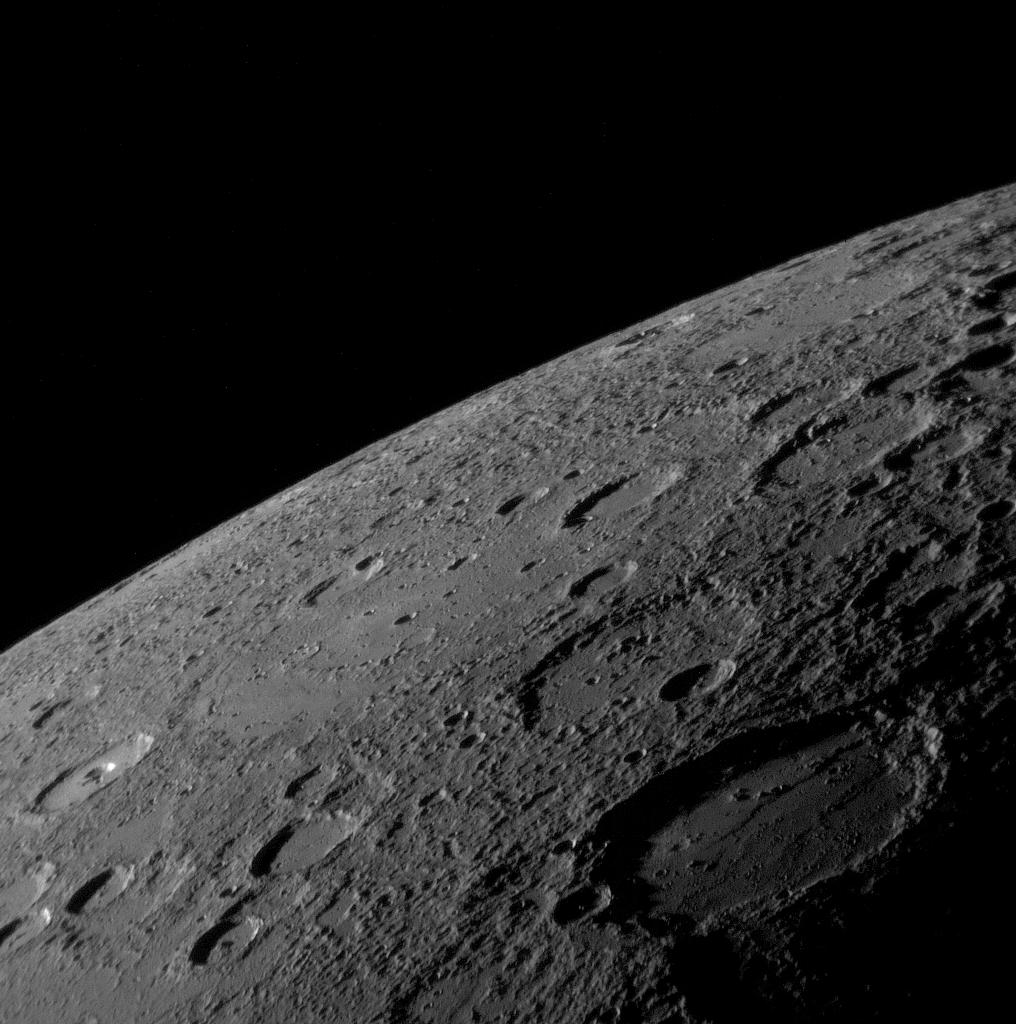
If you didn’t read the title, and I tell you the image below is our Moon, I think all of you will believe me…

To be honest, I may also mistaken it as our Moon if I didn’t read the caption.  Mercury and our Moon just look so similar to us laypersons because they do share some similarities:  they are both full with impact craters across their surfaces, they do not have atmosphere and their rocky surfaces have not experienced much geologic activity for the past 3 ~ 4 billions years.

However, Mercury and the Moon do have important differences.  The most obvious difference between the two is that the Moon has dark area filled with basaltic lavas forming the maria and bright highlands, but Mercury do not.  There is only subtle variations in the brightness of Mercury’s surface.

Mercury Horizon

As the MESSENGER spacecraft drew closer to Mercury for its historic first flyby, the spacecraft’s acquired this image on January 14, 2008, when the spacecraft was about 18,000 kilometers from the surface of Mercury, about 55 minutes before MESSENGER’s closest approach to the planet.  Credit: NASA / JHUAPL / CIW

The image shows a variety of surface textures, including smooth plains at the center of the image, many impact craters (some with central peaks), and rough material that appears to have been ejected from the large crater to the lower right.  This large 200-km-wide crater was named Sholem Aleichem for the Yiddish writer.  In this MESSENGER image, it can be seen that the plains deposits filling the crater’s interior have been deformed by linear ridges.

The shadowed area on the right of the image is the day-night boundary, known as the terminator.

These images are from MESSENGER, a NASA Discovery mission to conduct the first orbital study of the innermost planet, Mercury.

50 years old satellite still in orbit

•March 18, 2008 • Leave a Comment

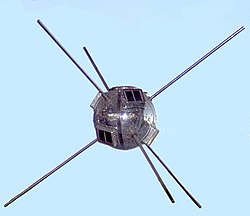
Vanguard 1, the oldest surviving artificial Earth satellite, turned 50 years old yesterday.  Just imagine, 197,000 orbits around Earth, completed more than 10 billion kilometres of travel!  Up there, it has outlived almost all of the human who created it.

Vanguard1

Vanguard 1 was very light, about 1.5 kg.  It was the 4th artificial satellite to reach orbit, after Soviet Union’s Sputnik 1, 2 and America’s Explorer 1.  Vanguard 1’s current orbit ranges from ~ 650 to 3,800 km in altitude.

Vanguard 1 was the first artificial earth satellite powered by solar cells, and its small suite of instruments provided unprecedented information on Earth’s size and shape, air density and temperature ranges, and the micrometeorite density in space.

However, in 1964, all its experiments and transmitter fell silent.  Since then, there was no longer any communication with it.  Vanguard 1 now just remains as the oldest piece of space junk still in orbit.

Maybe one of these days, we may be able to bring the satellite home, bringing it back down to Earth, to study the long-term environmental effects of space on a spacecraft, which can be very helpful in designing future spacecraft.

Source: msnbc

Cassini Diving over Enceladus

•March 14, 2008 • Leave a Comment

Cassini is a spacecraft currently in orbit around Saturn.

Enceladus is the 6th largest moon of Saturn (~500 km in diameter).

On March 12, 2008, this man-made moon met the natural moon… at closest approach of 50 km! That was very close!

PIA08409 Enceladus_sm

This 3-image mosaic is the highest resolution view yet obtained of Enceladus’ north polar region during Cassini’s March 2008 flyby of Enceladus.  Credit: NASA/JPL/Space Science Institute.  More photos of March 2008 flyby of Enceladus.

Once upon a time, in year 2005, Cassini performed several close flybys of Enceladus and discovered evidence for geyser-like jets.  These continuous eruptions of ice water create a gigantic halo of ice dust and gas around Enceladus, which are the source of the material in Saturn’s tenuous E-ring.

enceladus_plume

This false-colour view taken on Nov. 27, 2005 identify the source locations for individual jets spurting ice particles, water vapour and trace organic compounds from the surface of Saturn’s moon Enceladus. Credit: NASA/JPL/Space Science Institute.

On March 12, 2008, this was what happened: Cassini, flying at about 15 km/s, dived through the icy water geyser-like jets, snatching up precious samples that might point to a water ocean or organics inside the little moon.  The geysers emanate from fractures – casually referred to as “tiger stripes” – running along the moon’s south pole, spewing out water vapour at ~400 m/s.

The close encounter by Cassini provides a much more detailed look at the “tiger stripes” that modify the surface.  New images show that compared to much of the south polar region on Enceladus, the north polar region is much older and pitted with craters of various sizes.

enceladus tiger strips

This close-up view of Enceladus taken on July 14, 2005 shows a distinctive pattern of continuous, ridged, slightly curved and roughly parallel faults within the moon’s southern polar latitudes. These surface features have been informally referred to by imaging scientists as “tiger stripes”.  Credit: NASA/JPL/Space Science Institute.

This was the first of 4 Cassini flybys on Enceladus this year.  During this flyby, the spacecraft came within 50 km of the surface at closest approach and 200 km while flying through the plume.  Future trips may bring Cassini even closer.

The Cassini-Huygens mission is a cooperative project of NASA, the European Space Agency and the Italian Space Agency.

Source: CICLOPS Press Release

Another interesting article from The Planetary Society Weblog

Welcome to my dark sky

•March 11, 2008 • Leave a Comment

Welcome!

This blog is named “my dark sky”, with the hope that not only all of us but also our future generations will have the chance to bath in starlights under a truly dark sky.

This is a place where we share the wonders of the universe, to understand how it works, and to update ourselves on the latest findings.

Always look up, and you will be rewarded with the beauty of the night sky…

Goodbye to an Unsung Hero…

•March 6, 2008 • Leave a Comment

ulysses header

This is the story of a spacecraft that most of us had never heard of before.

The unsung hero is Ulysses, a solar space probe that is loyally and silently doing its job out in space, for over 17 years!  And it was designed only to last 5 years.  After almost 2 decades in space, its radioactive power source has finally decayed to a point where it can no longer support all its instruments.  Ulysses is succumbing to its harsh environment and is likely to finish sometime in the next month or two.

The most interesting aspect of this spacecraft was its solar polar orbit; meaning its orbit is perpendicular to the orbit of the planets so that it could look straight down onto the Sun’s pole, something that we had never seen before.  To reach such high solar latitudes, Ulysses was launched toward Jupiter so that Jupiter’s large gravitational field would accelerate Ulysses out of the ecliptic plane to high latitudes.

Ulysses is in a six-year orbit around the Sun. Its long path through space carries it out to Jupiter’s orbit and back again.  Ulysses is equipped with instruments to characterize fields, particles, and dust, to study the Sun’s environment and understand how it works.

However, this is all going to end soon… as Ulysses is receding from the Sun out to Jupiter’s orbit, the spacecraft is getting colder and colder.  With its power source dying, it is unable to heat up and prevent its hydrazine fuel from freezing in the fuel lines.  Hydrazine fuel is critical for Ulysses to maneuver to point its antenna toward Earth.

ulysses

Ulysses is a joint mission between ESA and NASA.  It was launched in 1990 from a space shuttle and was the first mission to study the environment of space above and below the poles of the Sun.  The reams of data Ulysses has returned have forever changed the way scientists view the Sun and its effect on the space surrounding it.

Source: ESA News

The Grand Spiral Galaxy from Hubble

•February 12, 2008 • Leave a Comment

M74

M74 (NGC628) is a grand spiral galaxy located approximately 32 million light-years away in the constellation Pisces.  The image is 31,000 light-years wide. Credit: NASA/ESA Hubble Space Telescope.

This nearly face-on galaxy M74 is a stunning example of a “grand-design” spiral galaxy.  Its well-defined spiral arms are dotted with clusters of young blue star and glowing pink regions of ionized hydrogen (hydrogen atoms that have lost their electrons), with winding dust lanes that begin very near the galaxy’s nucleus and tracing all the way along the spiral arms.  This is just breathtaking!

M74 is slightly smaller than our Milky Way galaxy, containing about 100 billion stars. It is the dominant member of a small group of about half a dozen galaxies, the M74 galaxy group.

Usually a stunning image like this is not taken one shot.  It is composite image created using a few different kinds of filters.  In this case of M74, the filters used to create the color image isolate light from blue, visible, and infrared portions of the spectrum, as well as emission from ionized hydrogen.