All these happen in one night: 13th August 2010 – Friday. And you do not want to miss them.
This Friday, find a place with an unobstructed western horizon and have your dinner there while enjoying the sunset. As the Sun sets around 7:30 pm, the first two objects that will catch your attention will be the beautiful crescent Moon and a very bright “star” Venus, side by side in the sky. Slightly later, when the sky has darkens enough, Saturn and Mars will pop out of the twilight to join the Moon and Venus in a tight conjunction – all within a circle of 10 degrees in diameter.
Can you ask for more?
Surprising, yes you can…
If you think three planets plus one moon is not enough, then there’s more for you… move your gaze between the conjunction and the western horizon. If the sky is clear, you will notice another bright “star” (brighter than Mars or Saturn) about 10-15 degrees above the horizon – that’s the little planet Mercury.
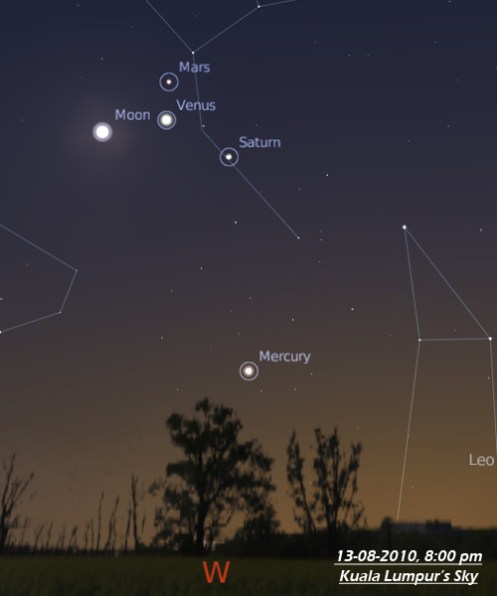
The best part of this conjunction is that you do not need any telescopes or binoculars to enjoy it. All the planets and the Moon are bright enough to be easily visible to the naked eye. You can also set up a camera to capture the event. It’s quite simple actually, just mount your camera to a tripod, aim and shoot. You can do it even with a compact camera, not necessary an SLR camera, as long as the camera allows you to play around with its setting.
So there you go, in the same patch of the sky, you have seen four out of five of the planets known since the ancient civilisations (the missing one is Jupiter, which will rise in the east around 11 pm) plus one beautiful crescent Moon.
Can you ask for more?
Again, the answer is yes!
After the planets and Moon sets around 10 pm, things will only get better. If you think you have enough for the night and leaves, you are going to miss a display that’s even more exciting than the planetary conjunction – a meteor shower!
August is the time for Perseids meteor shower, which is one of the most reliable meteor shower of the year. This shower is active from July 17 to August 24. Starting slowly, with just a few meteors per hour, it’ll peak to a ZHR of more than 60 meteors on August 12/13, and then slowly subside again to a few meteors per hour.
The source of the Perseids meteor shower is Comet 109P/Swift-Tuttle. Although the comet is now is receding back into the outer Solar System and is nowhere near Earth, the comet’s tail does intersect Earth’s orbit and we glide through it every year in August. Tiny bits of comet dust hit Earth’s atmosphere travelling at about 60 km/s, burns and gives us the Perseids.
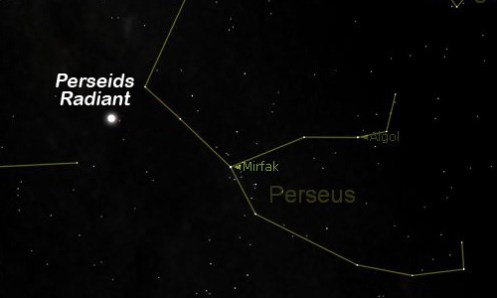
Not all meteors that you see are Perseids; some may be sporadic (or random) meteors. So how do we know a meteor is a Perseid or not? Simple. Just trace back the path of the meteor and see if it ends up in constellation Perseus. If yes, then it’s a Perseid; if not, then it is just a sporadic meteor.
Remember, you don’t need any equipment such as telescope or binoculars to see meteors. All you need is just your naked eyes. Find a group of family or friends, go to a safe, dark site, lie down and enjoy! (to learn more about meteor/meteor shower and how to observe, go to Meteor Shower ABC.)
Clear skies everyone!
Always look up, and you will be rewarded with the beauty of the night sky…
Posted in Mars, Mercury, Moon, Observations & Tips, Saturn, Venus
Tags: Meteor shower, Perseids




 My Dark Sky
You must be logged in to post a comment.