Some updates on my China Eclipse Trip…

•July 30, 2009 • Leave a Comment

I’m back from China on Monday, but too many things to catch up that only until now I have time to write a few words.

The trip was excellent! I managed to see the eclipse, which is BREATH-TAKING!!! and also manage to snap some photos (although I’m not very happy with the results :-( quite a lot of blur photos…). Give me a day or two to tidy up the photos and I’ll post them here. Promise.

Apollo 11 40th Anniversary

•July 20, 2009 • Leave a Comment

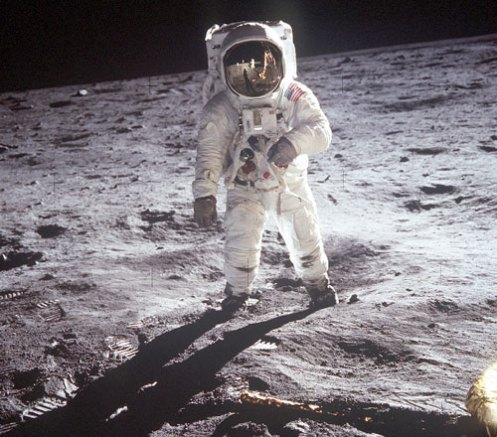
Exactly 40 years ago today, on July 20, 1969, earthling set foot on another world for the first time.

AS11_40_5903-BuzzAldrin_sm

The Apollo 11 mission successfully landed human – Neil Armstrong, Michael Collins and Edwin Aldrin – on the Moon in the Sea of Tranquility (Mare Tranquillitatis) and returned them safely to Earth. Although they only spent 2.5 hours walking on the lunar surface, but these were definitely historic hours for mankind.

“one small step for a man, one giant leap for mankind”
~ Neil Armstrong ~

I actually plan to dig out some Apollo 11 images to share with you, but then I realised that The Big Pictures had done a very good job on that, so I just link you to it… my favourite is #30.

The 40th Anniversary of Apollo 11


Apollo40YearsApollo 40th Anniversary Homepage

Visit Universe Today to find all the links that has anything to do with this anniversary

LRO Sees Apollo Landing Sites!

•July 19, 2009 • Leave a Comment

The NASA’s Lunar Reconnaissance Orbiter (LRO) was sent to the Moon with the mission to identify safe landing sites for future explorers. But before the probe starts to do that, it had first returned pictures of past explorers landing sites, showing the Apollo Mission’s Lunar Module (LM) descent stages sitting on the lunar surface.

LRO-Apollo11 LRO-Apollo15

LRO-Apollo16 LRO-Apollo17

The descent stage is bottom part of the LM that stayed behind on the Moon. The top part – the ascent stage – is what took the astronauts back to orbit to meet the Command Module and then from there they returned to Earth.

The position of the Sun low in the sky causes long shadows on the descent stages (which is roughly 12 ft in diameter) and this made the modules locations evident. The region where the astronauts landed was quite smooth, so the object that can cast a long shadow there was the module itself.

LRO-Apollo14

The image of the Apollo 14 landing site had a particularly desirable lighting condition that allowed visibility of additional details. The Apollo Lunar Surface Experiment Package, a set of scientific instruments placed by the astronauts at the landing site, is discernable, as are the faint trails between the module and instrument package left by the astronauts’ footprints.

The Lunar Reconnaissance Orbiter Camera, or LROC, was able to image five of the six Apollo sites, with the remaining Apollo 12 site expected to be photographed in the coming weeks. Bear in mind that these images are taken before the probe reached its final mapping orbit. Future LROC images from these sites will have two to three times greater resolution. Stay tuned!

Source: NASA LRO Mission Page
All images credit: NASA/Goddard Space Flight Center/Arizona State University

The Moon for All Mankind

•July 18, 2009 • Leave a Comment

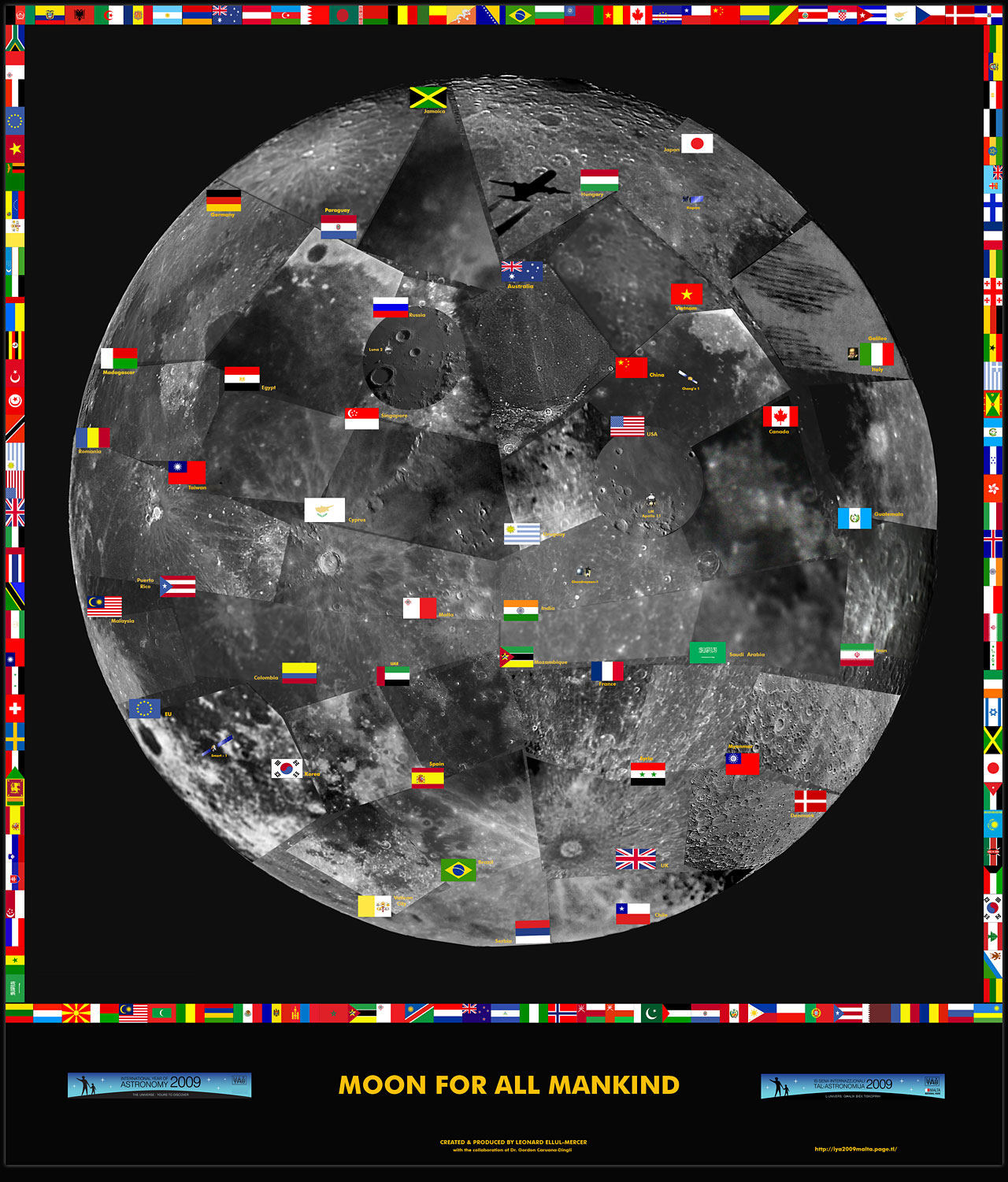
IYA2009-moon-mankind

This is a mosaic of our Moon composed of images taken by 40 countries from all over the world called “The Moon for All Mankind”. Malaysia has also contributed a small piece to this Moon, see if you can find it.

Most of these images were taken during the May or June full moons of 2009, but some were far older, such as Italy’s four hundred year old sketch by Galileo Galilei. The mosaic also features the Russian Luna 2 – the first unmanned spacecraft to land on the Moon, the Apollo programme, the EU Smart-1 spacecraft, the Chinese Change 1 probe, the Japanese Kaguya probe and the Indian Chandrayaan-1 probe to the Moon.

The project was coordinated by Malta, an archipelago of small islands in the Mediterranean, as part of the events for International Year of Astronomy 2009.

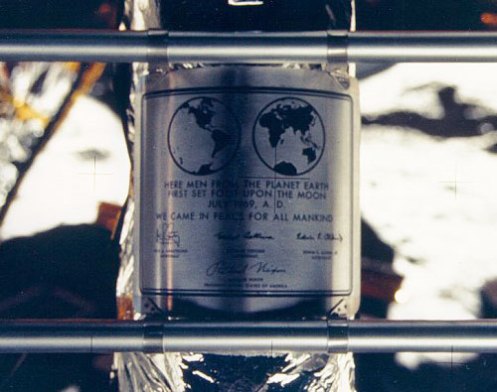
The font used in the project is Futura, the same font used on the plaque that was fixed to the Apollo 11 lunar module Eagle, which read:

“HERE MEN FROM THE PLANET EARTH FIRST SET FOOT UPON THE MOON JULY 1969, A.D. WE CAME IN PEACE FOR ALL MANKIND”

AS11-40-5899 Apollo11Plaque

Astrophotography Exhibition at Planetarium Negara

•July 17, 2009 • Leave a Comment

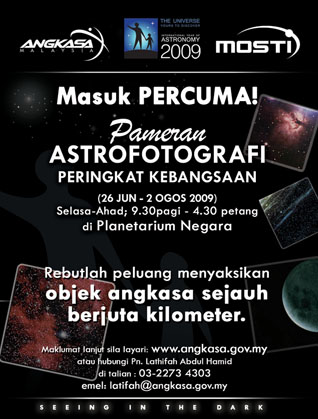
Seeing in the Dark

PameranAstro-1

This is the theme of the Astrophotography Exhibition currently held at Planetarium Negara, Kuala Lumpur.

As part of the activities for International Year of Astronomy 2009, our national space agency, ANGKASA, is organising this exhibition with the objective to share the beauty and uniqueness of our universe with the public by showcasing astrophotographs taken by local amateurs.

The exhibition is held from Jun 26, 2009 until Aug 2, 2009 and admission is free.


PameranAstro-2

PameranAstro-3

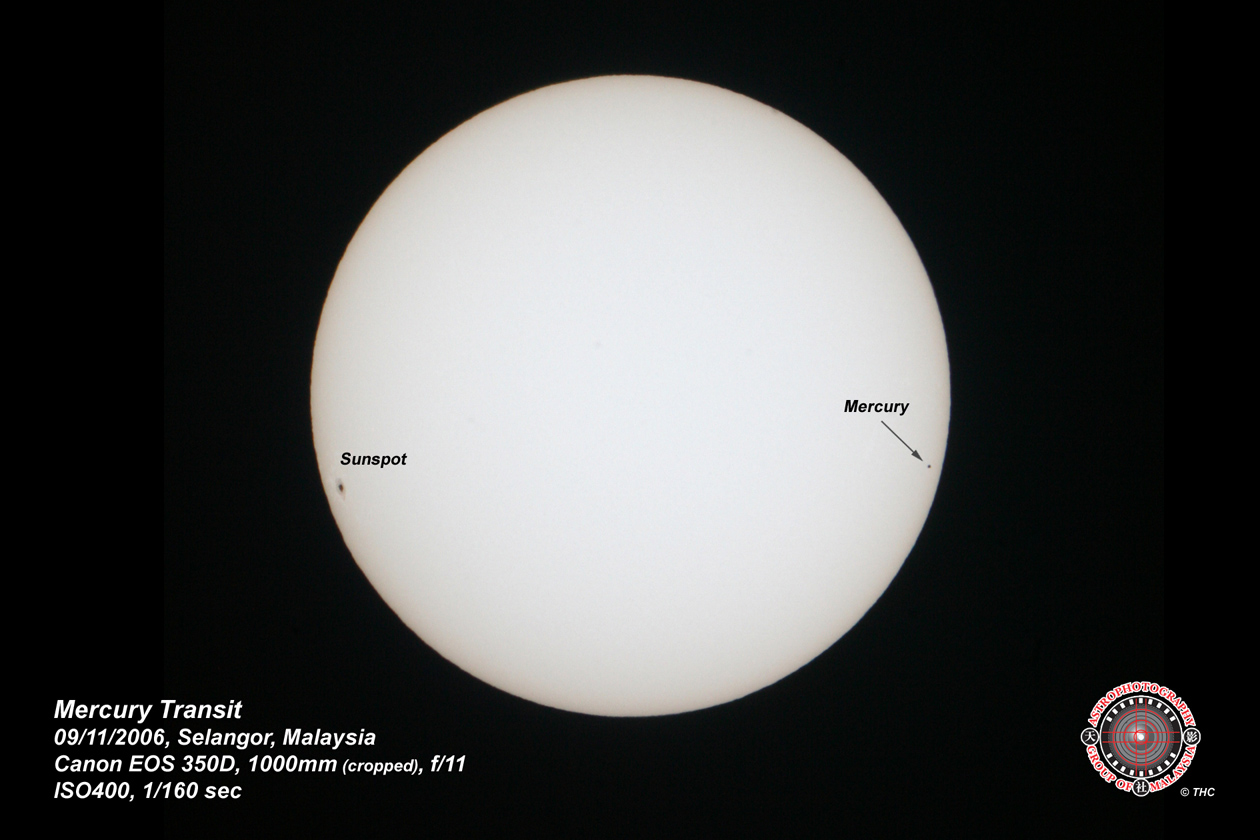
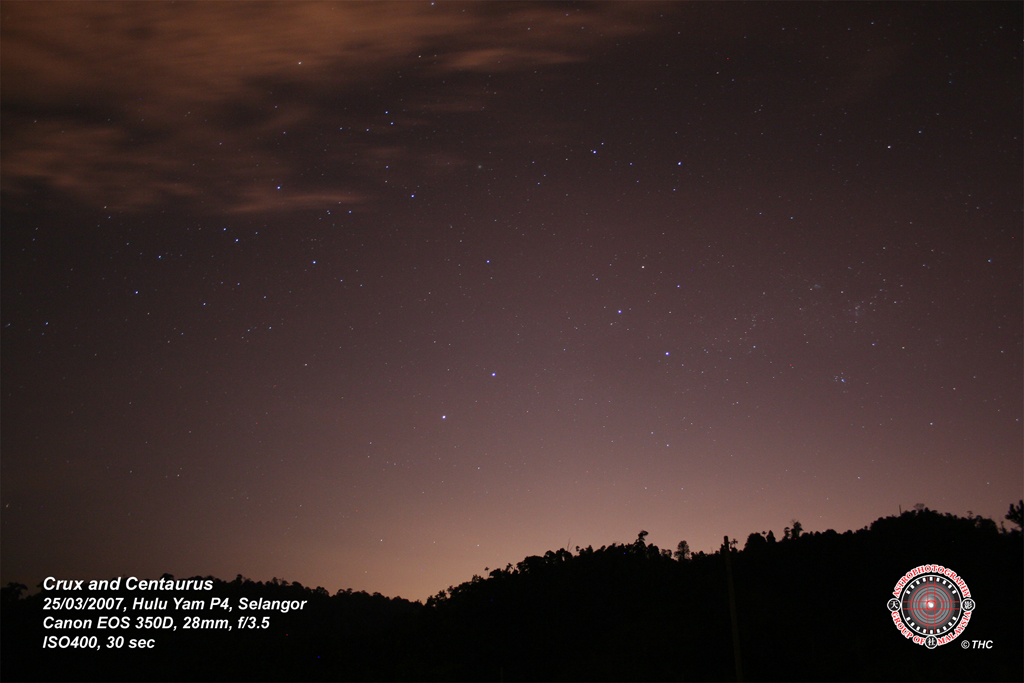
The above pictures are snapshots of the exhibition hall. Can you guess why I purposely show these two pictures? Because my photos were among them! See the “white round Sun” in the first picture, that’s my shot of Mercury Transit. And in the next picture, the middle one is my Smiley Face taken last December and the top rightmost is constellation Crux and Centaurus taken back in 2007.

I was never a dedicated photographer, I only shot when is convenient – when I were about going out for dinner and if I saw something nice in the sky, then I give the sky a shot. If I was somewhere observing and the sky is clear, then I give it a shot. I seldom go the extra miles (like travelling hundreds of kilometres to a dark site, staying up the whole night, or wake up very early in the morning) to take nice pictures. So you see that most of my photos are taken near my house and during sunset and those photos always ended up sitting in my hard drive (or maybe in some friends’ hard drive too).

This is the first time my photos were in the public exhibition and I’m very happy… woooooo… a sense of achievement…

If you are free, why not drop by Planetarium Negara and admire the works of our local astrophotographers?

Total Solar Eclipse – 22 July 2009

•July 13, 2009 • 5 Comments

It’s time for another total solar eclipse!

And this time it’s going to be different… very very different… not because it’s the Eclipse of the Century, but because I’m going to China to witness it!!!

TSE2009 Animated

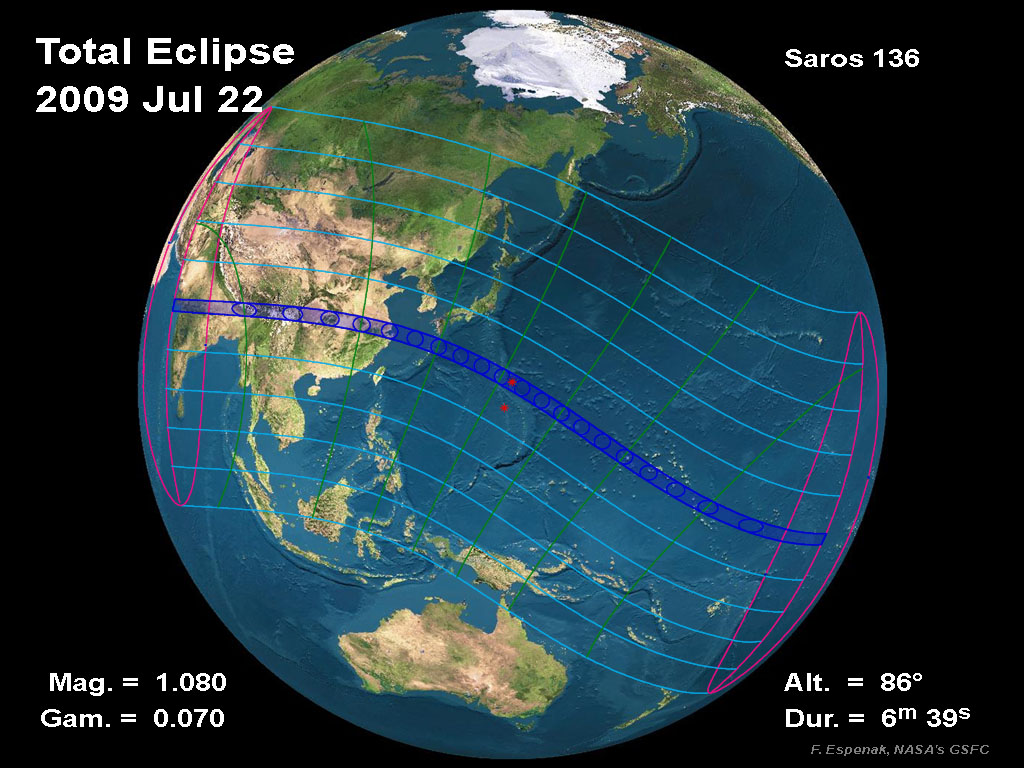
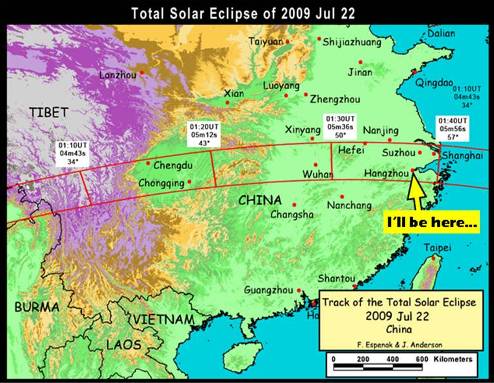
The path of the Moon’s umbral shadow begins in India and crosses through Nepal, Bangladesh, Bhutan, Myanmar and China. After leaving mainland Asia, the path crosses Japan’s Ryukyu Islands and curves southeast through the Pacific Ocean where the maximum duration of totality reaches 6 min 39 s.

6 minutes and 39 seconds!

That’s the longest total solar eclipse we can have for the 21th century! (and hence the Eclipse of the Century at the beginning of the post). We have to wait until Year 2132 to have a longer TSE than this one.

The reason for this long eclipse is simply because now is July; a time when the Sun is farthest away from Earth (aphelion), thus is smallest in size. And the Moon also just passes it nearest point to Earth (perigee), thus it looks big in our sky. Combine a small Sun with a big Moon, and bang, you have a long totality (the Moon will have more time to block the Sun).

As seen from the diagram above, Malaysia was not in the totality path (where the Moon’s umbral shadow is), but we are in the broader region of the Moon’s penumbral shadow – meaning that we can still see a partial eclipse. Even so, it’s not so favourable to us because at maximum the Moon only covers 8% of the Sun’s disk in Kuala Lumpur and 12% in Ipoh (and slightly more if you are further north). Click here for more details and here for animation.

In Kuala Lumpur,
First Contact – 8:29 am (when the Moon first “touches” the Sun’s limb)
Maximum Eclipse – 9:07 am (when the Moon covers the Sun’s disk the most; 8%)
Last Contact – 9:48 am (when the Moon “leaves” the Sun)

So you know a partial solar eclipse is going to be visible soon and you are looking forward to that. Now, how do you observe this event SAFELY?

There are few ways. You can project the image of the Sun onto a piece of paper or a wall either by using pinhole projector (long box or cardboard) or telescope, or use a solar filter either the glasses type or attached it in front of a telescope. Only then, you can observe the Sun safely. You don’t really need a telescope to enjoy this.

Caution: Sunglasses, exposed film, x-ray film, polaroid filters etc. are NOT suitable to be used for Sun observation. Use only filters or glasses that are specially made for Sun viewing.

Remember this: Safety precautions always have to be taken for any observations involving the Sun. NEVER EVER look at the Sun directly without any safety filters. The consequences will be a damaged eye or blindness.

Please bear in mind that although the Sun will be partially covered, the remaining of the crescent Sun will still be intense enough to damage your eyes. It is NOT safe at all to look at the partial Sun directly.

I’ll be in Hangzhou observing. The duration of totality is about 5 minutes; hope I’ll stay calm, not panic, and have enough time to take some decent photographs to share with you all.
TSE2009China

Wish me clear skies in China!!!

~~~~~

More information:
NASA Eclipse Website
Mr. Eclipse (Fred Espenak)
Total Solar Eclipse of 2009 Jul 22.pdf – a very complete information on this solar eclipse

Crescent Earth

•July 10, 2009 • 1 Comment

My favourite images are always those that we can’t see from our position stuck on Earth…

CrescentEarth by Apollo17.  Click to enlarge.
Image Credit: NASA

We have seen tons of crescent Moon photos, and maybe one or two crescent Sun (during solar eclipse). Crescent Venus? Easily visible from Earth. Crescent Earth? You have to be not on Earth to see it…

The crescent Earth rises above the lunar horizon in this spectacular photograph was taken from the Apollo 17 spacecraft. The Apollo 17 was the last Apollo mission to land men on the Moon. Eugene Cernan, commander of Apollo 17, still holds the distinction of being the last man to walk on the Moon, as no humans have visited the Moon since December 14, 1972.

Just look at that blue marble… no wonder people say our planet is the most beautiful in the whole Solar System… I can’t agree more…