You’ll know now is August, thanks to the Mars Hoax

•August 22, 2008 • 3 Comments

I bet most, if not all, of you must have got this email before…

Two moons on 27 August
27th Aug the Whole World is waiting for……… …..
Planet Mars will be the brightest in the night sky starting August.

It will look as large as the full moon to the naked eye. This will cultivate on Aug. 27 when Mars comes within 34.65M miles off earth. Be sure to watch the sky on Aug. 27 12:30 am. It will look like the earth has 2 moons. The next time Mars may come this close is in 2287.

Share this with your friends as NO ONE ALIVE TODAY will ever see it again.

So, do you really believe that you will be able to see Mars as large as the Moon on 27 August?

NO! Don’t believe it. It’s wrong. Mars can never be as large as the Moon in our sky!

Since 2003, every year in August, I’m sure to receive this email, and this year is no exception. But I’m happy that those who sent me the email are sceptics. They don’t just accept what the article said; they sent me the email for clarification, to confirm the facts, because they don’t think it’s possible. This is a good sign, when you get some emails that you are doubtful, you must check the facts, ask someone, googled it and not just forward the “sometime can be so wrong” information out to everyone in your address book and “help” to spread the wrong information.

OK, now to the facts.

First, how did all this started?

The story began in August 2003, when Mars came historically very close to Earth, which is the closest approach for the past 60,000 years. How close? 55.76 million km (34.65 million miles) away from Earth. If you think that was not close, consider this: when Mars is on the other side of the Sun from us, it can be as far as 400 million km. And currently (August 2008), it is about 360 million km away.

Naturally, if an object is nearer to us, it’ll look larger. So, during Mars historical closest approach to Earth on 27 August 2003, it, of course, will look largest than any other time. And it’s true that “no one alive today will ever see Mars this large again” because the next time Mars is going to come this close to Earth will be in year 2287.

So, I said large. But how large? As large as the Moon? No, no, no, nooooo… Simple maths will tell us that it is impossible. Mars is only twice the size of our Moon, but at closest approach back in 2003 it was 144 times further away. Since the size of an object seen in the sky is inversely proportional to its distance, Mars will have to be at least 144 times larger than the Moon to look as large.

A very good example is our Sun. Our Sun is the only natural object in the sky that will look as large as the Moon. Although the Sun is about 400 times much further away than the Moon, it has a diameter 400 times of the Moon, therefore the Sun will appear about the same size as the Moon in the sky. And that’s why we can have solar eclipse.

Solar Eclipse on 1 August 2008 taken in China. The black disc is our Moon, blocking the Sun at the back. The size of our Sun and Moon is almost the same in the sky. Credit: William Chin (APGM)

On 27 August 2003, Mars angular size in the sky was 25.11 arc-second. This was very “large” if compared to “normal time” Mars, which can be as small as 10 arc-second or even smaller.

Maybe someone was playing a joke by sending out that email; or maybe someone mess up the figure 25.11 arc-second and the size of a full moon, which is 30 arc-minute. One look at these two figures one may jump into conclusion that since the difference between 25.11 and 30 is small, then Mars should be almost as large as the Moon. Wrong here! Just be careful of the unit, 25.11 arc-SECOND and 30 arc-MINUTE! 1 arc-minute is equal to 60 arc-second. This is just like trying to say 25 mm are almost the same length as 30 cm!

Mars closest approach to Earth happens around Mars Opposition. This is the time, as seen from Earth, when Mars appears at the opposite side of the Sun. And this is also the time when Mars, in its orbit around the Sun, comes close to Earth. And this is also the time when Mars is best placed for observation. Mars Opposition occurs every 2 years and 2 months or every 26 months.

Due to the fact that the orbits of Earth and Mars are not circular and they do not centre exactly on the Sun, the distance between Earth and Mars, and hence the size of Mars, can vary for each opposition. The diagram below from Hubble clearly illustrates this.

Mars Opposition 1995-2007 by Hubble. Click to enlarge.

Mars at Opposition: This illustration shows the relative positions of Earth and Mars at the last seven oppositions (1995-2007), when the Sun and Mars are on exact opposite sides of Earth. The images of Mars show the planet’s apparent relative size at each opposition, as viewed by Hubble Space Telescope. Illustration credit: Z. Levay (STScl)

Another two Mars Oppositions have past since the “Great Mars Opposition” in August 2003. The next Mars Opposition will be in January 2010.

Hopefully the next time when you receive the Mars Hoax email again, you are confident to sent it back and tell the sender that he/she is wrong and this is only a joke.

You can also read the article I wrote 3 years back on this. The hoax email then was more “details” than the one above.
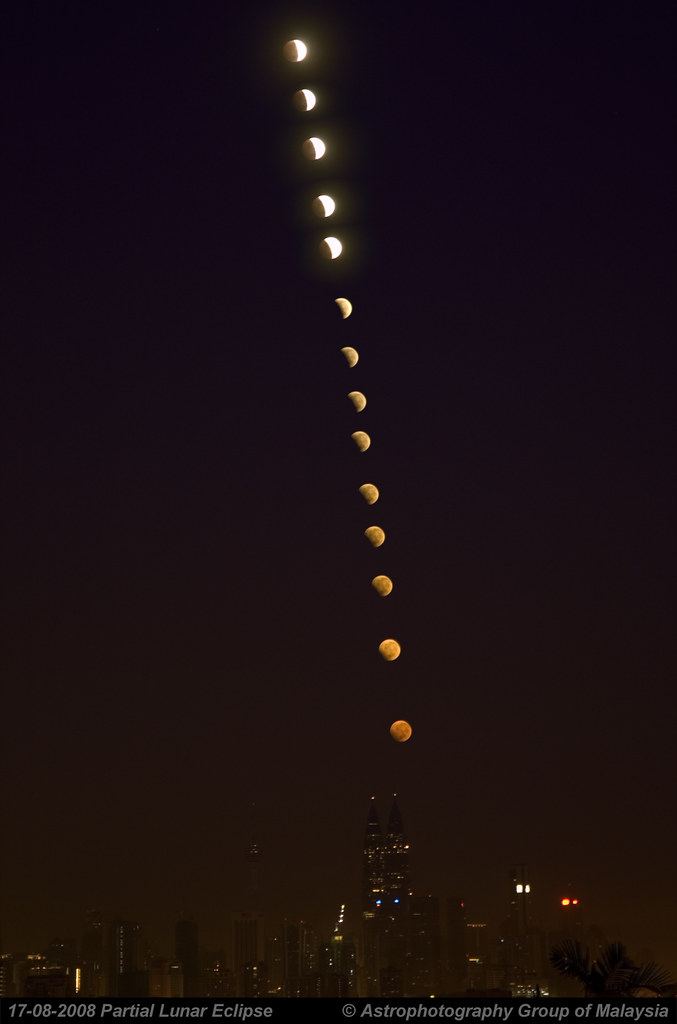
Partial Lunar Eclipse on 17 August 2008 (Images1)

•August 19, 2008 • 1 Comment

So, as promised, below is the sequence of last weekend partial lunar eclipse with the Petronas Twin Tower and KL Tower (barely visible to the left) as foreground. Unfortunately, both the towers had switched off their light so they are not so prominent as they usually are.

20080817 Partial Lunar Eclipse by thchieh. Click to enlarge.

17 August 2008 Partial Lunar Eclipse Sequence from 5:45 am to 6:55 am. Nikon D70, ISO200, Composite of 14 images. Credit: thchieh (APGM).

After looking at the “real” lunar eclipse, let’s take a look at a “fake” one taken after the “real” eclipse.

20080817 Fake Lunar Eclipse by thchieh. Click to enlarge.

This “fake” lunar eclipse was taken after the “real” partial lunar eclipse on 17 August 2008. The missing part of the Moon was not due to Earth’s shadow but was due to the clouds near the horizon. Canon350D, ISO200, 0.5 sec. Credit: thchieh (APGM).

As the Moon was setting near the twin tower, the sky was getting brighter. Suddenly I spot the tip of the tower in my telescope. Realising this is going to be a good photo opportunity, I readjust the camera and telescope – in panic, because the Moon was setting fast and “disappearing” into the cloud – and shoot. Arrgh… bad shooting angle… readjust and shoot again and again and again… and above was the best I got.

It looks a bit blur, maybe due to equipment shake; maybe I didn’t focus it well; maybe is because of the haze; or just maybe is all of the above.

That’s not all; I still have one more set of images to stitched, so stay tuned.

Partial Lunar Eclipse on 17 August 2008 (Report)

•August 18, 2008 • Leave a Comment

Wow, what a night… I stayed up the whole Sunday morning just for the lunar eclipse with some friends. After that I almost slept away the whole Sunday…

On early Sunday morning, we reached our observation site in Ampang, Kuala Lumpur (Malaysia) about 1:30 am and the sky is slightly cloudy. We still can see the Moon clearly, but it was surrounded by a very thin layer cloud. We setup our equipment and wait…

Unfortunately, the clouds got thicker and thicker that it totally covered the Moon. And we missed most of the show when the Moon slowly moves into Earth’s shadow. Once in a while the Moon will show itself, but only for a very brief moment. We manage to catch a few pictures, but it was mostly accompanied by clouds. The irony part is that the sky opposite the Moon (i.e. the eastern sky) is soooo clear that we can even see the stars!

And then things started to change… As the time getting nearer and nearer to the greatest eclipse around 5 am, the clouds started to disperse and viola, the eclipse Moon showed itself, clearly! And this good weather maintained until the end of the eclipse. Even as the Moon is setting low near the horizon, we still can see it, which is just FANTASTIC!

We purposely go to Ampang because we want to capture the eclipse with the twin tower (KLCC) as our foreground and we did it. We are very satisfied and happy and sleepy… Give me a few days to process the images and I’ll post it here asap.

When people say “to watch the stars (in this case is the Moon) one just have to be patient”, this can’t be more true in our case. If we give up at the start of the eclipse when the clouds is so thick and it seems like it’s going to rain, then we’ll not be rewarded with such a fantastic view of the eclipse.

Stay tuned for the photos or visit APGM website for some of the eclipse photos (some members are always very efficient in processing the photos, not a bit like me that usually took a few days to do that).

Cassini done another close flyby of Enceladus

•August 16, 2008 • Leave a Comment

After the successful March flyby of Enceladus, Cassini did it again on August 11, flying 50 km above the surface of Enceladus at a speed of 18 km/sec.

Enceladus is of much interest to scientist because it is geologically active. Not many objects in our Solar System are active, other examples being Jupiter’s moon Io and Neptune’s moon Triton. Most of the objects in our Solar System are “dead”, such as our Moon, so an active object definitely will catch astronomers’ attention.

Although we now know that the “tiger strips”, or formally called “sulci”, on the south pole are busy spewing icy plumes, there are still a lot of unanswered questions: what is driving the geysers? Is there any near-surface water? Why or how such a small moon can presently have such active geology?

Tiger Strips on Enceladus. Click to enlarge.

Mosaic of Saturn’s moon Enceladus. The four most prominent sulci (from top to bottom: Damascus, Baghdad, Alexandria and Cairo) appear as generally horizontal fractures near lower right, and they extend into the moon’s night side. Credit: NASA/JPL/Space Science Institute.

In the previous flyby the Ion and Neutral Mass Spectrometer (INMS) onboard Cassini took centre stage and determined the composition of the icy plumes that emanating from Enceladus’ south pole. This time, however, the objective is to obtain high resolution images of the south polar vents, along with detailed maps of the composition and temperature of the geologically active region.

And this is not easy.

Just imagine, the spacecraft is moving at a whopping speed of 18 km/sec, at a distance of only 50 km above the surface. This means that Cassini will be zipping through the moon, and this will cause motion blurring in the images, making taking a sharp, unsmeared image very difficult. The challenge is, described by the Cassini Imaging Team, as equivalent to trying to capture a sharp, unsmeared picture of a roadside billboard about 1.5 km away with a 2000 mm telephoto lens held out the window of a car moving at 80 km/hr.

From Cassini’s point of view, Enceladus was streaking across the sky so quickly that the spacecraft had no hope of tracking any feature on its surface. The best option was to point the spacecraft far ahead of Enceladus, spin the spacecraft and camera as fast as possible in the direction of Enceladus’ predicted path, and let Enceladus overtake at a time when we could match its motion across the sky, snapping images along the way. This special technique came up by the imaging team is called “skeet shooting“.

And they did it!

Cassini spacecraft has pinpointed precisely where the icy jets erupt from the surface of Saturn’s geologically active moon Enceladus.

Click to enlarge.

Cassini shot past the surface of Enceladus on Aug. 11, 2008, acquiring a set of seven high-resolution images targeting known hot spot locations on the moon’s “tiger stripe” fractures, or sulci. Five of those images are presented in this mosaic.

One highly anticipated result of this flyby was to pinpoint previously identified source locations for the jets that blast icy particles, water vapor and trace organics into The yellow circles on the mosaic indicate source locations I and V identified in “Enceladus Jet Sources.” Credit: NASA/JPL/Space Science Institute.

Click to enlarge.

Another two of those seven high-resolution images are presented in this mosaic.
Here, Damascus Sulcus runs across the center, from left to right. The yellow circles on the mosaic indicate source locations II and III identified in “Enceladus Jet Sources”. Credit: NASA/JPL/Space Science Institute.

More skeet shoots of Enceladus.

There will be two more flybys of Enceladus this year, on October 10 and October 31, which may bring the spacecraft even closer to the moon.

Carnival of Space #67

•August 15, 2008 • Leave a Comment

Carnival of Space #67 is up at Next Generation. Check it out!

Partial Lunar Eclipse on 17 August 2008

•August 12, 2008 • 2 Comments

Eclipse time again…

This month, we are blessed with two eclipses: a total solar eclipse on August 1 and two weeks later on August 17, we have a partial lunar eclipse.

Solar eclipse happens when the Moon blocked the Sun and this only happens during new moon when the Moon is between us and the Sun. Lunar eclipse happens when the Moon moves into Earth’s shadow and “disappears” from view. This only happens during full moon when our planet is between the Moon and the Sun.

If that is the case, why do we not have eclipses every new moon and full moon? The answer lies in the orbit of the Earth and the Moon.

The orbit of the Moon around Earth is not in the same plane as the orbit of our Earth around the Sun (the ecliptic); the Moon’s orbit inclines about 5 degrees from the ecliptic. Because of that, the Sun-Earth-Moon is not always in a straight line; most of the time the Moon is either above or below the ecliptic. That’s why the Moon doesn’t block the Sun on every new moon or in Earth’s shadow every full moon.

Unlike a solar eclipse that is only visible along the narrow “path of totality”, a lunar eclipse can be viewed anywhere on the night side of Earth; meaning almost half the globe can see the event, and you can see it right outside your house provided it is night-time and the sky is clear.

Another difference is that for a total solar eclipse, the longest time the Sun can disappear from view is 7 min 40 sec, because the Moon and the Sun has almost the same angular size in the sky (the Sun although is 400 times larger than the Moon, it is also 400 times further away). After blocking the Sun briefly, the Moon will move away and reveal the Sun again.

But for a total lunar eclipse, the Moon can disappear from view as long as an hour. This is because Earth cast a shadow in space far larger area than the Moon itself and the Moon will require some time to move out from the shadow. Check this animation of the partial lunar eclipse at Shadow & Substance to visualise that.

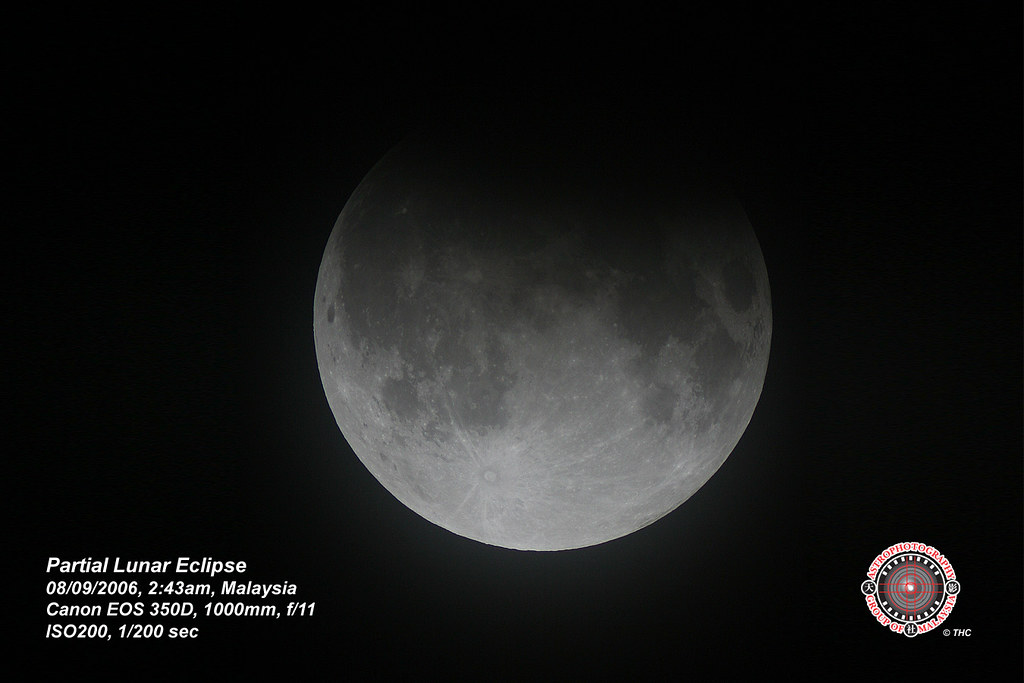
Partial Lunar Eclipse on Sep2006. Click to enlarge

This weekend, instead of totally disappear into the shadow of our planet (a total lunar eclipse), the Moon will only partially goes into shadow, resulting in a partial lunar eclipse that lasts about 3 hours.

The show starts at 2:23 am (18:23 UT) when the Moon first contacts the Earth’s penumbra*. At 3:35 am (19:35 UT), the Moon is about to enter the umbra*. Little by little, the Moon will be “eaten-up” until it reaches its greatest eclipse at 5:10 am (21:10 UT), where 81% of the Moon will be immersed in the Earth’s shadow. After that the Moon will slowly “coming back” and at 6:44 am, the Moon will be totally out from the umbra. The eclipse will end at 7:57 am (23:57 UT) when the Moon leaves the penumbra.

This time, the eclipse favour Peninsular Malaysia. People from the peninsular will be able to see the Moon leaving the umbra. Unfortunately for Sabah and Sarawak, the Sun rises before the Moon is out from the umbra.

*Our Earth’s shadow consists of two parts: the darker central umbra and the lighter penumbra.

Click here for more details and diagram of the eclipse.


What will you see?

At the start of the eclipse, the Moon looks like a normal bright full Moon. Then as it enter the penumbra it seems to get just a little bit darker, but you won’t notice much, since the change is small.

As time goes by, you will start to see bit by bit of the Moon starts disappearing. At the greatest eclipse, the “dark part” of the Moon may change its colour to copper red or orange, depends on the condition of our atmosphere.

After that, the whole process reverses and the Moon gets lighter and lighter until it finally goes back to being a normal Full Moon.

How to view this partial lunar eclipse?
This event can be observed just outside your house. But you have to make sure that you an unobstructed western horizon – the Moon is setting as you view the event.

You can observe this event just by using the naked eyes. Alternatively you can also view it through binocular or telescope (no filter required). Or if you want to record the event, you can use a camera to take multiply shots of the eclipsed Moon throughout the event and then stitched them together to get the progress of the eclipse.

Hope you will enjoy the show this weekend and clear skies to everyone out there.

Carnival of Space #66

•August 11, 2008 • Leave a Comment

Wow, another week is gone… so it’s the Carnival time again.  The latest carnival is now up at A Mars Odyssey.  I know lately I haven’t got much space news for you, so if you are thirst for interesting space articles, be sure you visit the Carnival of Space.