Ulysses is Still Alive!

•July 14, 2008 • Leave a Comment

UlyssesLast month, ESA announced that the joint ESA/NASA mission Ulysses will officially conclude on 1 July this year, after over 17 years of operation.

But until today, the spacecraft is still alive!

Previously Ulysses was “predicted” going to die soon because as it is receding from the Sun out to Jupiter’s orbit, the spacecraft is getting colder and colder until a point where its hydrazine fuel will freeze in the fuel lines.

However, as a result of fuel bleeding and other operations strategies, the Ulysses team have managed to avoid freezing the hydrazine so far. In an email from the Ulysses Mission Operations Manager Nigel Angold to the Ulysses community, it seems that the mission could actually go on for some time.

Yay, keep going Ulysses…

Stargazing Camp in Gopeng, Perak

•July 12, 2008 • Leave a Comment

There will be a stargazing camp end of this month at Gopeng, organised by Sunbright Services.

The theme of the camp is the Summer Sky, including Scorpius, Sagittarius, Hercules, Cygnus, Lyra, Aquila, the Summer Triangle and other deep-sky objects – star clusters and nebulae. Jupiter will also be visible during that time.

Date: 26 to 27 July 2008 (Sat-Sun)
Venue: My Gopeng Resort, Gopeng, Perak.

Fees: RM170 – RM188 (depends on type of accommodation)
Contact: Pooi Hang HP: 012-220 8921 or email: pooihang@yahoo.com

The resort is in a quiet countryside by a river, a nice place to relax from the hassle of a city. The package includes 1 night accommodation, 6 meals, insurance, jungle trekking, body rafting, stargazing talk and activities with telescope setup. Click here for more information and itinerary of the trip and here for the registration form.

I’ll be there, so hope to see you there too.

MyGopengResort

Carnival of Space #62

•July 11, 2008 • 1 Comment

This week Carnival of Space is at Space Disco, with an extravaganza of images.  There are more than 20 articles, enough to keep you busy for the weekend.  Hope you enjoy them!

Jupiter Opposition Today

•July 9, 2008 • 1 Comment

Jupiter is at opposition today, a time that is best to observe it.  Jupiter will rise as soon as the Sun sets and only sets when the Sun rises.

I’ve been wanting to write about this for days… somehow I just can’t find the time.  Now I’m actually squeezing the break time between meeting to write this, so I’m sorry that I don’t have time to write more.  Click here for more details.  Just be aware that the star chart shown is not for our location.  Our “teapot” will be much higher and its orientation will also be different, with the “teapot month” pointing up.

Busy times…

•July 6, 2008 • Leave a Comment

It has been a very busy month, and also for the months to come…

If you are a regular visitor here, you will notice that I didn’t post much for the last month. When I started this blog, I hope that at least I’ll have a post a day. But unfortunately, my daytime job is eating up a very big chuck of my time, and I’m left with little time to even catch up on the space news.

I will, however, try to post as much as I can, aiming at about three posts a week. Hopefully it can be more.

At the meantime, if you want up-to-date astronomy and space news, I suggest that you drop by Universe Today or visit the Planetary Society Weblog for more specific news on our Solar System.

Always look up, and you will be rewarded with the beauty of the night sky…

Meeting of Saturn, Mars and the Moon

•July 5, 2008 • Leave a Comment

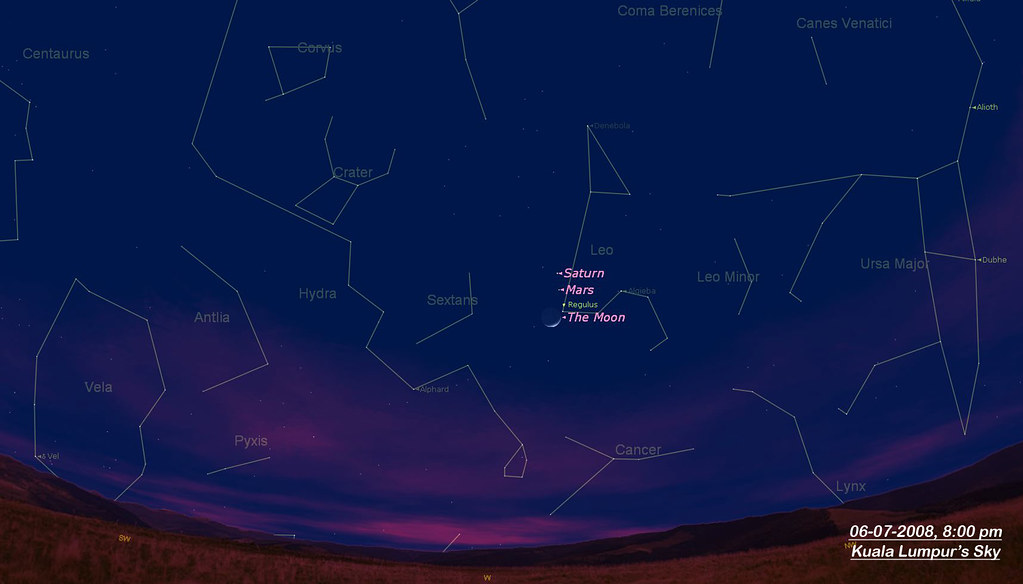
Take a look at western sky after sunset this Sunday. There will be a conjunction of two planets, a crescent Moon and a bright star. Beautiful…

The planets are Mars and Saturn, and the bright star is Regulus – the brightest star in Leo. Both Saturn and Regulus have been together for some times, and now Mars is joining the pair. And the best part is this Sunday evening a young crescent Moon is going to join the show. Don’t miss them!

Mars is the dimmest of them, shining at magnitude 1.7. Next is Regulus, slightly brighter than Mars, at magnitude 1.3. Saturn, shining at magnitude 0.8, is about a full magnitude brighter than Mars. The crescent Moon, of course, will be the brightest of the group.

Observe the colour contrast between the planets and the star. Mars appears orange-red while Saturn is yellowish and Regulus appears bluish-white.

080706 Leo

During the past months, Mars was moving from one constellation to another, making its way to Leo to meet its big brother, Saturn. On July 10 and 11, Mars will come to conjunction with Saturn, passes only 0.7 degrees south of Saturn. This will be the closest encounter of Mars and Saturn until year 2022.

Scan a telescope along the line: you’ll see craters on the Moon, a bright point of light from Regulus, a very tiny red disk of Mars and the majestic rings of Saturn. Take a good look at Saturn’s rings before it disappears from us next year.

If you do not have a telescope, it’s OK; naked eyes view of this celestial meeting is enough to take your breath away!

Today’s Sun is the smallest in this year

•July 4, 2008 • 2 Comments

Today, 4 July, the Earth reached its furthest point from the Sun for this year. We call this point in space aphelion.

Usually we say that the Earth is 1 astronomical unit (AU) from the Sun, which is equal to roughly 150 million km. This is just the average value because the orbit of Earth around the Sun is not a perfect circle, or else we will always be at the same distance from the Sun.

Our orbit is elliptical, not a lot, but slightly with an eccentricity* of 0.017. Hence, there will be time when our planet is nearer to our star, and time when it is further away. January is the time when it’s nearest (called perihelion), and 6 months later, will be the time when it is farthest away (called aphelion).

aphelion-perihelion

The Earth is 147 million km from the Sun at perihelion and 152 million km at aphelion, so today our Earth is 5 million km further away than it is in January, or 2 million km further away than the average distance.

It was Kepler who first explains that planets are orbiting the Sun in a path described as an ellipse. According to Kepler’s 2nd Law, at our furthest point from the Sun, the Earth is travelling most slowly in its annual orbit around the Sun.

And also since we are furthest away, the Sun’s angular size is the smallest during the year, if you ever notice it (I don’t think a casual observer ever notice the change in size of the Sun). A good way to compare the size of the Sun is by taking a picture on January and another one is July, and then put them side by side.

WARNING: DO NOT LOOK AT THE SUN DIRECTLY WITHOUT ANY SAFETY FILTERS OR EQUIPMENT!!!

*The value is between 0 and 1. Eccentricity of zero means a perfect circle, the higher the value means the more it deviates from a circle and its shape becomes long and skinny. It is equal to one in the case of a straight line.