How does a pen work in space?

•April 2, 2008 • Leave a Comment

We may not give it much thought, but have you ever wondered how a pen works in space? 

The pens that we have been using everyday use gravity assist to pull the ink down.  So, if only we write on a horizontal surface, will the ink flow nicely.  If not, for example, writing vertically against a wall, you will find that after a few words the ink just won’t flow anymore.

There are other problems as well.  In the vacuum of space, the ink would evaporate and dry out.  Too cold, it’ll get too thick to flow.  Too hot, it’ll get dry out.  So, ordinary pens can’t be used in space.

So how?

Head over to Astroprof for a very interesting and informative story on “space pen”.

Cassini Tastes Organic Material at Enceladus

•April 1, 2008 • Leave a Comment

On March 12, 2008, Cassini dived through Enceladus geyser-like jets.  The jets themselves harmlessly peppered Cassini, exerting measurable torque on the spacecraft, and providing an indirect measure of the plume density.

As Cassini bravely dived through the plume at 15 km/s, the spacecraft’s Ion and Neutral Mass Spectrometer tasted organic materials, volatile gases, water vapour, carbon dioxide and carbon monoxide, some 20 times denser than expected. 

“A completely unexpected surprise is that the chemistry of Enceladus, what’s coming out from inside, resembles that of a comet,” said Hunter Waite, principal investigator for the Cassini Ion and Neutral Mass Spectrometer.  “To have primordial material coming out from inside a Saturn moon raises many questions on the formation of the Saturn system.”

Enceladus Heat Map from Cassini

Heat radiating from the entire length of 150 km-long fractures (the tiger stripes) is seen in this best-yet heat map of the active south polar region of Saturn’s ice moon Enceladus.  The measurements were obtained by the Cassini spacecraft’s Composite Infrared Spectrometer from the spacecraft’s close flyby of the moon on March 12, 2008.  Credit:NASA/JPL/GSFC/SwRI/SSI

Another discovery by Cassini shows that the so-called tiger stripes, the source of the geysers, are 17 deg C warmer than previously seen and 93 deg C warmer than other regions of the moon.  These surprisingly high temperatures make it more likely that there’s liquid water not far below the surface.  Enceladus, now joining Jupiter’s moon Europa, to have a subsurface ocean.  Another possible place to look for life.

Organic material + warmer temperature + possible liquid water = good place to look for life.

Some essential building blocks needed for life do exist at Enceladus.  Although there is no evidence of life there now, but it just don’t stop us from wondering, right?

Saturn Rings and Moons

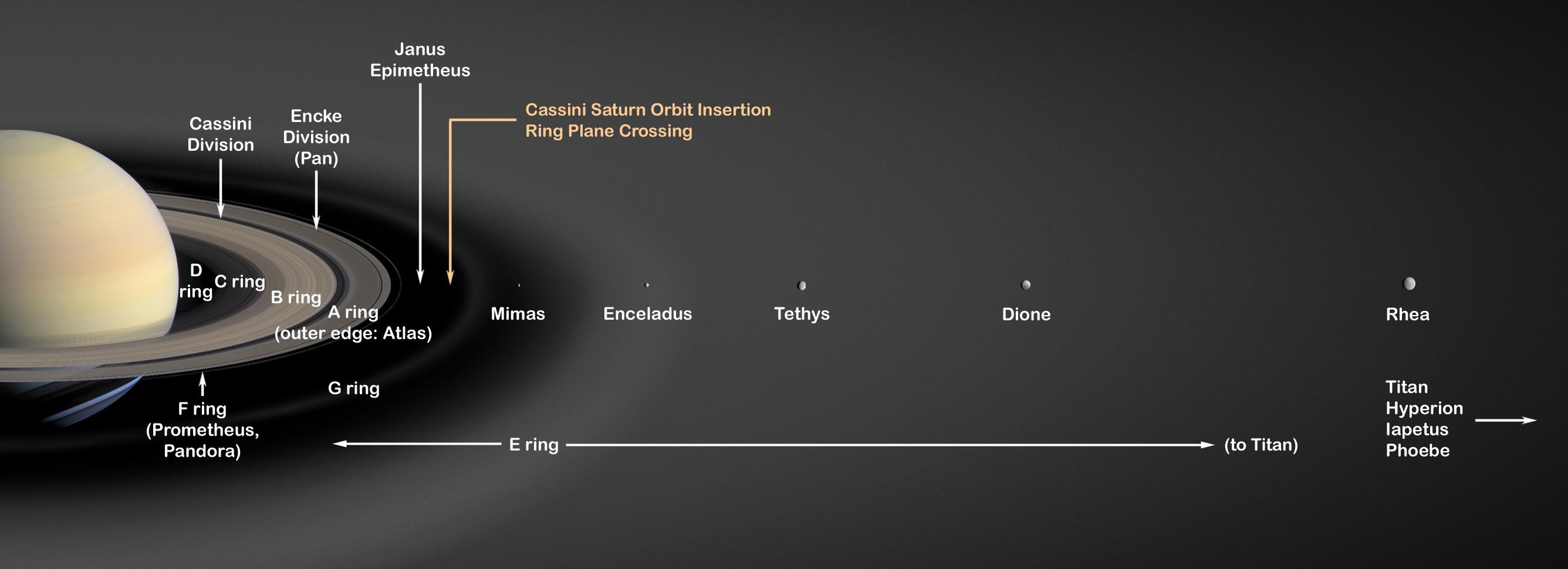
This is an artist’s concept of Saturn’s rings and major icy moons.  Enceladus is located in the densest region of Saturn’s E-ring, possibly indicating there is some relationship between the geyser emissions and ring density.  Credit: NASA/JPL

Cassini will return in August for an even more daring, lower flyby of this strange, gassy moon.

Source: NASA Mission News

Blogroll – Part 2

•March 29, 2008 • Leave a Comment

Hope you have a good time exploring the sites I suggested yesterday.
Now, let’s continue…

galaxyzoo_logo.jpg

(4)  Galaxy Zoo – a place where we can contribute to the astronomy world.  This zoo consists of millions and millions of galaxies and you can help to identify the shape of a galaxy; weather a galaxy is an elliptical, a spiral or a merger or not a galaxy at all. You click the appropriate button, and the next galaxy automatically pop-up for you to identify.

To start, what you need to do is sign-up, take a brief tutorial in practicing classifying galaxies. After the tutorial you will take a short trial to test your skills to see how well you can identify galaxy. If you don’t pass the trial, you can try again. Once you pass the trial, you can start contributing to Galaxy Zoo science!   A very brief introduction here.

~~~~~~~~~~

(5)  Weather report… but for space… This is SpaceWeather.  A quick place to find information of the current Sun (such as sunspots, flare, coronal hole, solar wind etc.), near-Earth asteroid, auroras, some sky event alerts, and a lot of beautiful images from around the world.

~~~~~~~~~~

(6)  Thinking of buying a telescope or any astronomy related equipment?  Thinking of organizing a star party and need some help?  Thinking of having an astro-tourism trip where you can have daytime tour of places of interest and nighttime stargazing?  Thinking of organizing an astronomy camp for your school or setup an astronomy club?

Your answer to all the questions above can be found at Stargazer Scientific, located in Bukit Jalil, Kuala Lumpur – an expert in organizing astronomical events, courses, camps and provision of full ranges of telescope and astronomy related equipment. 

They also run the Stargazer Forum where you can post any astronomy related questions or look for any second-hand equipment.

~~~~~~~~~~

(7)  Universe Today will keep you update on astronomy and space news.  Not only that, sometime they have book reviews and beautiful images to share.

~~~~~~~~~~

Temporary that’s all for now.  There are a few more sites I have in mind, but I think I’ll post them later.  If you have some interesting sites you want to share, please post it in the comments below. Thanks!

Blogroll – Part 1

•March 28, 2008 • Leave a Comment

If you look at the side bar, there is a column call “BLOGROLL”.  Under the Blogroll, there is a list of some interesting sites I would like to share with you all.

astronomy-cast.jpg

(1)  You want to know more about astronomy, but you don’t like to read… so what to do?  How nice if we can just sit back, relax and listen to someone explains it all to us… if so, then welcome to Astronomy Cast: “a weekly fact based journey through the cosmos, where we not only help you understand what we know, but how we know what we know.”

Astronomy Cast offers listeners weekly discussions on astronomical topics ranging from planets to cosmology.  The show is hosted by Fraser Cain (Universe Today) and Dr. Pamela L. Gay (Star Stryder).  Together they explore what is known and being discovered about the universe around us.

Every show lasts about 30 minutes, and currently there are 81 episodes on the site and new episode are coming in every week!  The show is in mp3 format (< 20MB) so you can listen to it from your computer, mp3 player or even your handphone.  You can listen to it while waiting for bus or LRT or in the car especially when stuck in a traffic jam, so you won’t be wasting your time.

~~~~~~~~~~

(2)  Welcome to Astronomy Picture of the Day (APOD). Discover the universe through pictures.  Each day a different image or photograph of our fascinating universe is featured, along with a brief explanation written by a professional astronomer.  This is a good place not only to see breathtaking astronomy pictures, but also to learn the science behind them.  This site started in June 1995, a picture a day, so just imagine how pictures are there now!

~~~~~~~~~~

APGM logo

(3)  Astrophotography Group of Malaysia (APGM).  This is our very own Made in Malaysia astrophotographs.  Many people do not know this, but Malaysia does have places where we can do astronomy observing and photographing.  And we also have people capable of doing that.

Visit APGM photo album to see some fabulous astrophotographs taken by local amateur astronomers.  The saturn animation posted earlier and the two pieces rectangular images on top of this blog featuring our Milky Way is taken by APGM’s member.

~~~~~~~~~~

TO BE CONTINUE…

I give a break to let you digest and explore the 3 sites above, we’ll continue tomorrow.

Sunspots!!!

•March 27, 2008 • Leave a Comment

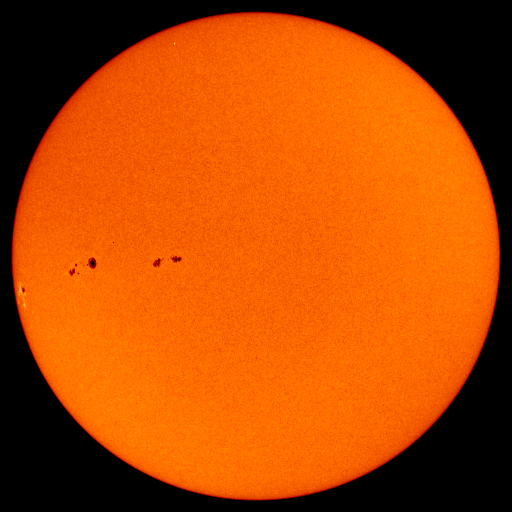
Three new sunspots have emerged on the Sun surface and they are growing rapidly.  One of them (989) even unleashed an M2-class solar flare, which is the biggest flare of the year.  These sunspots are associated with the old Cycle 23, not the new Cycle 24, based on their magnetic polarity.

Sunspots 987,988,989

Three new sunspots on the Sun.  From right: Sunspot 987, 988, 989 (near the limb).  Credit: SOHO/MDI

Those who have been monitoring the Sun will tell you that nowadays we don’t see a lot of sunspots.  The Sun has been blank because we are just leaving a period called the Solar Minimum, the time when the Sun is least active.

So, don’t hesitate, turn your telescope (remember to attach the solar filter!) to the Sun now and enjoy… better still, if you can attach your camera to your scope (with solar filter) and take a photo of them.

WARNING: DO NOT LOOK OR POINT YOUR TELESCOPE AT THE SUN DIRECTLY WITHOUT ANY SOLAR FILTER OR SAFETY EQUIPMENT!

Extra: Image of Sunspot 987, 988, 989 by Greg Piepol through H-alpha telescope.

Beautiful Images from STS-123 Shuttle Mission

•March 27, 2008 • Leave a Comment

There have been a lot of beautiful images from the current NASA space shuttle mission, STS-123 at the International Space Station (ISS).

The primary mission objectives include rotating an expedition crew member, installing the first section of the Japan Aerospace Exploration Agency’s Kibo laboratory and the Canadian Space Agency’s two-armed robotic system, Dextre.

STS-123 Launch 

Against a black sky, the Space Shuttle Endeavour and its seven-member STS-123 crew head toward Earth-orbit and a scheduled link-up with the International Space Station (ISS).

Earth Horizon

A colourful view of airglow layers at Earth’s horizon photographed by a STS-123 crewmember on the Space Shuttle Endeavour while docked with the ISS.

STS123-EVA

Astronaut Robert L. Behnken, STS-123 mission specialist, participates in the extravehicular activity (EVA) (or spacewalk) as construction and maintenance continue on the International Space Station.  The blackness of space and Earth’s horizon provide the backdrop for the scene.

Dextre

Pictured here are Dextre (centre), also known as the Special Purpose Dextrous Manipulator (SPDM), the solar array panels (right) and a section of a station truss (left).  A blue and white Earth provides the backdrop for the scene.

Full Moon from ISS

Framed by components of the International Space Station, a full moon is visible in this view above Earth’s horizon and airglow.

ISS

Backdropped by a blue and white part of Earth, the International Space Station is seen from Space Shuttle Endeavour as the two spacecraft begin their relative separation.

More images from STS-123 mission here.

*STS stands for Space Transportation System

Saturn’s rings are disappearing…

•March 26, 2008 • Leave a Comment

Yes, you read it correctly… Saturn’s rings are disappearing… Not in the real sense, but only from our point of view on Earth…

How come?

Read on…

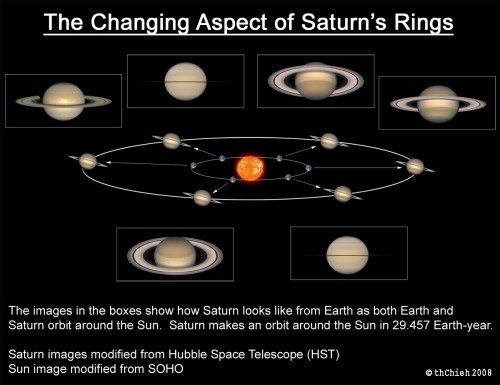
First of all, Saturn’s rotation axis is tilted, just like Earth, but with a slightly bigger angle of 27 degrees (Earth’s tilt is 23.5 deg).  Since the rings of Saturn are around its equatorial plane, the rings are also tilted relative to the Sun/Earth.
changing-aspect-saturn-rings_sm.jpg

Refer to the diagram above, as Saturn moves around the Sun with its tilted rings, there will be times when the rings are tilted maximum to us, and times when we will see the rings edge-on.  Since Saturn’s rings are so thin (about 0.2 to 3 km only!), when they are edge-on to us, it seems that the rings have disappeared when view through small telescopes.

Now, we are approaching the “ring plane crossing” period.  So month after month, Saturn’s rings are getting thinner and thinner, until on Sept 4, 2009, they disappeared.  The last time the rings disappeared happened in 1995.
saturn-2003-2007-ani.gif

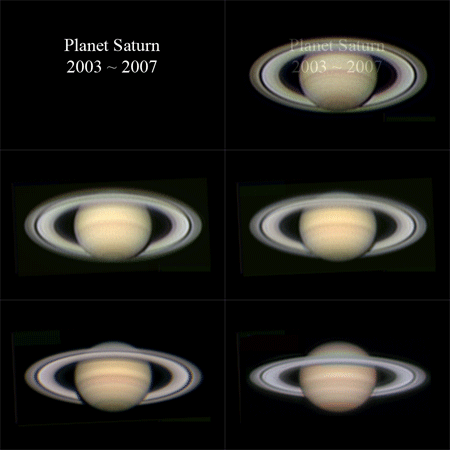
This animation shows the changing aspects of Saturn’s rings from 2003 to 2007, taken by our local amateur.  Bear in mind that Saturn’s ring plane is not actually wobbling.  The changing aspects of the rings is caused by the changing direction which we view the rings as both our Earth and Saturn orbit the Sun.  Credit: William Chin (Astrophotography Group of Malaysia)

Ring plane crossing happens every 14-15 years during Saturn’s 29.5-year orbit around the Sun.  Although this may not seems to be good news to us, because we will lose a lot of “ooh” and “aah” and “wow” from our friends, ring plane crossing do has scientific values.

When the rings of Saturn are nearly edge-on to Earth, the glare from the rings is reduced considerably, and faint objects near Saturn are easier to see.  Months before and after the ring plane crossings, unique observations of Saturn, its rings and moons can be made from Earth which are available at no other time.

HST Saturn Rings Crossing

The image shows the 1995 ring plane crossing.  At the bottom image two of Saturn’s icy moons are visible as tiny starlike objects in or near the ring plane. They are, from left to right, Tethys (slightly above the ring plane) and Dione.  Credit: Hubble Space Telescope


Where is Saturn now?
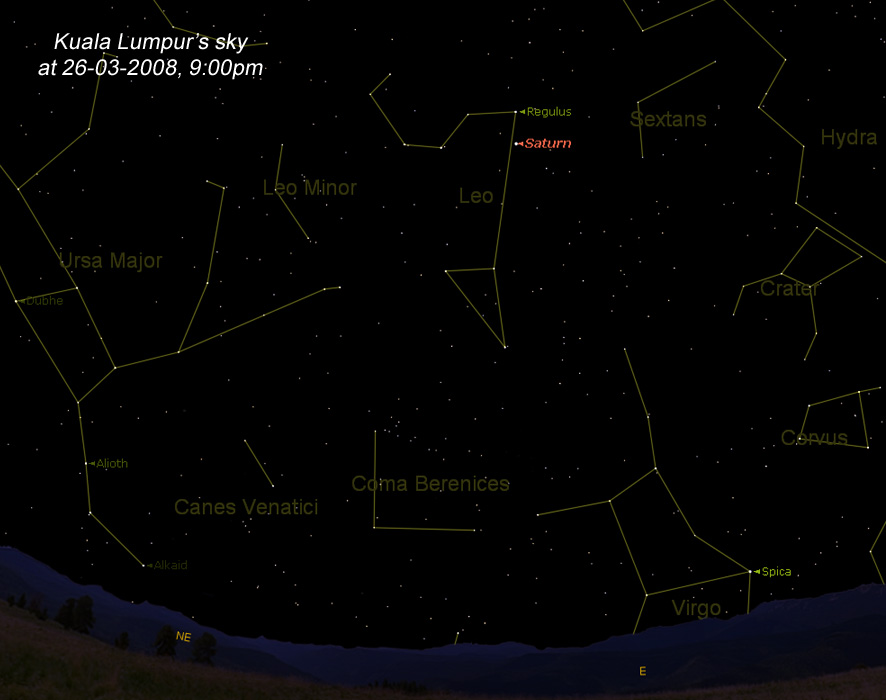
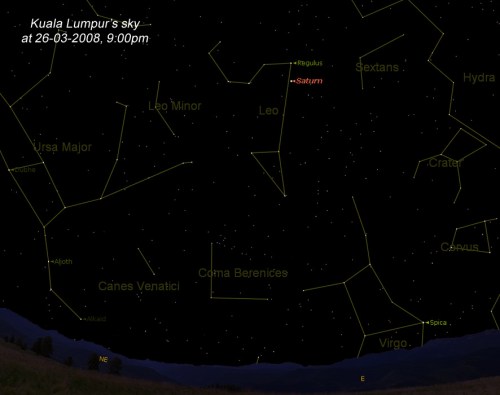
Saturn is high up in the sky now after dark, in Leo, near to Regulus, the brightest star in Leo. 

First, locate Leo famous asterism, the backward question mark that represents the lion’s front part which ends at Regulus, then move about 3 degrees to the east of Regulus and you will find a bright yellowish “star” that is not in a star chart.  This yellowish bright “star” is Saturn. 

If you have a telescope, even if it’s only a small one, Saturn will not disappoint you.  The rings may be thinner now, but it is still easily visible.

Grab your every chance to see Saturn’s rings before it says bye-bye…
080326-9pm-saturn.jpg

Extra: Science @NASA