Busy busy busy times…

•May 14, 2009 • Leave a Comment

Today I realise that I’ve not posted anything for one whole month! Hopefully my regular reader won’t think that this blog is dead!

The blog is still alive, just that the author is too busy with everyday life that (can you believe that!) I have to temporary put the stars aside… or to be more precise, to put writing about the stars aside… I didn’t forget about the stars; I still remember to look up every time I’m outside; I still saw the beautiful sunset crescent moon, I still saw Orion setting in the west, I still saw Scorpius making appearance in the night sky now, I still saw brilliant Venus and Jupiter in the early morning; it’s just that I have no time to write about and share all these with you.

It’s a pity, this year is the International Year of Astronomy, I should be actively taking parts in promoting astronomy, but the timing is so not right now. Only just now I’ve manage to clear up some (just some) outdated news feeds and found a few interesting stories that I hope to share with you all. I try to get them out soon, and hopefully you don’t mind I’m posting some outdated news (and of course not forgetting some fresh news along the way).

And talking about seeing the crescent moon in the evening, it really reminds me how time flies… “What, crescent moon again?!?!” => translates to “another month had passed!!!”. It’s really scary to think about that…

Warning! Summer solstice is around the corner

The Star Formation Game

•April 15, 2009 • 2 Comments

This is cool…

Do you think playing computer game is a waste of time?

Not if you combined science and game.

When you looked up at the stars, have you ever wondered how the stars are formed? Did you know that these stars will eventually die and the massive ones will go supernova? And did you know that supernova explosions can cause new stars to be born?

Basically, stars are born from clouds of gas. These gases are just hanging out in space, balanced between gravity and pressure, until “something” come along and disturbed them. The “something” can be collision between the clouds, or a nearby supernova explosion compressed the gases and causes them to collapse and form new stars.

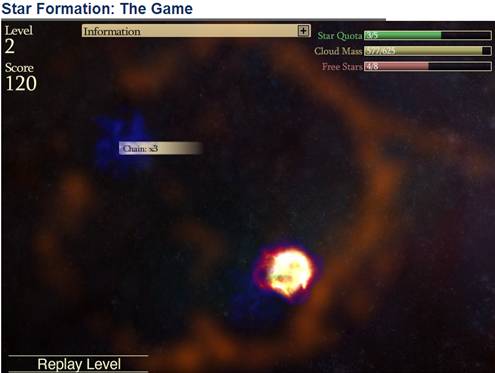
And now, you can use this concept to play a game called The Star Formation Game. In this game, you start with a gas cloud, a certain amount of “free supernova seeds” and your job is to create stars. Just click where you want the supernova to explode; this will subsequently compress the gas and form new stars – provided you detonate the supernova at the right place. Once you achieved the designated star quotas, you move on to the next level. Do it wrongly, the cloud dissipates and The End.

I did very badly in the game… how bout u?

star-formation-game

STS119 Mission and the ISS

•April 1, 2009 • 2 Comments

Wow! This is the best ISS picture I’ve ever seen!

This is the complete view of the International Space Station (ISS) with all its four sets of solar arrays unfurled. With these complete sets of solar arrays, the ISS now brighter than Venus in the night sky!

ISS. Click to enlarge

The STS-119 mission successfully installed the final set of solar array wings. The image above shows the ISS as seen from Space Shuttle Discovery as the Shuttle separated from the station. The space station is backdropped by the blackness of space and the thin line of Earth’s atmosphere.

ISS. Click to enlarge

ISS. Click to enlarge

More images on the mission can be found at NASA’s Human Spaceflight webpage.

ISS can be easily seen if you know where and when to look. Go to Heavens-Above or Spaceweather.com and check it out.

Earth Hour 2009

•March 25, 2009 • 1 Comment

earth-hour

It’s the time to switch off your lights for Earth Hour again…

Last year, Earth Hour was quite quiet in Malaysia… I switched off my light as planned, and since I couldn’t do anything much, I went to sleep. And the next thing I know is the Sun rising! So it’s a huge success to me – I’ve not only switched off the light and fan (yes, I slept through the night without the fan!) for 1 hour, but for a whole solid 11 hours.

This year, Earth Hour is no longer quiet in Malaysia – everyone is on high gear! It is not just the individuals, but the government and big companies are also taking part. Our Prime Minister has shown his support and endorsement of Malaysia’s participation. Landmarks such as KLCC, KL Tower, Sunway Resort, Penang Bridge, hotels in Penang and many more will be switching off their lights to support this event.

And just look at all the resources and publicities: we have our own dedicated Malaysia – EarthHour website, facebook, YouTube, Twitter, Flickr, media, and blogs (like mine). Judging from the tens of email regarding Earth Hour sent to my inbox, everyone is aware and is very excited about this event.

So, what is this Earth Hour?

Basically, this event is very simple, just

Turn off your lights for 1 hour on Saturday March 28, 2009
from 8:30 pm to 9:30 pm

Reason? To convey support for action on climate change. “Your Light Switch is Your Vote” – switching off your lights is a vote for Earth, or leaving them on is a vote for global warming. You choose.

Earth Hour Executive Director, Mr Andy Ridley, says, “Earth Hour is an opportunity for the global community to speak in one voice on the issue of climate change, while at the same time coming together in celebration of the one thing every single person on the planet has in common – the planet.”

Now, I know someone may ask what can we achieve by just turning off the lights for one hour? Ya, 1 hour only, what can we achieve when the rest of the 8759 hours in the year we just don’t care?

And that’s exactly the point – we want to raise awareness to all humans on Earth that don’t be “don’t care”. It lets us pause and think what we can do to protect the Earth. We, individually, are just one person, but we can still do our small part to fight global warming – save energy, save electricity, save water, save paper, save earth resources…

And together let us show our support that we care about our living planet!

Sign up now for Earth Hour 2009.

Saturn Observation at Planetarium Negara on 13 Mar 09

•March 12, 2009 • Leave a Comment

Planetarium Negara will be holding a Saturn Observation session in conjunction with Saturn opposition.

Date: 13 March 2009 (Friday)
Time: 8 to 10 pm
Venue: Main Entrance of National Planetarium Complex

For further inquiry please contact National Planetarium at 03-22734301/4303/5484 or visit their website at http://www.angkasa.gov.my/.

Kepler was Launched to Search for Other Earths

•March 11, 2009 • Leave a Comment

Last Friday – Mar 6 – NASA’s Kepler mission was successfully launched into space. This is a very meaningful mission to us – a mission that will seek for other earths out there, and help us understand if planets like Earth are common in the universe.

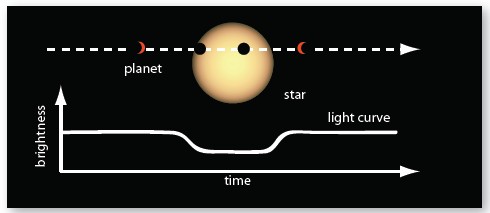
Not like other missions where their targets keep on changing, Kepler will only stare at the same star field in the Cygnus-Lyra region for its entire mission, watching more than 100,000 stars hopefully to capture the transit of Earth-like planets when they pass in front of their parent star. When that happens, the planet will blocks a very very small fraction – only 1/10,000 – of the light from its parent star, causing tiny dips in the brightness of the star. If the dips are periodic, then we can be sure that we found a planet.

planet-transit

We can calculate the size of the planet from the change in brightness. The interval between transits will tell us the size of the planet’s orbit and estimate the planet’s temperature. These qualities determine possibilities for life on the planet.

Kepler mission will be an important step in answering the age-old question: Are we alone? It has the capabilities of detecting Earth-size or even smaller planets in the habitable zone of sun-like stars. The habitable zone is the distance from a star where liquid water can exist on the surface of a planet. If is too near, all the water will vaporised; if is too far, the water will be frozen ice.

And we believed that liquid water to be essential for the formation of life (we are our only example of life, and we need liquid water…). So, if we found a planet in the habitable zone, then we are a step nearer in our search of extraterrestrial life.

The first planets are expected to be found by Kepler are the “hot Jupiter” – gas giants that circle close and fast around their parent stars. Next are probably Neptune-sized planets, followed by rocky ones as small as Earth. The true “Earth” – where the planets are in the habitable zone – would take at least three years to discover and confirm.

Here are some quick facts about the Kepler mission:

> Kepler is the world’s first mission with the ability to find true Earth analogs – planets that orbit stars like our Sun in the habitable zone.

> By the end of Kepler’s 3.5-year mission, it will give us a good idea of how common or how rare other Earths are in our Milky Way galaxy.

> Kepler detects planets by looking for periodic dips in the brightness of stars – the transit method.

> Kepler has the largest camera ever launched into space, a 95-megapixel array of charge-coupled devices (CCD), like those in everyday digital cameras.

> Kepler’s telescope is so powerful that, from its view up in space, it could detect one person in a small town turning off a porch light at night.

One last note: Kepler carried my name with it into space, how cool is that!

Chang’e 1 Impacted the Moon Last Sunday

•March 3, 2009 • 1 Comment

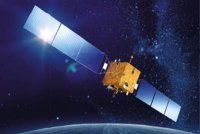
change-1I must be the last one in the world to report this. Anyway, just in case some of you are not aware, the Chinese lunar probe Chang’e 1 crashed onto the Moon last Sunday, March 1.

Don’t worry, nothing went wrong with the probe. The crash was intended – a controlled crash that was designed to accumulate experience for the landing of China’s second lunar probe.

The impact ended the 16-month mission of Chang’e 1, which was launched into space on October 24, 2007. The probe hit the lunar surface somewhere near the equator.

Chang’e 1 was the first phase of China’s three-stage moon mission. The second phase, which is currently in progress, aims at soft landing and the third phase of the mission will see another rover landing on the Moon and bring back mineral samples for scientific research in 2017.

With the crashing of Chang’e 1, the Moon now left with three probes orbiting it: the Indian Chandrayaan-1, the Japanese Kaguya and one of its “baby-satellite”, Ouna. The other baby-satellite of Kaguya, OKINA had impacted the lunar surface last month.

Soon, these probes are going to join by the US Lunar Reconnaissance Orbital (LRO), scheduled for launched end of April.  One of its objectives is to find safe landing site and use it as a stepping stone to travel to Mars and beyond.