
21st Century Waves… This is where the Carnival of Space #90 is held. Though is a bit late to say Happy Valentine Day, but that’s exactly how all the articles last week fit into the words. Go take a look!
Comet Lulin is here! Go see it now!
•February 12, 2009 • Leave a CommentSome of you may have already heard of Comet Lulin. And some of you may even have seen it or photographed it. I know I’m late to mention this comet, but it’s better late than never, right? :-)
Comet Lulin was discovered in July 2007. The comet was on the images taken by Taiwanese astronomer Lin Chi Sheng (hey, I have personally talked to this guy before when he visited Malaysia in year 2000; but I don’t think he remember me…) at the Lulin Observatory in Taiwan but it was Quanzhi Ye from China who first discovered a moving object from these images.
At first it was thought to be an asteroid, but later was confirmed to be a comet. The comet was named Comet Lulin (C/2007 N3), after the observatory where the images were taken. This discovery was actually part of the Lulin Sky Survey Project to explore the various populations of small bodies in the solar system, especially objects that possibly could pose a hazard to the Earth.
Comet Lulin had swing by the Sun and is now heading our way. Don’t worry, it’ll not hit us; at its closest distance, on this Feb 24, it’ll still be 61 million km away, about 160 times the Earth-Moon distance.
This comet is moving fast in our sky due to its unusual orbit. Lulin is actually moving in the opposite direction as the planets, therefore from our perspective, it’s moving quickly against the background stars and these changes can be easily observed from night to night.
This westward movement of Lulin makes it visible earlier and earlier everyday. Currently it rises around midnight. Over the next few weeks, it will rise averagely 20 minutes earlier each night.
It is currently at magnitude 5 or 6, easily visible in binoculars, and can be detected with the naked eye under a dark sky. It is predicted to brighten up to 4th or 5th magnitude, but we can never know for sure, especially for comet on its maiden trip around the Sun. We may have surprises… or disappointment…
These few days are not a good time for observation because the bright Moon is in the way.
Click here for the location of Comet Lulin from Feb 13 to Mar 2, 2009.
Lulin has just left the constellation Libra and now heading into Virgo. On Feb 16, it’ll pass very close to the brightest star in Virgo – Spica, just 3 degrees north of it. A binocular view will show the bright star and the comet in the same field of view. Spica rises around 11 pm on Feb 16.
The comet will then continue its fast and furious journey across Virgo. By Feb 23, it leaves Virgo and moves into Leo to meet up with Saturn on Feb 24. Feb 24 is also the date for closest approach. Saturn can be easily visible to the naked eye at the lion’s hind legs, and hopefully Lulin could be as well. The comet is almost at opposition now, and can be seen in the east as the Sun sets.
If you observe the chart, you’ll see that the gaps (distance) between the days are getting larger and larger. Around Feb 24, Comet Lulin will be racing at more than 5 degrees per day, and will be leaving Leo in about a week’s time. This speedy motion is fast enough to show obvious motion when observes through telescope.
As the comet moves away from the Sun and Earth after Feb 24, it fades quickly. Four days later on Feb 27, it’ll pass by within 1 degree south of Regulus – the brightest star in Leo. On Mar 5, Lulin can be seen near to M44, the Beehive Cluster, and probably not visible to the naked eyes.
Pictures of Comet Lulin show its greenish coma and two tails. The green colour comes from cyanogen (CN) and diatomic carbon (C2). Both of these substances glow green when illuminated by sunlight in the near-vacuum of space.
The two tails – a normal tail and an anti tail – are the dust tail and ion tail. Ion tail is ionised gas pushed away from the comet by the solar wind, so it always point directly away from the Sun.
The dust tail, as its name implies, are a trail of dust left behind by the comet along its orbit as it moves through the solar system. Dust tends to traces the comet’s orbit, since it is heavier and thus harder to push around by the solar wind. Because of this, dust tail does not point directly away from the Sun.
For Comet Lulin, it is leaving the Sun behind. The solar wind pushes on the ionised gas from “behind” and thus creating an ion tail “in front” of the comet – an anti tail. The comet dust, however, stay where it was drop, thus forming a dust tail trailing behind the comet.
Carnival of Space #86, 87, 88, 89
•February 8, 2009 • Leave a CommentI just realised that I’ve missed many weeks of Carnival of Space! I’ll post them all below, hopefully some of the articles are still relevant.
#89 at The Moon Society Blog.
#88 at The Space Writer.
#87 at The Martian Chronicles.
#86 at collectSPACE.
Penumbral Lunar Eclipse on Feb 9
•February 7, 2009 • Leave a CommentEclipse time again!
On January 26, during this lunar month’s new moon, we have a partial solar eclipse. 15 days later, on the same lunar month’s full moon, we are going to have a lunar eclipse.
Same as the solar eclipse, lunar eclipse also comes in few flavours. The best of course is the total lunar eclipse, when the Moon totally hides inside our planet shadow – more precisely, the umbra shadow. If the Moon only partially enters the Earth’s umbra shadow, then we’ll see a partial lunar eclipse.
If the Moon misses altogether the umbra shadow and only moves through the penumbra shadow, then it’s called penumbral lunar eclipse. And this is what we are going to have on this coming February 9.
Penumbral Lunar Eclipse of Feb 9, 2009. Credit: F. Espenak, NASA-GSFC.
As usual, check out shadow and substance for the nice animation.
The show starts at 8:38 pm when the Moon first contacts the Earth’s penumbra. The greatest eclipse happens two hours later at 10:38 pm. The Moon will continue to move through the shadow until finally leave the penumbra around midnight.
You can see this eclipse just outside your house as long as there are no trees or building blocking your view in the eastern horizon. You do not need any equipment to observe, your naked eyes alone is enough. Alternatively you can also see it through binoculars or telescope (no filter required).
For this eclipse, you will not see the Moon being “bite out”, what you will see is that the bright full moon will be getting dimmer and dimmer as the eclipse progress to the greatest. The dimmer part is most obvious at the northern part of the Moon because it’s “deeper” in the shadow.
Hope you will enjoy the show and clear skies to everyone out there.
Also, I would like to take this opportunity to wish all Chinese Happy “Fifteen Night”.
Always look up, and you will be rewarded with the beauty of the night sky…
Partial Solar Eclipse of 26 Jan 2009
•January 29, 2009 • 7 CommentsThe sky was still clear when I setup my equipment. But as soon as I was done, the clouds were rolling in… arrrrghhhhh…
Somehow, the Sun managed to poke out of the cloud on and off.
Around 5:20 pm, the clouds covered the western sky and that’s it… I never saw the Sun since then that day… ironically, the eastern sky was so blue and free from clouds! arrrrghhhhh…
See that strip of blue sky there? I was hoping that at least I can catch the end of the eclipse there. But as the Sun set, so did the clouds! arrrrghhhhh again…

Anyway, although I didn’t manage to see the whole eclipse, I’m still very happy because this was my first time of photographing a solar eclipse. It’ll be my training for this coming July TOTAL solar eclipse in China. Wanna join me?
Partial Solar Eclipse Activities at Planetarium Negara
•January 20, 2009 • Leave a CommentIn conjunction with the Partial Solar Eclipse on January 26, the National Space Agency (ANGKASA) will be organising the Partial Solar Eclipse Daily Programme. Details as follow:
Date: 20-01-2009 to 30-01-2009
Venue: Planetarium Negara, Kuala Lumpur
Contact: 03-22735484 or lau@angkasa.gov.my or latifah@angkasa.gov.my
On January 26 itself, a Partial Solar Eclipse Observation will be held beginning from 4 pm until 7 pm, also at Planetarium Negara. Activities include exhibition, talk, planetarium show, making of solar projector and solar cap. Click here for the full details.
Here’s the best part: if you are unable to be in Indonesia to see the annular eclipse, or unable to attend the observation in Planetarium Negara, don’t worry, the people at ANGKASA will bring the event LIVE to your computer. If you can’t experience the event on the spot, you still can know what’s going on. Remember to tune-in to their website for the live webcast.
Having said that, still nothing can beat the real experience of seeing the event for yourself. If you are in the annularity path or in the area when partial eclipse is visible (southern Africa, Australia, Southeast Asia and Indonesia), do take the trouble to observe it*, and be amaze that a simple geometry in space can give such a spectacular view on Earth.
*please do exercise caution when viewing the Sun (click and scroll to the end). NEVER EVER look at the Sun directly without any safety filters. If you’re not careful, you will end up with a damaged eye or blindness.
Partial Solar Eclipse in Malaysia this Chinese New Year
•January 19, 2009 • 2 CommentsWhile the Chinese society in Malaysia will be busy celebrating the arrival of a new year this coming January 26, up in the sky, not aware by most people, part of our Sun will be blocked by our Moon, causing a partial solar eclipse.
This is no coincidence that the partial solar eclipse happens on the first day of Chinese New Year. The first day of a Chinese calendar month is the day on which the astronomical New Moon is calculated to occur, and solar eclipse only happens during a new moon, when our Moon is between us and the Sun.
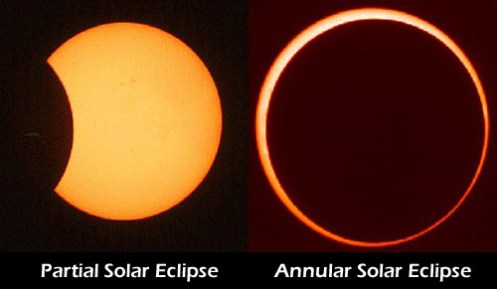
The main show is not the partial solar eclipse – we are only at the side seats… The main event is the annular solar eclipse which begins its path in the South Atlantic Ocean, travels eastward south of the African continent into the Indian Ocean and later pass by southern Sumatra and western Java, central Borneo and northwestern edge of Celebes before ending at Mindanao, Philippines. In total, the eclipse lasts 3 hours 46 minutes.
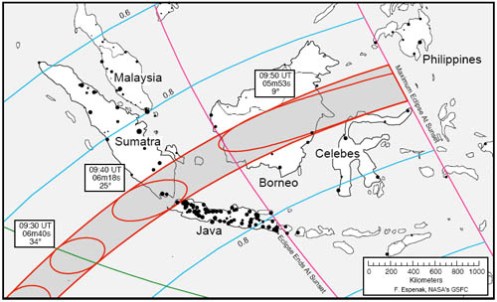
For animated version of the annular solar eclipse, visit ShadowandSubstance.com
As shown in the figure above, we are not located at the annular path – we are quite near to it, but not near enough, so we only get a partial solar eclipse… and this is what makes solar eclipse – be it total or annular – so special. You really have to be in exactly the right place at exactly the right time to see it. If not, then you either get a partial solar eclipse or worse, you get the everyday Sun.
The partial solar eclipse this January 26 will be visible primarily from southern Africa, Australia, Southeast Asia and Indonesia.
In Malaysia, the first contact – when the Moon first “touches” the Sun – begins around 4:30 pm (depending on where you are). The Moon will then slowly cover-up the Sun until maximum eclipse occurs around 5:50 pm, when our Sun is 21 degrees above the horizon. Around 7 pm, the Moon leaves the Sun’s disk and the show ends.
Again, how much of the Sun’s disk that will be blocked by our Moon depends on your location. For Kuala Lumpur, the maximum coverage is 64%. Look again at the table of local circumstances by ANGKASA for major towns in Malaysia and you will notice that the coverage of the Sun’s disk is more for East Malaysia compared to West Malaysia. The reason is very simple: Sabah and Sarawak are nearer to the annular eclipse path than the Peninsular (see diagram above).
So you know a partial solar eclipse is going to be visible soon and you are looking forward to that. Now, how do you observe this event SAFELY?
There are few ways. You can project the image of the Sun onto a piece of paper or a wall either by using pinhole projector or telescope, or use a solar filter either the glasses type or attached it in front of a telescope. Only then, you can observe the Sun safely. You don’t really need a telescope to enjoy this.
Caution: Sunglasses, exposed film, x-ray film, polaroid filters etc. are NOT suitable to be used for Sun observation. Use only filters or glasses that are specially made for Sun viewing.
Please bear in mind that although the Sun will be partially covered, the remaining of the crescent Sun will still be intense enough to damage your eyes. It is NOT safe at all to look at the partial Sun directly.
I’ll link you to our ANGKASA site, where the staffs there did a great job of showing you how to build simple pinhole projector (long box or cardboard) to view the Sun safely.
Remember this: Safety precautions always have to be taken for any observations involving the Sun. NEVER EVER look at the Sun directly without any safety filters. The consequences will be a damaged eye or blindness. So be very careful!
Planetarium Negara will be organising activities for this event. More details in the next post.



 My Dark Sky
You must be logged in to post a comment.